


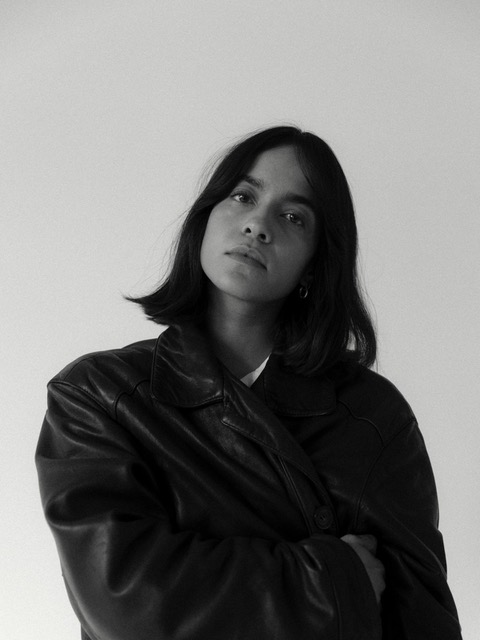
Argentinian-French born actress, writer, and director Fanny Vega channels her family’s complex history of migration, silence, and resilience into her deeply personal short film Echoes. Drawing inspiration from her father’s escape from Argentina’s military dictatorship and her grandmother’s Indigenous roots, Vega explores how generational memories live within the body — shaping identity, love, and survival.
Based between New York, Paris, and L.A she is part of a new wave of actress/filmmakers using cinema as both expression and healing. Through Echoes, Vega turns her own inherited silence into art, creating a poetic reflection on the invisible threads that bind us to our ancestors and to one another.

IMAGE: NIKITA GARLOV
1. Echoes draws from your family’s history — your father’s escape from Argentina’s dictatorship and your grandmother’s Indigenous roots. What inspired you to turn these deeply personal stories into a film?
I think this story has been calling me for years. Being in this industry, I always knew that at some point I would have to tell it. I love my father and grandmother deeply — their story is beautiful, but it also awakened in me a profound desire to seek the truth. I’ve come to recognize something within myself that longs for closure and expression.
My father fled Argentina during the military dictatorship of the ’70s and ’80s, and that history has always lived within our family. So many stories orbit around that larger one — perhaps something to explore in a feature someday.
Echoes is more intimate. It explores how what they lived still lives in me — how we inherit everything that came before us, often without realizing it. Our elders leave emotional imprints, an invisible heritage carried in our bodies. Migration, especially, leaves deep wounds — feelings of uprootedness, loss, and survival that shape the way we love and see the world.
For me, this process has been deeply therapeutic. It’s about acknowledging those wounds and transforming them into strength, into art, into something that connects us. By giving voice to silence, we begin to heal — and invite others to do the same. Echoes became my way of turning silence into communion.
2. You describe migration as a “living inheritance.” How do you translate that idea — the weight and memory of migration — into visual and emotional language on screen?
For me, migration isn’t just about geography — it’s something that lives in your body every day. It’s in how you breathe, how you react, how you relate to yourself and to the world. Even when you think you’ve moved on, there’s always a part of that history that finds its way back to you — pieces of your father, your ancestors, and the untold stories that live through you.
In Echoes, I wanted that presence to exist not only in words but through the body — in gestures, pauses, and the spaces between. It’s all in the image, the thought, the way I move or look at something. The film drifts between external landscapes and inner states, between the intimacy of memory and the inherited patterns that shape us.
It’s also about resilience — about what it means to feel both rooted and uprooted at once. Emotionally, it explores how absence becomes presence, and how what was left behind still shapes how we love, move, and dream.
3. The film explores intergenerational trauma, silence, and resilience. What have you discovered about your own relationship to these themes through the process of writing and performing Echoes?
I realized I was carrying much more than I thought. As an actress, you’re constantly digging into your emotions, and during that process many buried sensations began to resurface — especially when I moved to New York. I started to see the parallels between my own experience of leaving my country, my father’s escape from Argentina, and even my grandmother’s displacement from her land.
I discovered that much of the fear and pain I felt wasn’t entirely mine. It was inherited — passed down through generations that never had the chance to express or release it. My father never spoke about his trauma, but I could see how it shaped his life, his beliefs, his behavior. And I began to notice how I was unconsciously repeating some of those same patterns.
Through Echoes, I understood that I have the power to end that silence — to give voice to what was suppressed. Resilience, for me, isn’t about being “tough.” It’s about empathy and compassion toward yourself. It’s about allowing yourself to feel what generations before you couldn’t.
4. As the writer, director, and performer, how do you navigate the vulnerability of telling your story while also shaping it for an audience?
Vulnerability is truly at the heart of my work. Echoes is inspired by my own life and emotions, though I’ve taken fictional turns to tell the story. For a long time, I tried to hide certain parts of myself — especially the darker, more complex ones. Becoming the actress I am today has meant learning to accept all of me and to express that truth through art.
It’s terrifying to expose yourself like that — to be emotionally naked before the world — but there’s also great freedom in it. When I transform something raw and private into art, it becomes healing. I don’t believe silence heals; connection does. When we speak about what hurts, we create space for others to recognize themselves too.
As a director, I maintain a bit of distance. I have a clear vision of how I want the film to look and feel, but I’m also collaborating with creative partners who help shape it. I love leading and generating ideas, but I equally value having another perspective to lean on.
5. Through Echoes, you turn silence into expression. What does that act of transformation mean to you as an artist?
For me, transforming my inner world into expression is everything — it’s the reason I became an actress. I’ve always felt this need to give form to emotions searching for release. In my family, many things were left unspoken — pain, fear, patterns of behavior. I always sensed a deep silence around suffering. Eventually, I realized I couldn’t carry that silence without giving it a voice.
Through art, I give those emotions shape — a face, a movement, a story. That act of transformation feels sacred. It’s not about performing pain; it’s about understanding it, owning it, and turning it into beauty — into something that connects us. I’m not trying to fix the past; I’m letting go of its pain. Creation, to me, is a way to release what’s been living inside and allow it to touch others.
Acting is the perfect balance between the inner and outer worlds — between what’s hidden and what’s revealed. Echoes is exactly that: turning what was hidden into light, allowing myself to feel fully, and hopefully helping others to feel through me.
6. You’re collaborating with a team of filmmakers from New York, Los Angeles and creatives from all around the world. How have these creative partnerships influenced the tone and vision of the project?
I’m working with people I’ve collaborated with before — filmmakers from different parts of the world — and there’s a deep sense of trust between us. They believe in my instincts as both an actress and an artist, and that trust changes everything. It gives me the freedom to stay raw and present, knowing they’ll hold the space and build the visual architecture around my performance.
What I value most in collaboration is exactly that: trust and confidence. I love surrounding myself with people who share the same desire to tell the truth with intimacy — to create a kind of poetic realism that blurs the line between memory and presence. Each collaborator brings their own tone and cinematic sensitivity, and together we’re building something that feels deeply alive and human.
7. What do you hope viewers — especially those who have experienced migration or inherited silence — will take away from Echoesonce it’s complete?
I hope they feel seen — and I hope they feel beautiful. I want them to recognize parts of themselves: their patterns, their traumas, their behaviors, and to bring awareness to them. We often carry things unconsciously, without knowing where they come from. Sometimes it’s only when we see them reflected in someone else that we truly recognize them.
That’s what makes a film beautiful — when something inside you feels mirrored, even the parts you never talk about. I want people to feel that recognition, that connection. Maybe through that awareness, they can begin to realign, to heal, to release what they’ve been holding onto. Because I believe we connect through our wounds — not by hiding them, but by embracing them.
COMMENTS