


Electroluminescent Screen is a phrase you expect in niche signage and industrial panels, not the centerpiece of a giant Game Boy built from 3D printed bricks. That is the precise provocation behind this project. The maker was not chasing specs, they were chasing feeling.
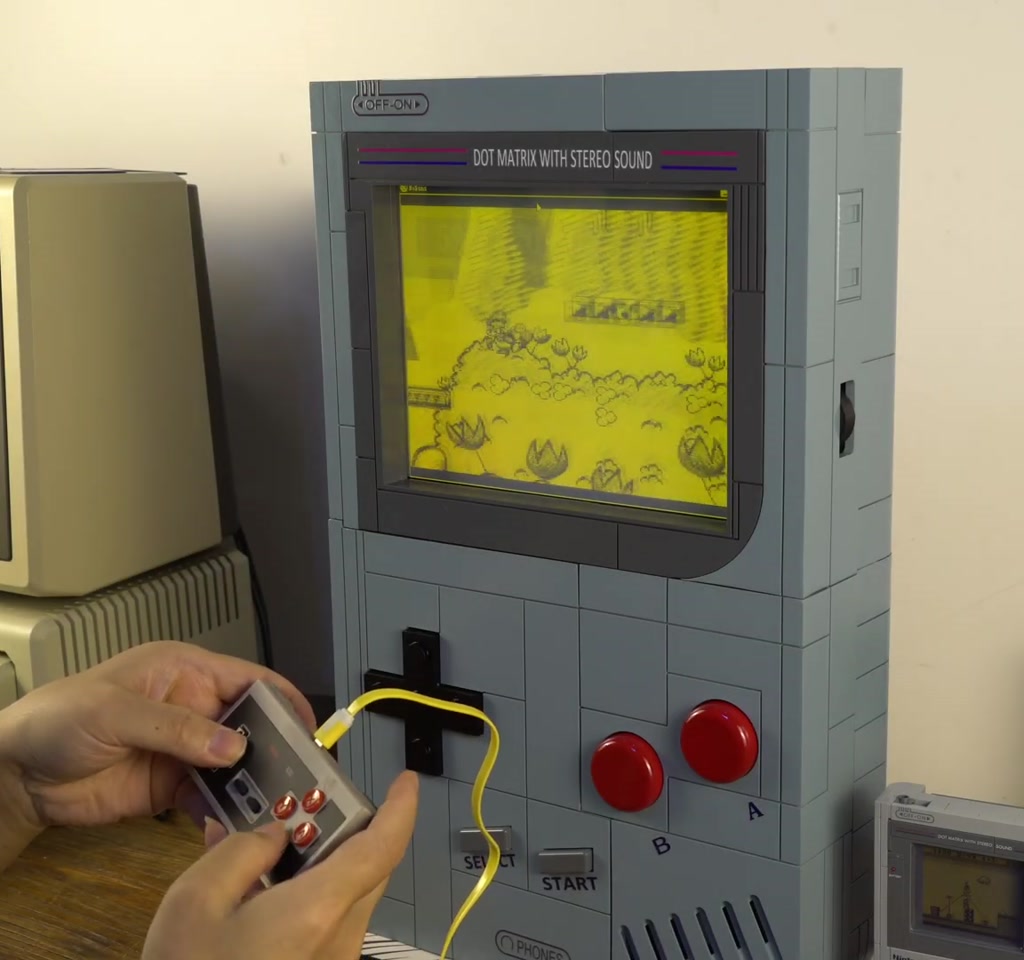
The result is uncanny. A hulking Lego-style shell hides a slim electroluminescent panel that bathes retro games in a soft, warm glow that reads as nostalgia rather than noise. The trick is not illusion, it is design that respects the physics of old displays while leaving their weight in the past.
Why The CRT Glow Still Matters
Look at virtually any modern capture of classic games, and you will notice a fight. Developers optimized sprites for cathode ray tube displays. Those displays were messy and imperfect but those imperfections were part of the art. Pixel edges blurred under scan, and the phosphor bloom made color palettes feel richer.
Gamers remember it as atmosphere. The reality is technical. Interlaced scanning, phosphor persistence, and the glow from the electron beam acted like analog filters. They softened blocky pixels, hid dithering, and—sometimes—created accidental effects that later became part of a game aesthetic.
Why Emulate The Flaw
There is a temptation today to chase fidelity by reproducing every pixel faithfully on LED panels. That leaves many classic games looking clinical. The maker behind this build wanted the opposite. They wanted a display that introduced a controlled softness, an organic bloom that makes sprites sing instead of scream.
The Limits Of CRTs
CRT displays deliver the effect but come with massive trade-offs. They are heavy, fragile, and power hungry. For a large handheld-inspired console, the weight alone makes CRT impossible. The challenge was to find thin light hardware that still behaves like a tube in the ways that matter.
The Electroluminescent Screen Revelation
Electroluminescent panels are familiar to anyone who has opened older industrial gear or exotic consumer electronics. They use phosphor layers excited by an electric field so that each pixel emits light directly. That direct emission produces a kind of even bloom that is visually closer to old tubes than modern backlit LCD panels.
Crucially, these panels require a different kind of driver. They do not accept VGA or HDMI. They rely on a stream of synchronization pulses, a clock, and data lines. That constraint sounds like an obstacle until you remember that classic display controllers were built around the same primitives.
Building A PCI Graphics Card For EL Panels
Instead of shoehorning the electroluminescent panel into a converter, the maker took the cleaner path. They built a dedicated PCI graphics card that outputs exactly the signals the panel expects. The card is open source and was designed to speak the language of industrial EL displays.
This is not a drop-in replacement for a modern GPU. It is a specialist card whose whole purpose is to recreate horizontal synchronization, vertical synchronization, and pixel clocks at the right timings for the panels being used.
The 6554 Chip And Custom BIOS
The project relied on a 6554 series chip to generate the necessary timing signals. The maker adapted a BIOS and burned a custom ROM tuned to the panel resolution and refresh behavior. That ROM then lives on the PCI card and presents the electroluminescent panel with a stable video feed.
That choice matters because the EL panels responded to old-style timing more predictably than to digitally converted signals. Sticking with the old primitives removed a whole layer of interpolation and conversion artifacts that would have undermined the desired softness.
Open Source Hardware Choices
The card supports most four eight RP industrial electroluminescent screens as implemented in the build. The files and schematics are open source so other builders can adapt the firmware or the timings for different panel sizes. The approach treats the display like a first-class peripheral rather than a hacked accessory.
This is an essential distinction. When you drive a display at its native timing, you get creative control over the bloom and motion characteristics. That is how the maker preserved the romantic glow rather than creating a washed-out imitation.
Designing The Giant Lego Game Boy
Once the display electronics were settled, the rest of the project became about chassis and ritual. The maker designed a huge Game Boy shell that reads like a playful sculpture. Instead of injection molding, they used a light-curing 3D printer and printed the pieces over several days.
Printing the shell took about a week. That timeframe allowed the maker to iterate on snap fits and surface textures so assembly felt like actual Lego building. After printing, the parts were spray-painted and colored to get that chunky toy aesthetic and crisp iconography.
3D Printing The Shell
Photopolymer printing gives tight detail and smooth surfaces that are ideal for large-scale toy-like builds. It also lets a maker split a complex shell into manageable panels for printing and finishing. When the pieces were sanded and painted, they locked together with confident clicks, much like real Lego bricks.
Controls And Motherboard
The internal hardware mixes old and new. An Intel 845 motherboard lives inside the shell as the computational core. For tactile input, the maker chose large arcade-style buttons, which give satisfying travel and accentuate the toy-like feel. Custom decals and transfer stickers finish the look and make the build feel handcrafted rather than industrial.
What The Final Build Really Feels Like
Play a game, and the panel rewards you with that sought-after softness. Sprites bloom at the edges but remain crisp enough to read. Colors behave in a way that evokes comic book printing, where colors sit on top of texture instead of being perfectly flat.
The maker noted a limitation that remains honest and telling. True color electroluminescent panels were not available for this build. The panels used produce a limited palette compared to modern displays. That is part of the charm rather than a flaw. The result is an image that reads as an antique comic rather than a modern high-fidelity screen.
There is also a practicality. If you want to play games from other platforms, you can attach an external gamepad. The design accepts external input gracefully, which makes it a living object rather than a static art piece.
Why This Matters For Display Design Going Forward
What this build demonstrates is a simple truth. Visual appeal is not always about higher resolution or more accurate color. It can be about matching the physical behavior of the original medium. That is a design principle with broad implications for restoration emulation and creative hardware.
Display makers and artists are increasingly comfortable choosing compromise as a creative choice. The electroluminescent panel in this build is fast, thin, and light, yet it preserves a class of analog behavior normally tossed aside as obsolete. That is a powerful combination.
There are practical opportunities here as well. Lightweight glowing panels can reintroduce an analog feeling into handheld devices where weight and power are constraints. With software tuned to those displays, you can achieve unique aesthetics without reverting to cathode ray tubes.
The maker shared the open-source files and the custom BIOS so others can replicate or refine the technique. That invitation changes the build from a neat one-off into a potential movement in retro display thinking.
If you want deeper technical notes or the schematics, check the project description for links to the open source repository where the card firmware and board designs live.
Electroluminescent screens are not the solution for every project, but as this build shows, they are a serious tool for anyone who cares about the emotional tone of a display. The glow is not nostalgia for nostalgia’s sake. It is an expressive choice that can make old games feel like they belong in the same room as you.
This project asks a final question that matters more than kit lists. If we can build displays that give digital content a sense of history and material presence what else could we choose to resurrect and reframe next
COMMENTS