


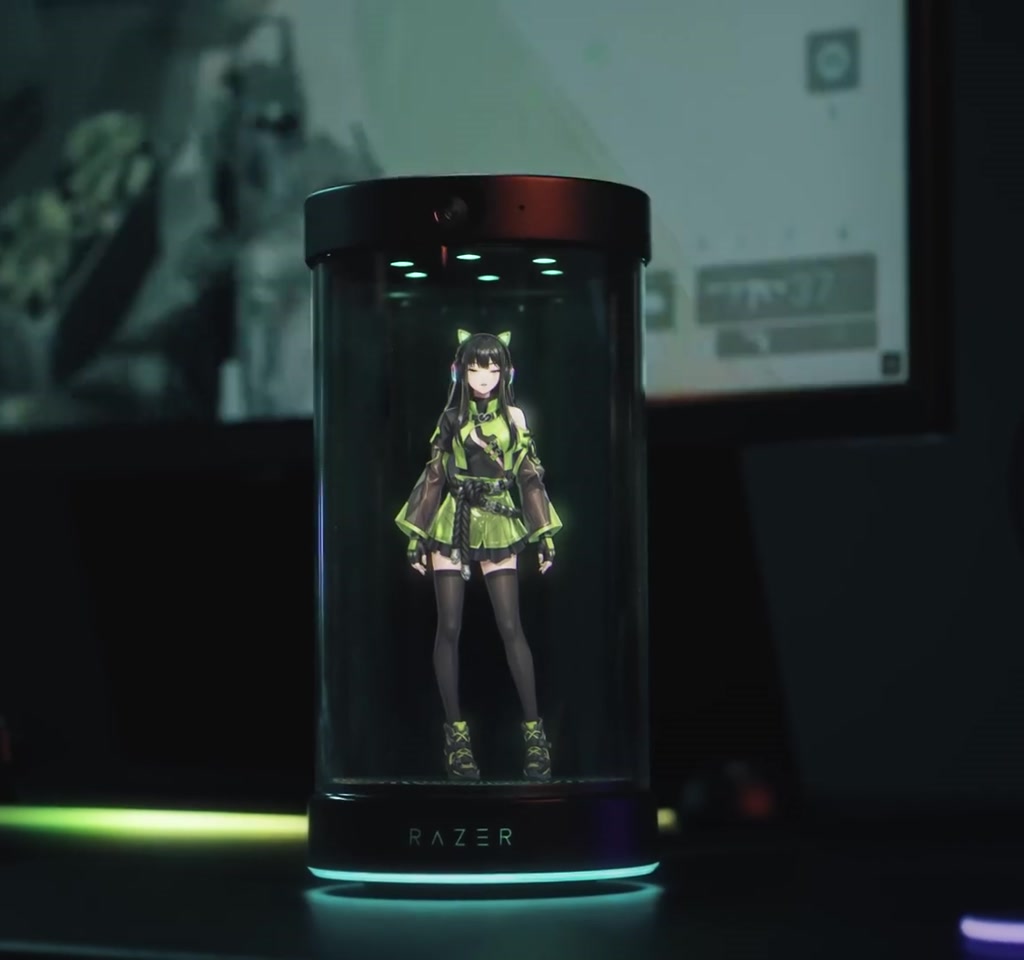
Razer announced Project Ava at CES, a tiny glass chamber that projects an animated companion and plugs into xAI’s Grok engine. It looks like a prop from a near-future movie and acts like a personalized assistant that never leaves your desk. What matters right now is not the anime aesthetics or the cheeky gamer avatars. The real significance is that Project Ava converts the abstract idea of a persistent AI into a physical object that sits in your room and mediates daily life.
Most people will treat this as a toy or a gaming novelty. That is a misunderstanding. Project Ava is an experiment in making continuous AI attention socially normal. If it succeeds, the consequence will be less about winning a match and more about how people accept a constant synthetic presence in private spaces. This article reveals why that shift matters, and where the promise runs up against hard limits: privacy, latency, and economics.
What Project Ava Is Really Selling
On the surface, Project Ava promises three things, as Razer presents them. It will manage life tasks like schedules, it will help with work queries and brainstorming, and it will act as a gaming wingman that coaches you in real time. The holographic characters are the packaging. The product is selling the idea of a visible, voiced assistant that behaves like a roommate without physical needs.
What becomes obvious when you look closer is that the physical display changes the interaction model. A floating avatar reframes an ordinary chatbot into a social actor. That makes feedback feel personal, which helps engagement, but it also amplifies emotional responses and social expectations. That is why the visual design matters more than the underlying model for adoption.
How It Works, Roughly
The Grok Engine And The Backend
Razer states Project Ava uses xAI’s Grok engine for its conversational core. That means much of the heavy lifting is performed off-device by a remote model rather than by local silicon. The implication is simple. Project Ava will require a constant network connection for the most capable features and will inherit constraints and update cycles tied to the model provider.
The device is currently available for reservation with a $20 deposit that Razer says will be credited toward the final purchase price. It is scheduled to ship in the second half of 2026, but Razer has not disclosed the retail price. That reservation deposit and the shipping window are concrete signals that final costs and long-term subscriptions could be separate decisions consumers must make later.
The Hologram As Interface
The hologram itself is an animated projection inside a small enclosure. Razer offers multiple avatars, from disembodied orb designs to anime-style characters and esports-themed personalities. That variety is deliberate. The team behind this positions the hologram as a relationship layer, not merely a skin on top of text responses. The tradeoff is clear. A more expressive avatar increases engagement but also raises expectations for nuanced emotional behavior and continuity of memory.
The Gaming Pitch And Its Limits
Coaching Versus Comebacks
Razer frames Project Ava as a gaming wingman, complete with characters like an esports persona called The Faker that will coach you. In theory, the system can offer tactics, aim advice, and play style pointers. In practice, the usefulness depends on two performance constraints.
First, latency matters. Real-time coaching for fast-paced games is sensitive to network delays. Even moderate lag measured in tens to a few hundred milliseconds can make spoken coaching too slow to be actionable for split-second inputs in competitive shooters. Second, access to live game state is required to give context-aware advice. Unless the device integrates directly with a game or your streaming setup, coaching will default to generic recommendations rather than frame-perfect instructions.
Is It Cheating Or Coaching
Razer says the companion is strictly a coach and trainer, but tournament rules and multiplayer communities will decide what counts as assistance. The moment you have a device watching your play and offering suggestions in real time, competitive purity questions appear. The social friction here is a feature more than a bug. For casual players, the agitation will be novelty. For ranked ladders and pro scenes, this could invite regulation or bans depending on how integrated the coaching is with gameplay telemetry.
Privacy, Cost, And Adoption Tradeoffs
Project Ava sits at the intersection of convenience and persistent observation. There are at least two concrete trade-offs to accept before buying in.
- Data And Privacy Tradeoff. Because it runs on Grok and offers continuous presence, Project Ava will likely send conversational context and possibly ambient cues to remote servers. The tradeoff is privacy for capability. For many users, the convenience of a conversationally rich assistant will outweigh data exposure. For privacy-conscious users, the cost is meaningful.
- Economic Tradeoff. Reservation costs $20, with shipping slated for the second half of 2026 and no final price announced. That $20 is only a small commitment. Expect the full cost to fall into the hundreds rather than the tens, and expect ongoing fees for premium model access. The device may ship at an affordable headline price and then rely on subscriptions to unlock advanced capabilities. That business pattern is common for connected assistants.
To add quantified context to the energy question, even a modest always-on display that draws five to ten watts would consume about 3.6 to 7.2 kilowatt hours over a 30-day period. That is not astronomical, but it is visible on a household electricity bill when multiplied across similar devices and households. Small steady costs add up, both in dollars and in data flows.
Where Project Ava Fits In The Wider Picture
Project Ava is not a singular invention. It is the next step in a larger pattern where companies give physical form to services that used to live purely on phones or screens. That change reshapes how people relate to software. A desk-sized hologram suggests permanence, and permanence alters expectations for reliability, updates, and relationship management.
From an editorial standpoint, the detail that stands out is the theatricality of the avatars. Razer is banking that a visible personality will increase daily engagement, but that bet has consequences. The moment a gadget becomes companion furniture, it picks up social meanings. An anime idol in a glass box is charming for some and unsettling for others. That friction is exactly where the product will be judged in real homes and dorms.
Practical Advice For Early Adopters
If you are tempted to reserve one, keep these practical limits in mind.
- Reservation deposits are small but not refundable credit in the sense that they lock you into a future pricing decision. Only commit if you accept uncertainty around the final price and subscription model.
- Expect an always-on network requirement for the best features. If your internet fluctuates, the experience will too.
- Think about physical placement. The hologram is designed to be visible and audible. That makes it subject to household dynamics and privacy conversations.
What Project Ava shows us most clearly is how fast the social layer has moved to the front of product design. The technology that drives the experience is important, but the real question will be how people choose to live with a small, talking projection that claims a desk and attention.
Razer positions Project Ava as a lifestyle peripheral for life, work, and play. Whether it becomes a novel accessory or a ubiquitous domestic companion will depend on hard constraints that are not solved by shiny avatars: trust boundaries, subscription economics, and the practical limits of latency and data access. The interesting part is not the hologram itself but the social contract it asks consumers to accept.
What happens when the novelty fades, and the companion has to be useful, trustworthy, and affordable every day of the year? That is the question the industry has not answered yet, and the one to watch as Project Ava moves from teaser to household object.
COMMENTS