


The pitch was deliberately simple at the Dubai World Congress for Self-Driving Transport. Tensor, introduced by Amy Luka and presented by Tensor Auto, was framed as the first Level 4 fully autonomous vehicle you can personally own. The car comes across as a finished idea, a luxury cabin with five LiDAR sensors, carriage doors, side cameras instead of mirrors, LED screens to talk to pedestrians, and an assertion that it is fully agentic, meaning it can learn from and proactively interact with its owner.
The real significance here is not merely that Tensor can drive itself. What changes the game is the idea of an agentic personal vehicle that makes decisions on behalf of its owner, not just follows a route. That alters the relationship between people and machines in ways most people are not prepared for. It surfaces hard questions about who is in control, what data is required, how much a system like this will cost to buy and maintain, and how regulators will permit its behavior in public.
What becomes obvious when you look closer at the details is that ownership is being reframed. Tensor is selling more than mobility. The company is pitching a car that will nudge your schedule, drive itself when you ask, and drive itself when you do not. That shift brings convenience and a set of practical tradeoffs that will determine whether personal Level 4 cars are a niche novelty or a mainstream reality.
What Tensor Claims To Be And Why The Hardware Matters
According to the presentation, Tensor is set up for autonomy from the ground up. It includes five LiDAR sensors, with one at the front, two on the sides, including what the team called a Halo LiDAR, and one in the rear. The vehicle replaces traditional side mirrors with side cameras that feed the interior displays. Carriage doors are a deliberate move toward easier entry and a different aesthetic for a roomy cabin.
All of those elements matter because Level 4 autonomy is essentially a sensor and perception problem followed by a safety and systems integration problem. Having multiple LiDAR units gives broader coverage and redundancy. Replacing mirrors with cameras changes driver ergonomics and the interface between human and machine. LED displays on the front and rear for communicating with pedestrians are not a gimmick. They are a direct response to a real limitation of autonomous systems, which is nonverbal communication with vulnerable road users.
From an editorial standpoint, the hardware choices align with a clear design thesis. Tensor Auto appears to prioritize situational awareness and an anticipatory user experience over simple driver assist features. That thesis can work. It also raises immediate technical and operational limits that are easily overlooked in a showroom presentation.
The Meaning Of Agentic In A Personal Car
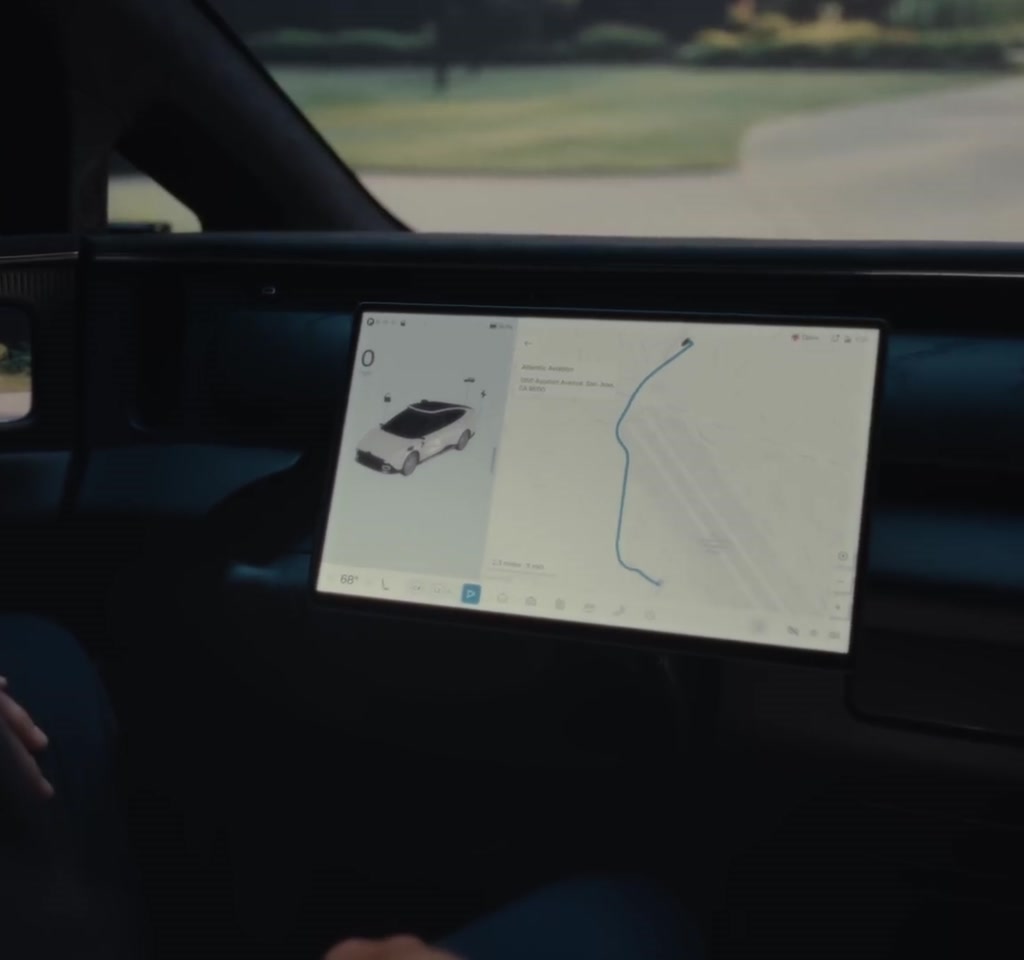
Tensor was described as the first fully agentic car. This is the part that changes how the vehicle should be understood. Agentic means the vehicle is designed to take initiative, learn patterns, and communicate proactively. In Tensor’s example, the car sends a message to an app suggesting a departure time to reach a meeting. That sounds helpful until variables multiply.
The part that changes how this should be understood is the asymmetry of information and authority. A human owner may expect the car to obey commands. An agentic car will occasionally countermand those impulses if its models predict a better outcome. That requires trust, and trust is not a commodity you can buy with hardware alone.
Anticipation Versus Consent
The moment this breaks down is when the system acts without clear, reversible consent. Scheduling a departure is one thing. Automatically rerouting, leaving an unattended driveway, or picking up strangers are different. The transcript explicitly mentions the car operating when nobody is inside, and using LED screens to communicate with pedestrians. Those are capable features, but they also create legal and ethical friction. Consent needs to be granular and auditable if the vehicle is to act on behalf of a person in public space.
Learning From You And The Data It Requires
For the car to be agentic, it needs data. Lots of it. Trip histories, calendar access, biometric or preference signals, local maps, and sensor logs all feed the learning loop. That raises three practical realities. First, the vehicle will be collecting continuous data from both inside and outside the cabin. Second, that data has value and risk. Third, the usefulness of the agentic promise scales with the amount and quality of data available.
Judging by how the feature is positioned, Tensor Auto is betting users will accept a sustained level of data sharing for convenience. That is a design choice and a market bet. It will succeed only if the company can explain, secure, and calibrate that data flow in a way people trust.
Two Concrete Constraints And Their Quantified Context
There are at least two concrete tradeoffs that determine whether a product like Tensor can move from demonstration to daily life. Both are often glossed over in marketing but become decisive in real-world deployment.
Constraint one, cost and business model. Level 4 capable hardware and the compute to run real-time perception, and planning generally do not live in the same price band as mainstream cars. While precise pricing was not announced, vehicles with comparable sensor suites and compute platforms tend to fall in the hundreds of thousands of dollars range rather than the tens of thousands. If Tensor Auto wants mass adoption, they must either dramatically reduce sensor and compute costs or adopt a subscription or fleet-managed ownership model. Either path changes who can realistically own one.
Constraint two, energy and maintenance. A stack that includes multiple LiDAR units, high-resolution cameras, radar, and the compute to fuse those streams usually increases power draw. That additional load often sits in a range from tens to low hundreds of watts of continuous draw for sensors and processing, depending on efficiency. An electric vehicle can reduce its effective range by a noticeable percentage over long trips. Maintenance also accumulates. Sensors need recalibration after impacts, LiDAR optics require cleaning, and software will need regular updates. In practice, maintenance tends to surface after repeated use cycles rather than weeks, and over the life of the vehicle, those costs are material.
These constraints are not hypothetical. They shape buyer expectations, residual values, insurance pricing, and the engineering roadmap. The car can be brilliant in a city environment with robust service support and a high price point. It looks different when compared to a car that most consumers can afford and maintain in a suburban garage.
Design Choices Tell A Story About Use Cases
Tensor’s cabin is built for luxury and space. Carriage doors and interior displays signal a product that expects people to spend time inside while the vehicle handles driving. That is a distinct use case. It is more concierge and less commuter hatchback.
LED screens that speak to pedestrians are interesting because they admit a limitation. Autonomous systems cannot rely on subtle human cues. By externalizing messages, the car is trying to bootstrap human-machine cooperation. But external displays carry their own constraints. Visibility in daylight, language or icon clarity, and how pedestrians interpret a simple message vary by context. That means the solution works well in controlled environments and may be less effective in chaotic streetscapes.
There is also a human factors constraint. Side cameras replacing mirrors means a different visual flow for drivers. Those systems must minimize latency and offer rich situational awareness or they will frustrate people who occasionally take manual control. The transcript emphasizes a dual mode that allows manual driving. That is essential. Rarely used, but necessary, manual controls reveal where the promise meets human expectation.
Ownership Looks Different With An Agentic Car
Tensor Auto appears to be positioning its product as personally owned but agentic. That combination brings new categories of friction. Insurance companies will want audit trails and clear liability assignments. Regulators in many jurisdictions treat Level 4 deployment as an operational approval matter. That means real-world use will likely be measured in years rather than months as rules catch up with the technology.
There is also the question of who services the car. Software updates, safety patches, and model retraining require continuous infrastructure. If Tensor Auto manages that centrally, then ownership includes an ongoing service relationship. If owners manage updates themselves, the complexity of maintaining a living autonomy platform will likely push many buyers toward enterprise or fleet solutions where the maintenance burden is centralized.
An agentic personal car turns ownership into a relationship with a device that can act on your behalf. That is quotable, and it matters because legal, social, and technical systems were not built around devices that take initiative in public space.
Where This Fits In A Broader Shift
Tensor is not an isolated novelty. It fits into a broader sequence of shifts in mobility. First, the move from driver assist to supervised autonomy. Then, the move from supervised autonomy to true capable autonomy within specific operational domains. Finally, the transition to agentic personal machines that blend scheduling and mobility. Each step increases convenience and friction in roughly equal measure.
From a cultural perspective, Tensor signals a future where machines no longer only execute tasks but manage lives to some degree. That is appealing, but it also places an administrative load on regulators and service providers to define acceptable behavior. It is likely that adoption will be uneven, with early use concentrated in high-wealth corridors or controlled environments where sensor performance, legal clarity, and maintenance networks align.
One practical point to watch is the interaction between personal agentic cars and shared mobility. If cars can leave home to reposition themselves autonomously and pick up others, the distinction between personally owned and fleet-managed vehicles will blur. That will reorganize urban traffic patterns and raise second-order effects such as curb allocation and local emissions in ways cities will need to plan for.
Tensor Auto invites us to imagine a car that tells you when it wants to leave for your meeting. The detail most people miss is how many systems must align for that sentence to be more than a demo line. Data privacy controls, robust and affordable sensor suites, energy efficiency, and a legal framework that assigns responsibility all have to be solved simultaneously before agentic ownership becomes ordinary.
There are reasons to be excited about the possibility and reasons to be cautious. The forward-looking question is not whether autonomous cars will exist. It is whether society, markets, and regulation will accept vehicles that act on behalf of individuals in public space. That acceptance determines whether Tensor and designs like it remain a high-end curiosity or reshape everyday mobility.
For more on the presentation and details as presented at the congress, visit Tensor Auto for additional material and official specifications.
COMMENTS