


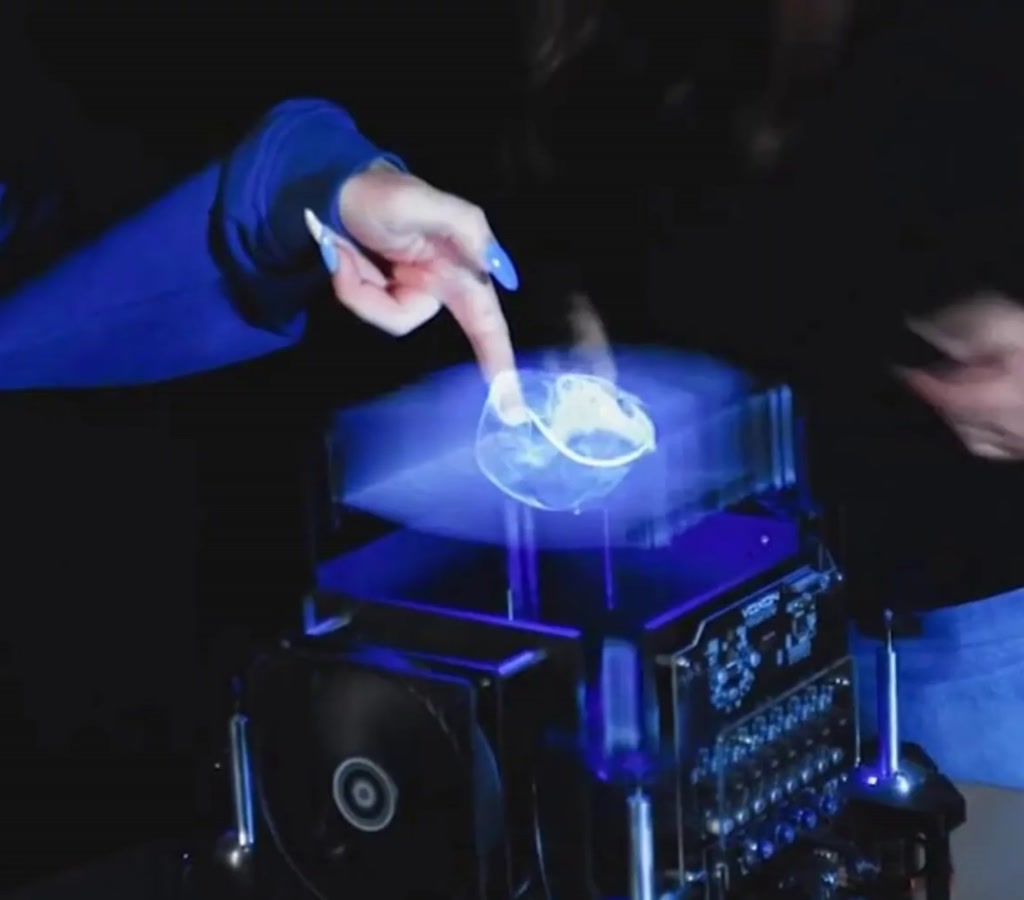
The most striking thing about FlexEVOL is not that it creates floating three-dimensional images. The real significance is that it invites your hand into those images and expects the world to behave in a familiar way, not as a layer of abstractions or controller mappings.
That matters because most current spatial displays still force users to learn a language of pointers, rays, or menus. FlexEVOL replaces that translation with direct alignment between where your hand is and where virtual geometry appears. What becomes clear when you look closer is this alignment reduces cognitive load and speeds up simple manipulation tasks at the cost of precision and operational complexity.
Researchers at Universidad Pública de Navarra built FlexEVOL as an experimental swept volumetric display that uses elastic diffuser strips so users can literally insert their bare hands into the display volume. Early user testing shows reach-through interactions feel intuitive and comfortable, and for many practical tasks, they beat traditional input devices on speed.
How FlexEVOL Builds A Tactile Looking Glass
Swept volumetric displays form three-dimensional images by projecting rapid two-dimensional slices onto a moving surface. The persistence of vision from the sequence turns those slices into a coherent three-dimensional shape. FlexEVOL retains that principle but replaces the solid moving surface with a set of elastic strips made of fabric bands.
The system pairs a high frame rate projector with oscillating diffuser strips. The projector outputs slices of the image synchronized to the exact position of the moving strips. A correction algorithm predicts how each elastic band deforms during oscillation and warps the projected slices so the resulting 3D geometry looks stable to the viewer.
Materials And The Elastic Diffuser
Material choice is not decorative here. The team tested elastane, silicone, and dedicated projection fabrics before settling on polyester and elastane bands. Those bands offered the best mix of optical transmission, flexibility, and predictable deformation for the correction model.
What matters in practice is a balance between optical clarity and mechanical compliance. Too stiff and the diffuser behaves like a rigid barrier that prevents interaction. Too soft and the shape varies wildly, forcing frequent recalibration. The polyester elastane bands hit a practical middle ground for these experiments.
Correction Algorithm And Visual Fidelity
Movement of elastic strips introduces predictable distortion. The research team modeled that distortion and applies a polynomial correction to mesh vertices so the projected image compensates for the instantaneous shape of the strips. That correction keeps the virtual object visually coherent even while strips oscillate around a user’s hand.
Interaction Model And User Study
FlexEVOL maps direct gestures such as grasping, pinching, pushing, rotating, and sliding to actions like select, scale, move, and trace. There are no abstract metaphors or indirect control schemes. The system reads finger position when a hand crosses between strips and triggers object interaction based on contact and depth within the volume.
A study with eighteen participants compared reach through interaction on FlexEVOL with a conventional 3D mouse across selection tracing and docking tasks. Measured outcomes included completion time, positional accuracy, and perceived workload.
What The Results Show
Participants completed tasks faster with reach-through interaction and reported a lower cognitive workload. Accuracy was slightly reduced compared to the 3D mouse. Most participants preferred their hands because the experience felt immediate and required little explanation. Several remarked that inserting a hand into the oscillating strips felt safe though they noticed subtle tactile sensations from the moving bands.
Concrete Constraints And Tradeoffs
FlexEVOL is compelling but far from frictionless. First constraint is output bandwidth. The projector must stream many image slices per second, synchronized with strip motion. That typically means driving dozens to hundreds of slices each second, which pushes system requirements into higher-performance projectors and more powerful graphics hardware. In practice that raises cost from consumer-grade budgets into hundreds or low thousands of dollars for a reliable research prototype.
Second constraint is precision versus immediacy. Hand based reach through interaction reduced task time and cognitive load but decreased positional fidelity. For tasks that demand submillimeter accuracy, like fine surgical navigation or micrometric CAD adjustments, conventional precision controllers will still be preferable. FlexEVOL is more suitable where single-digit millimeter accuracy suffices and where natural gesture outweighs tight tolerance.
Third constraint is maintenance and calibration. Elastic materials deform with use and temperature so the correction algorithm must be tuned. That tuning adds operational overhead and periodic calibration, which may take minutes per session rather than being a set-and-forget arrangement. The diffuser bands themselves are a consumable element that will need replacement after repeated cycles of deformation.
Practical Implications For Design And Training
From an editorial standpoint, the detail that stands out is how FlexEVOL forces designers to think in terms of physical affordances rather than screen metaphors. Interfaces must respect occlusion and depth because users can physically enter the volume. That changes interaction design constraints and reduces the need for explanatory tutorials.
Potential use cases the team and participants suggested include collaborative design review, education, and medical training, such as surgery planning. For collaborative scenarios the direct mapping between hand movement and virtual object behavior reduces the cognitive premium of teaching a new input language to a group.
Noise Power And Energy Considerations
The research notes that FlexEVOL produces less mechanical noise than rigid swept displays that rely on heavier moving parts. However, higher projector frame rates and the electronics required for real-time correction do increase power draw relative to a static screen. Power demand is not extreme, but becomes noticeable during long sessions, so battery-powered or low-power deployments will face capacity constraints.
That means in practice, designers must balance session length with thermal and power management. For extended use cases like a full-day workshop, operators should budget for active cooling and stable power supplies rather than expect a plug-and-play effect.
Why This Still Feels Like A New Chapter
What FlexEVOL changes is not just where pixels appear, it changes what counts as a natural interaction. When alignment between hand and rendered object is consistent, the interface becomes an extension of bodily movement. That shift matters for adoption because people are more likely to use technologies that feel familiar on first contact.
There is a broader lineage here. FlexEVOL sits in the swept volumetric display family and could be read alongside other research into mid-air haptics and view-dependent rendering. For a deeper technical framing, see the swept volumetric display lineage on Bit Rebels.
At the same time, the technology reframes practical questions. The tradeoffs around projector bandwidth, material durability, and positional accuracy mean FlexEVOL is an exciting tool for ideation, visualization, and training, but not a universal replacement for every precision tool in a designer’s kit.
What becomes obvious after engaging with these systems is that the moment this approach breaks down is usually where precision rules over intuition. That is a design boundary that will guide how FlexEVOL or similar devices are deployed in real workflows.
FlexEVOL is provocative because it blends optical trickery with a tactile invitation. The next steps are not just crisper images but richer bidirectional feedback and ergonomics that let people use the space for hours. The display is a research platform more than a finished product, and the choices made by the team at Universidad Pública de Navarra point to a practical path forward for hands-on three-dimensional interaction.
For more on the system and demonstrations, visit a related research video that shows how the elastic diffuser and projection synchronization work in practice.
The question left open is how interaction design will evolve when virtual objects become reach through objects. That is where the real work begins.
COMMENTS