


The Velociter X-1 is presented as a compact, owner-operated answer to one of modern mobility’s oldest frustrations: getting airborne without airports. Velo X Aerospace, based in Hastings, Michigan, is pitching a single-seat electric vertical takeoff and landing aircraft that fits inside a footprint the size of a small SUV and claims it can operate from small clearings instead of runways. That promise is the headline. The technical and regulatory realities are the fine print that will determine whether the idea is practical for buyers.
The real significance here is not that someone built a multicopter you can climb into. What actually determines whether this matters is how the design balances three hard limits: energy storage, safety at low altitude, and certification rules that govern who may legally fly it. If those three things line up, the Velociter X-1 could make a different class of short hops achievable for private owners. If they do not, it will remain a compelling concept for demonstrations and early adopters.
Velo X Aerospace frames the X-1 for commuting above congestion, rural access, scouting, and recreation. The company emphasizes redundancy, automated stability, and a modest performance envelope: a cruise speed target of about 70 miles per hour, endurance of 45 minutes plus a 15-minute reserve, and a maximum payload of 260 pounds. Those numbers are the scaffolding for the ownership argument. What becomes obvious when you look closer is that each number carries practical tradeoffs that limit how and where the aircraft can be used.
This article explains the X-1’s architecture, the layered safety picture the company presents, the real constraints that will shape adoption, and the regulatory path that could either enable owner-operated flight or push the aircraft into a different market niche. The part that changes how this should be understood is that compact physical footprint and simple controls are only the beginning. The system succeeds or fails inside narrow windows of weight, energy, charging access, and legal permissibility.
Velo X Aerospace frames the X-1 as a practical single-occupant aircraft rather than a commercial air taxi. Its production timetable, reservation terms, and public performance targets let potential buyers and regulators evaluate tradeoffs rather than work from pure marketing claims. The remaining questions are technical, operational, and legal, and they are the ones that will decide whether lawns become runways for owners.
What The Velociter X-1 Is Trying To Do
The Velociter X-1 is a compact single-seat eVTOL that aims to let private owners take off and land vertically from small clearings, avoiding dependence on airports. It is positioned for short point-to-point trips such as neighborhood commuting, rural access, scouting, and recreational flights, with simplicity and redundancy as core design priorities.
The pitch is direct: give an owner a single-seat, electric aircraft that can take off and land vertically from small open areas and be operated without the infrastructure of an airport. Velo X Aerospace positions the X-1 for private ownership rather than air taxi fleets. The intended use cases include neighborhood-to-neighborhood commuting above traffic, reaching rural properties where roads are slow, short scouting flights, and recreational flying.
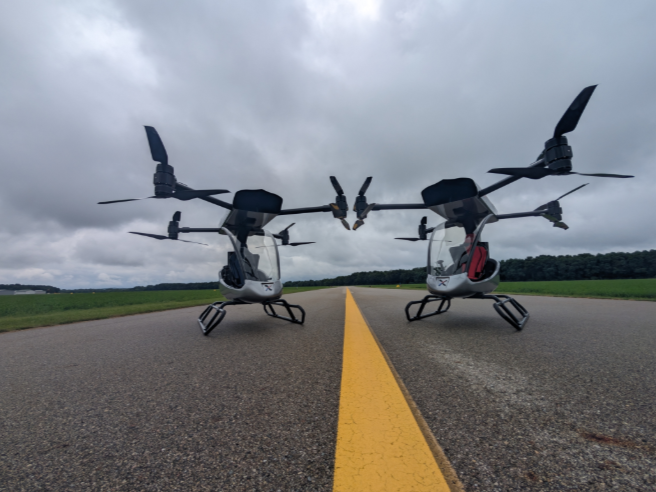
To support that positioning, the company has built the concept around three themes: compactness, simplicity, and layered safety. Compactness shows up in an announced footprint of roughly 91 inches by 100 inches. Simplicity is expressed through a multicopter layout using eight independent electric motors and fixed propellers, removing complex tilt mechanisms. Safety is layered via redundancy, obstacle sensing, and a ballistic parachute.
How The Aircraft Is Configured
The X-1 combines a small physical footprint with distributed electric propulsion and a focus on owner usability. The layout and systems are chosen to reduce mechanical complexity and simplify pilot interaction while still aiming to meet safety expectations for low altitude operation.
Propulsion And Energy
Propulsion is distributed across eight independent electric motors and propellers. Distributed electric propulsion creates redundancy and simplifies transitions between hover and forward flight because there are no tilt mechanisms. The company states the aircraft is battery-powered, but it does not publish a battery chemistry. The published performance targets are a cruise speed of about 70 miles per hour, 45 minutes of flight time plus a 15-minute reserve, and a maximum payload of 260 pounds. A third-party program summary suggests an empty weight near 500 pounds and a maximum takeoff weight near 760 pounds. Those weight figures imply a limited energy budget once pilot weight and any luggage are accounted for.
Controls, Automation, And Avionics
Velo X Aerospace blends pilot input with automated stability systems to lower the barrier to operation. The company markets automated takeoff and landing, GPS-based hands-free hover, and an integration plan for Garmin navigation, signaling an intent to align with existing avionics workflows rather than build a fully bespoke system.
Safety Layers And Practical Limits
Layered safety is the central narrative: redundant motors, a ballistic parachute, LIDAR for obstacle awareness, and a reinforced occupant cell. Those layers are meaningful, but each has performance limits that tighten the operational envelope for low altitude flights near obstacles and populated areas.
Safety claims are central to the X-1 narrative. The stated layers include eight independent motors for redundancy, a whole aircraft ballistic parachute as a last resort, multi-point LIDAR for obstacle warning, and a reinforced occupant cell. For low altitude operations, obstacle detection and avoidance are crucial because hazards are frequent and sometimes invisible until the last moment.
The moment this layered safety picture breaks down is when one or more components reach limits that are not recoverable within the aircraft’s energy and control margins. LIDAR will extend situational awareness, but LIDAR has finite range and performance constraints in fog, heavy rain, or dust. Redundant motors provide resilience to single motor failure, but surviving a motor outage depends on remaining thrust margin which shrinks with pilot weight, altitude, and headwind.
Two Concrete Constraints That Define Usefulness
Two pragmatic constraints tend to dominate real-world utility: the energy and range budget, and the operational and regulatory envelope. Both are quantifiable in broad strokes from public targets, but both vary significantly with conditions and policy decisions.
Constraint 1: Energy And Range
Published targets list 45 minutes of endurance plus a 15-minute reserve and an estimated range of about 60 miles under optimal conditions. Those are useful headline numbers, but they are highly conditional. Real-world range will depend on pilot weight relative to the 260-pound payload limit, how much time is spent in hover versus cruise, ambient temperature, and altitude. For example, a heavier pilot near the payload limit could reduce range by a noticeable fraction, turning a 60-mile optimistic range into something measured in tens of miles.
To give scale, battery energy densities for common lithium-ion systems typically fall in the low hundreds of watt-hours per kilogram. That places battery mass as a dominant factor in a 500-pound empty weight aircraft. The practical implication is that the aircraft likely budgets only a few hundred pounds of usable battery mass for its mission, which constrains either flight time or payload. Fast charging claims are similarly conditional. Velo X Aerospace publishes a marketing target of charging to 80 percent in under one hour using suitable chargers, while Level 2 charging is cited at about six hours and household charging is estimated at eight to ten hours in third-party summaries. Which scenario an owner experiences will depend on charger power, battery thermal management, and whether rapid cycles are repeatedly required.
Constraint 2: Operational And Regulatory Limits
Certification and operating rules will decide where and by whom the X-1 may fly. MOSAIC and powered lift guidance are still evolving, and the final FAA approach will set pilot qualifications, operating altitudes, permitted airspace, and maintenance expectations.
The company is pursuing guidance under evolving FAA MOSAIC and powered lift frameworks. MOSAIC intends to modernize rules for light sport and other small aircraft categories but is still an evolving pathway. Certification will determine pilot qualifications, operating altitudes, permitted airspace, and maintenance requirements. If the final certification requires a type rating or advanced pilot licensing, the pool of practical owners will shrink. If the FAA allows simplified pilot qualification for powered lift under MOSAIC-like categories, owner operation could be far more practical.
Put another way, the aircraft can be technically capable and still be unusable by many owners if certification places strict operational limits. The production target of first quarter 2027 and the staged reservation structure, including a $5,000 initial deposit and a 50 percent deposit 90 days before production for reserved slots, show the company is already positioning for early adopter demand. Early reservations do not change the regulatory path required to legally fly in everyday settings.
Certification, Training, And The Ownership Model
Velo X Aerospace frames the X-1 as owner-operated and leans on established avionics ecosystems. That orientation matters because it shapes automation choices, training expectations, and likely post-sale service models.
Velo X Aerospace frames the X-1 as owner-operated. That intent matters because it directly affects how the company approaches automation and avionics integration. Onboard Garmin navigation suggests a strategy to lean on established avionics ecosystems rather than building end to end custom navigation. That reduces integration risk and signals an intention to meet familiar pilot workflows.
Regulation will be the decisive variable. MOSAIC or an equivalent rule set could create a new light personal vertical category with simplified entry requirements. Alternatively, the FAA could require operations and training standards that align more closely with existing rotorcraft rules. The difference is practical: one outcome might allow a reasonable private ownership model with limited training, while the other would push the X-1 into the domain of professional operators and certified maintenance chains.
Training And Human Factors
Automated stability and GPS-based position hold reduce pilot workload, but familiarity with low altitude aerodynamics and hazard awareness cannot be eliminated. The company positions the control system as approachable for non-traditional pilots, but the training requirement will be set by regulators and by what owners need to safely operate in cluttered, low altitude environments where power lines, trees, and buildings are common.
Benefits And Use Cases
The X-1’s clear strengths are accessibility of footprint, simple multicopter handling, and a focused performance envelope designed for short hops. Use cases that fit are short neighborhood commutes, quick rural access, property scouting, and recreational flights where range and payload demands are modest.
Limitations And Tradeoffs
The most immediate tradeoffs are energy density versus weight, charging logistics, noise at low altitude, and regulatory uncertainty. Those limits reduce the pool of practical owners to those with compatible mission profiles and access to suitable charging and takeoff sites.
Noise and community acceptance are additional practical limits. Electric rotors are quieter than internal combustion engines, but propeller noise at low altitude still carries. Operating from small clearings near homes or public roads will raise local questions about acceptable flight frequency, noise profiles, and safety risk. Those are adoption frictions that exist independently of certification or performance numbers.
Velociter X-1 Vs Air Taxi Models And Larger eVTOLs
Framing the X-1 against larger eVTOLs and air taxi concepts clarifies tradeoffs: the X-1 minimizes complexity and footprint to favor owner operation, while air taxi models prioritize passenger capacity, range, and robust certification pathways to serve commercial routes.
X-1 Vs Air Taxi Models
Compared to air taxi concepts, the X-1 trades passenger capacity and longer range for lower mechanical complexity and a smaller footprint. That trade favors individual ownership scenarios but means it is not competing on the same metrics as fleet-oriented urban air mobility designs.
X-1 Versus Larger eVTOLs
Against larger eVTOLs, the X-1 is more compact and focused on short missions. Larger designs typically accept wider certification and infrastructure needs to offer longer range and higher payload, while the X-1 concentrates on narrow, owner-friendly trips with tighter operational constraints.
Who This Is For And Who This Is Not For
Who This Is For: Owners who need short, point-to-point hops; people with access to high-power charging or private sites; early adopters willing to accept operational limits and evolving regulation; those prioritizing compact footprint and simplicity over range and cargo capacity.
Who This Is Not For: Daily long-distance commuters who need reliable 60+ mile range with heavy payloads; prospective owners without access to suitable charging infrastructure or takeoff areas; people who require fully certified commercial operations today, since regulatory outcomes remain uncertain.
Company Timeline And Production Outlook
Velo X Aerospace states design and sourcing began in 2023. The company reports tethered test flights in 2024 for component validation and plans expanded testing through 2025, moving from tethered to unmanned and then manned flight testing. The company has targeted the first quarter of 2027 for production and opened reservations with an initial $5,000 deposit and staged payments for production slots. Third-party reporting indicates limited early slots and significant early interest, which is common for highly visible eVTOL launches.
Production timing is another practical constraint. Complex systems with integrated batteries, avionics, sensors, and safety backups often push schedules as testing reveals required changes. That is a pattern across advanced air mobility programs and is why timelines should be seen as targets rather than guarantees.
Where This Fits In The Broader Shift In Mobility
The X-1 illustrates a broader cultural and technological shift: personal mobility being rethought in three dimensions while still tethered to terrestrial constraints. Distributed electric propulsion and sensor-assisted awareness are becoming common templates, but the real unlocking moment depends on battery improvements, regulatory clarity, and proven operational safety.
Velo X Aerospace is not alone and the X-1 is not unique in concept. What makes it noteworthy is the clear owner focus, a compact footprint, and public numbers that let potential buyers and regulators evaluate tradeoffs. The company has layered safety claims and an automation strategy that could reduce pilot workload, but the details of certification and performance under real conditions will decide whether the aircraft is an early novelty or a new ownership class.
FAQ – Frequently Asked Questions
What Is The Velociter X-1?
It is a compact, single-seat electric vertical takeoff and landing aircraft from Velo X Aerospace designed for owner operation from small clearings, using eight independent electric motors and a small physical footprint.
How Far Can The Velociter X-1 Fly?
Public targets cite about 45 minutes of endurance plus a 15-minute reserve and an estimated range near 60 miles under optimal conditions. Real-world range will vary with pilot weight, hover time, temperature, and altitude.
How Long Does It Take To Charge The X-1?
Velo X Aerospace publishes an 80 percent charge target in under one hour with suitable high-power chargers. Level 2 charging is cited at around six hours and typical household charging is estimated at eight to ten hours in third-party summaries, subject to charger and battery thermal limits.
What Safety Features Does The X-1 Have?
The company lists eight independent motors for redundancy, multi-point LIDAR for obstacle awareness, a whole aircraft ballistic parachute, and a reinforced occupant cell. Each feature has operational limits and performance conditions.
Will Owners Be Able To Fly The X-1 Without A Pilot License?
That depends on FAA certification decisions under MOSAIC and powered lift guidance. The company intends owner operation, but final pilot qualification and operating rules will be set by regulators and could require more formal training.
Is The Velociter X-1 Quiet Enough For Neighborhood Use?
Electric rotors are quieter than internal combustion engines, but propeller noise at low altitude still carries. Community acceptance will depend on local noise sensitivity, flight frequency, and chosen takeoff sites.
When Is Production Expected?
Velo X Aerospace has targeted first quarter 2027 for production, following staged testing through 2025. Production timing is contingent on testing results and certification, so dates should be treated as targets rather than guarantees.
For further reading on FAA MOSAIC and powered lift pathways, and for updates on Velo X Aerospace testing milestones, follow public aviation policy coverage and company announcements.
COMMENTS