


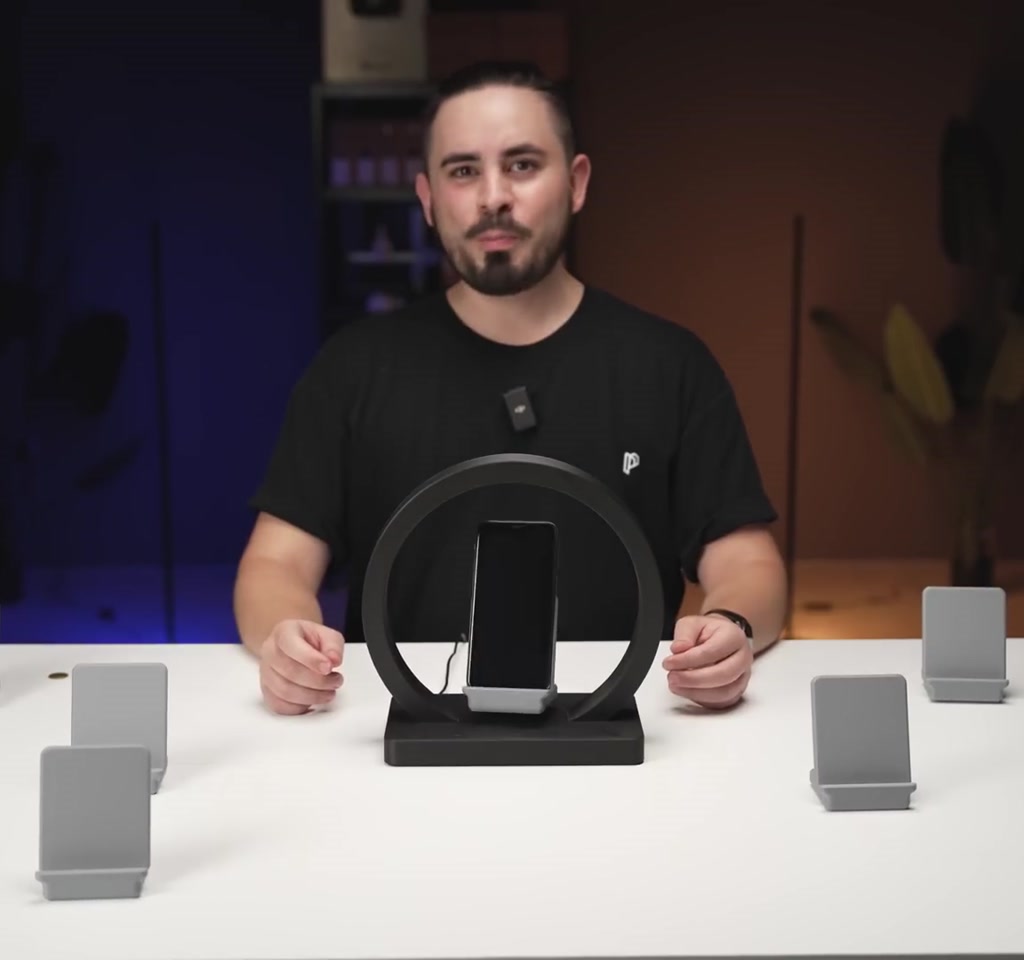
Floating a phone looks like a party trick, but engineering a levitating phone stand that survives daily use is a different problem. This build focuses on the practical work behind the spectacle: using a commercial magnetic levitation module, careful counterweighting, and precise 3D printing to turn instability into a usable product.
The core lesson is tolerance, not theatrics. In this project small geometry changes decided whether the phone drifted, tipped, or sat steady. The maker learned that millimeter-level adjustments and repeatable prints matter far more than aesthetics when the system must hold a real phone.
The Challenge Of Precision In Levitating Phone Stand Design
Direct Answer: Building a functional levitating phone stand requires extreme precision because the levitation field, the phone center of gravity, and the printed parts must align within millimeter tolerances. Small shifts in angle or spacer thickness turn a stable float into a forward tilt or a dropped phone.
Why Tolerance Matters
The levitation module can support about 0.5 kilograms, which is enough for many phones but leaves little margin. A heavy phone concentrates mass at a small magnetic interface and amplifies torque from any offset. That makes repeatable part mating and controlled geometry non-negotiable.
Common Failure Modes
Early tests tended to produce a forward tilt. Causes are predictable: misaligned magnet placement, incorrect column spacing, or a slight tilt in the printed cradle. Fixes are almost always another iteration and a one millimeter or sub-millimeter change, not a complete redesign.
Magnetic Levitation Module: Core Technology Explained
Direct Answer: The levitation module supplies the magnetic field and control electronics that hold a magnet and attached object aloft. In this project the module is the single purchased component; the rest of the build supplies mechanical alignment, counterbalance, and safety encapsulation for the powerful magnet.
What The Module Does
The module produces a controlled field and stabilizes a levitating magnet at a set hover height. In practice the module is rated to support roughly half a kilogram, which sets the primary load constraint for the entire stand.
Load Capacity And Limits
Because the module has a finite rated capacity, phone weight and added accessories must be considered. Going past the module rating or moving the center of gravity off the intended axis reduces stability and often requires a different levitator or mechanical changes.
Importance Of Exact Measurements: The One Millimeter Factor
Direct Answer: The one millimeter factor matters because levitation is highly sensitive to geometry. In this build, the difference between wobble and stability came down to single millimeter changes in column spacing and tilt angle. Expect multiple print-test cycles to dial in the correct dimensions.
Center Of Gravity And Lever Arms
Small increases in float height or spacer length create longer lever arms that amplify torque. Keeping the levitating object close to the balancing geometry reduces that torque and improves stability, which is why the measured 13 millimeter spacing and a low effective float height matter.
Tilt Angle Sensitivity
The project settled on a 73-degree tilt as the winning geometry. That shows how a single degree or a single millimeter of spacing can shift the equilibrium point. Design changes are best approached in measured, incremental steps.
Design And Iteration Process: From Concept To Prototype
Direct Answer: The build process is a rapid cycle of design, print, test, and tweak. Theory gets you to a starting point, but practical tests reveal how a phone actually behaves. Expect to iterate repeatedly, adjusting column position, spacer thickness, and tilt in small steps.
Prototype Cycles
Pablo used CAD to hide electronics, provide airflow, and keep the levitator elevated. Those choices are functional, not decorative. When parts must mate with millimeter precision, each prototype is a data point that informs the next print.
Testing Methods
Simple, repeatable tests revealed consistent forward tilt in early prototypes. The remedy was not radical change but incremental geometry adjustments until the 73-degree tilt and 13 millimeter spacing delivered reliable behavior.
Material And Printing Choices: Why Kidi Q2 Was Essential
Direct Answer: The project benefits from a reliable, repeatable 3D printer that delivers consistent first layers and tight tolerances. Builders who prioritize precision often choose printers with stable mechanical calibration and consistent dimensional accuracy to reduce iteration time and wasted material.
Printer Accuracy Requirements
The maker reported consistent first layers and accurate tolerances from their printer, which is crucial when millimeters matter. Printers that drift a fraction of a millimeter between prints will multiply iteration cost and frustration.
Filament And Finish Options
High precision prints often favor filaments and settings that produce stable dimensions and a clean matte finish. Slower print speeds and tighter environmental control improve accuracy, but they increase print time. That tradeoff is part of the decision to prioritize precision over speed.
Note on Kidi Q2: The original project emphasizes the value of a dependable desktop printer. Some builders pick models like the Kidi Q2 for its reputation in hobbyist communities, but the critical requirement is printer repeatability and dimensional stability rather than any single model.
Stability Solutions: Managing Tilt Angle And Column Spacing
Direct Answer: Stability comes from combining a precise tilt angle, carefully chosen column spacing, and a rear counterweight column. Encapsulating the levitating magnet with a threaded capsule keeps the magnet position repeatable and reduces accidental movement during assembly or service.
Managing Tilt Angle
Small tilt adjustments change how the phone balances over the levitation interface. An adjustable tilt mechanism would let builders tune balance without reprinting, but the original design used fixed printed angles that required reprints for big changes.
Managing Column Spacing
Column spacing moved the effective counterbalance point in millimeter increments during testing. The final configuration used 13 millimeters of spacing to center the phone mass over the levitator and resist forward tipping.
Levitating Phone Stand Vs Traditional Phone Stands: A Comparison
Direct Answer: Compared to traditional stands, a levitating phone stand prioritizes visual impact and novelty plus a delicate balance of magnetic alignment. Traditional stands offer simplicity, broad device support, and low maintenance. Choose the levitating stand for design and engineering interest; choose traditional stands for reliability and universality.
Levitating Phone Stand Compared To Conventional Stands
Practical decision factors include load capacity, ease of adjustment, and maintenance. The levitating design requires module selection, precise prints, and possible reprints for new phones. A conventional stand needs none of that and supports a wider range of devices out of the box.
When To Choose Which
If you value aesthetics, hands-on iteration, and a desktop conversation piece, the levitating approach has unique appeal. If you need robust daily use with minimal fuss, established commercial stands win on convenience and broad compatibility.
Who This Is For
This project is for makers who enjoy mechanical problem-solving, have access to a reliable 3D printer, and are comfortable iterating until tolerances line up. It fits tinkerers who want a design-forward desk object and who accept reprints as part of the process.
Who This Is Not For
This is not a plug-and-play solution for users who want a guaranteed fit for every phone without adjustment. Do not choose this if you need a maintenance-free stand, if you cannot accept the 0.5-kilogram module limit, or if repeated printing and small geometry tweaks are unacceptable.
Future Improvements And Upgrade Ideas
Practical upgrades include an adjustable tilt mechanism, quick-swap spacer system, or a screw adjuster to change tilt in fractions of a degree. Keep the magnet capsule and secure electronics, then add simple adjustability to expand the device compatibility without full reprints.
Another path is integrating features like wireless charging, though that adds complexity and may interact with the magnetic field. The safest incremental gains come from mechanical adjustability rather than changing core magnetic hardware.
Frequently Asked Questions
What Is A Levitating Phone Stand?
A levitating phone stand uses a magnetic levitation module and a suspended magnet to hold a phone above a base without contact. The module supplies the field and control electronics, while the 3D printed parts provide alignment, counterbalance, and safety encapsulation for the magnet.
How Does Magnetic Levitation Work In This Phone Stand?
The levitation module generates a controlled magnetic field that stabilizes a magnet at a hover height. The stand uses a magnet capsule, a rear counterweight column, and precise geometry so the phone stays centered and stable within the module’s rated load.
Why Is One Millimeter Difference Critical To The Design?
Levitating systems are sensitive to center of gravity and lever arms. Single millimeter changes in column spacing or spacer thickness alter torque and balance, which in this build determined whether the phone tilted forward or remained stable at the hover point.
Can This Levitating Stand Hold All Phone Models?
Not necessarily. The levitation module is rated at about 0.5 kilograms, and device size, weight, and case configuration affect balance. Many modern phones will work within that limit, but larger or heavier devices may require a different module or mechanical redesign.
What Materials Are Recommended For 3D Printing This Stand?
Use filaments and printer settings that prioritize dimensional stability and consistent first layers. Common hobbyist options include PLA and PETG, but the critical factor is print repeatability. Slower speeds, controlled environment, and calibration improve results.
Is The Levitation Module Included Or Purchased Separately?
The levitation module was the only purchased component in the referenced build. The maker sourced the module separately and shared design files so other builders can use the same or swap in different modules to test alternate magnet strengths.
How Stable Is The Phone When Levitating And Can It Spin Freely?
With the final geometry and counterbalance the stand can be stable enough for normal use and it can spin freely while remaining centered. Achieving that stability required iterative tuning to reach the reported 73-degree tilt and 13 millimeter spacing.
Are There Safety Concerns With The Powerful Magnets Used?
Yes. The magnets are very strong and can pinch, shatter, or interfere with nearby electronics. Encapsulating the magnet in a threaded capsule reduces accidental movement and exposure to the strongest field, which improves safety during assembly and service.
COMMENTS