


Air One arrived in public view as a deceptively simple idea: make flight as accessible as driving by removing complexity and wrapping the machine in redundancy.
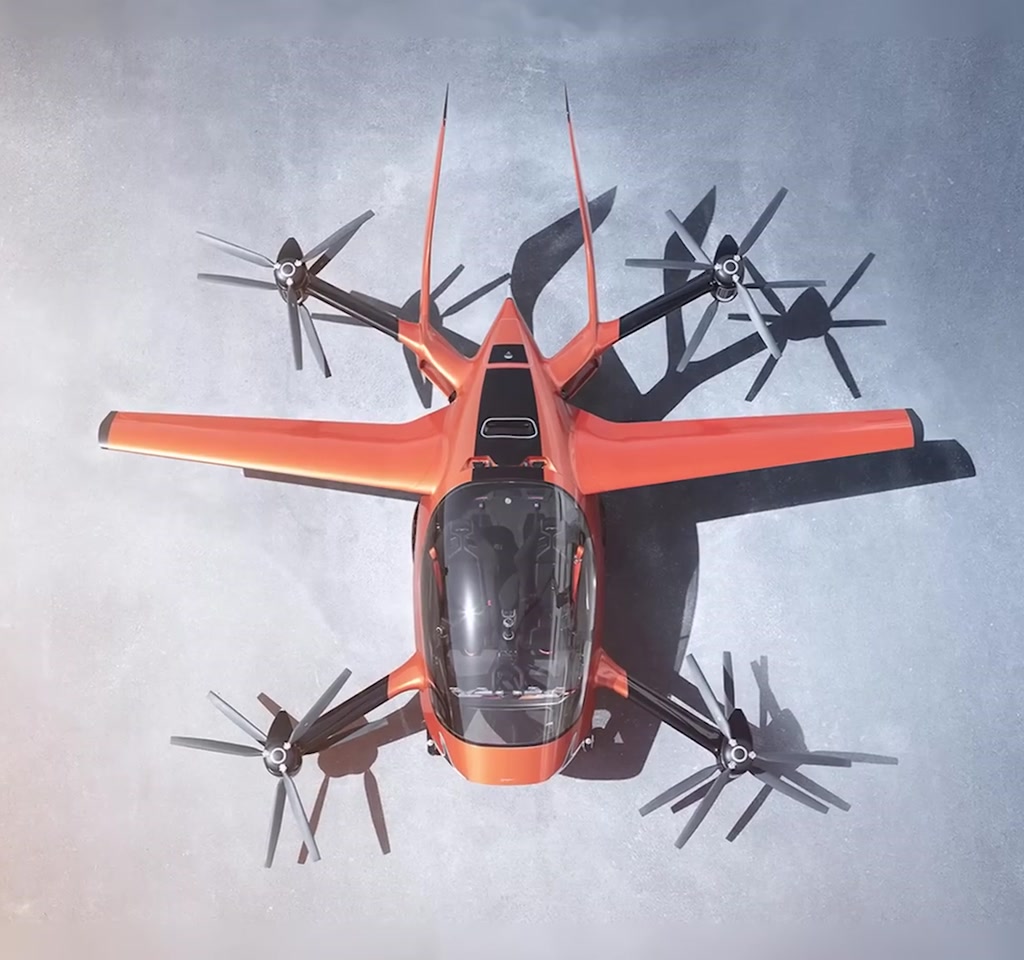
The company behind it, AIR, positions the two-seat electric vertical takeoff and landing aircraft (personal eVTOL) as safe, quiet, and easy to fly. The headline specs are clean and attention-grabbing. Up to 550 pounds of payload, as much as one hour per charge, eight motors with double propulsion redundancy, four separate battery packs, and a flight control method the company calls fly by intent, where a single joystick relays inputs to onboard computers.
The real significance here is not that you can point a joystick and go. What actually determines whether Air One changes urban movement is the tradeoffs between energy, weight, and the infrastructure that supports those batteries. That intersection shapes mission duration, costs, and where the aircraft can practically operate.
Most coverage focuses on the one-hour claim and the joystick, but the part that changes how this should be understood is the role of redundancy and batteries. AIR has already recorded full-scale flight testing as part of its FAA certification program, with a first major milestone reached in July of 2022, and says it has over 400 preorders. Those signals matter, but they do not erase the physics and systems work that decide when the Air One is a compelling daily tool versus a specialist vehicle for short hops.
Air One is best read as a system-level proposition: a vehicle, a control philosophy, and an implied ground network that must all align before the promise of quiet, joystick-driven commutes becomes routine.
How Air One Works At A Glance
AIR describes Air One as intentionally simple by mechanical design. The aircraft replaces traditional aerodynamic control surfaces with power differentiation across eight electric motors. According to the company, only four motors are required to keep the aircraft aloft, which is the basis for their claim of double propulsion redundancy.
The electrical architecture follows the same redundancy logic. AIR states the design includes quadrupled energy supply redundancy in the form of four separate battery packs. The idea is to envelope occupants in overlapping safety nets, and as an extra layer there is a ballistic parachute for whole-aircraft recovery.
What Fly By Intent Means For Pilots And Operators
Fly by intent is a control approach where a single joystick expresses a pilot’s desired motion and onboard systems translate that into safe, efficient motor commands. This reduces manual workload, enforces predictable flight envelopes, and creates a platform for standardized operations across different pilots and training levels.
Because the system intermediates between human input and propulsion hardware, it alters certification discussions and operational procedures. Regulators will evaluate not only mechanical redundancy but also software behavior under degraded conditions, which ties the control philosophy to the certification timeline.
Safety Architecture And Redundancy
Propulsion Redundancy
Eight motors with the ability to remain airborne on four offer a clear redundancy advantage. That configuration helps isolate failures to individual motors without forcing an immediate descent. AIR frames this as double propulsion redundancy and the practical payoff is fault tolerance in the propulsion system.
Energy And System Redundancy
Quadrupled energy supply, meaning four separate battery packs, reduces the likelihood of a single-point battery failure grounding the aircraft. However, that redundancy comes with a weight and complexity cost that has downstream implications for payload and range.
From an editorial standpoint, redundancy buys safety margins at the expense of usable mission capacity. More cells and more packs mean more mass, more thermal management, and more maintenance cycles, all of which influence operating economics and turnaround time between flights.
Benefits And Practical Advantages
Air One compresses many advantages into a small package: low noise, a compact two-seat footprint, and simplified pilot interaction. Those features reduce landing site requirements and make short point-to-point hops more plausible in urban-adjacent contexts where space and disruption matter.
Layered redundancy and a simplified user interface also lower the barrier for pilot training and operational standardization, potentially bringing trained operators to market faster than more complex light aircraft platforms.
Practical Limits And Tradeoffs
The most consequential boundaries for Air One are not aerodynamic nuance but energy economics and infrastructure. Two constraints will shape real world usefulness: mission time versus payload, and charging, infrastructure, and turnaround.
Mission Time Versus Payload
AIR advertises up to one hour per charge. That is a headline upper bound that only holds up under specific conditions. In practice, usable mission time will typically be measured in tens of minutes once you account for reserve safety margins, climb and descent phases, headwinds, and payload.
To put the scale in context, a 550-pound payload is significant for a two-seat aircraft. Carrying near the maximum payload will draw more energy and shorten flight time. A reasonable expectation is that mission endurance will vary by a large fraction depending on load and flight profile, which means operational planning needs to treat one hour as an upper limit rather than a routine figure.
Charging, Infrastructure And Turnaround
Charging an eVTOL scale battery pack is a different exercise than charging a car. Restoring an hour of flight in under an hour will require high-power charging infrastructure, typically measured in hundreds of kilowatts rather than the tens of kilowatts common for passenger EVs.
That has two implications. First, energy availability at vertiports or private pads must be robust, with distribution upgrades and perhaps on-site energy storage to handle repeated fast charges. Second, charging time and facility access will limit how many missions a single aircraft can perform per day, pushing operational economics toward fewer, higher-value flights unless infrastructure investment scales accordingly.
Certification, Market Signals And Adoption Friction
AIR reports that full-scale flight testing took place in July of 2022 and that certification with the Federal Aviation Administration is underway. Certification programs for novel aircraft typically require multiyear flight test campaigns, repeated data submission, and systems validation across many operational profiles.
That timeline is a constraint. Even with strong preorder interest, regulatory approval, pilot training, and the buildout of vertiport infrastructure can stretch into multiple years. That temporal friction delays when large numbers of aircraft appear overhead and when operators can achieve steady utilization.
The 400-plus preorders indicate market curiosity and commitment, primarily in the United States, but preorders are an early demand signal rather than proof of immediate availability. Production scale-up, supply chain logistics for battery packs and motors, and maintenance programs will all determine how quickly preorder interest converts into daily operations.
Air One Versus Alternatives
Placed against personal light aircraft and the broader urban air mobility category, Air One trades outright range for redundancy, ease of control, and compact size. Compared to traditional light aircraft it reduces pilot workload; compared to larger multicrew urban air mobility concepts it sacrifices payload and endurance for simpler operations and lower landing footprint.
Decision factors in a real-world comparison are straightforward: how far you need to go, how often you need to fly, the availability of high-power charging or fast battery swaps, and how quickly regulators certify the control system. Those are operational levers that often matter more than peak specifications.
Open Questions That Matter
Two questions linger. First, can ground networks scale with enough power density to support frequent turnarounds? Second, can regulators and operators agree on how much autonomy or pilot assistance is acceptable for public airspace? The answers will determine whether Air One is a commuting vehicle or a niche asset.
Those unresolved issues loop back to certification, infrastructure, and economics. Progress in any one area will alter how the others are judged, which keeps the future state intentionally unsettled until multiple thresholds are crossed.
Where Air One Fits In The Changing Airspace
Air One sits in a transitional category between personal light aircraft and true urban air mobility vehicles. Its strengths are simplicity of pilot interaction, layered redundancy, and a compact two-seat footprint that reduces landing site requirements.
The tradeoffs are operational. Range and mission cadence are governed by battery capacity and charging availability, while regulatory acceptance determines whether fly-by-intent systems can be certified for public airspace use at scale. This shifts the conversation from technology novelty to systems integration, infrastructure, and economics.
Who This Is For And Who This Is Not For
Who This Is For: Early adopters within organizations that can invest in private or dedicated vertiport infrastructure, flight schools prioritizing simplified training, and operators seeking quiet short-range hops where landing area is constrained.
Who This Is Not For: Commuters seeking routine city-to-city travel without supportive ground charging, buyers who need long endurance or large cargo capacity, and operators without access to upgraded electrical distribution or dependable fast-charge facilities.
Looking Ahead
Air One packages an appealing promise: lower the barrier to piloted flight without sacrificing safety. The company has tangible progress to point to, including flight testing milestones and preorder momentum, and those are meaningful markers in a crowded field of eVTOL concepts.
At the same time, the vehicle will become most useful within the boundaries set by energy density, battery charging infrastructure, and the pace of certification. Those are not technicalities. They are the thresholds that will determine whether Air One is a widespread commuting tool, a niche recreational aircraft, or a short-range specialist for logistics and training.
Follow AIR’s announcements and public flight events for the clearest signal of when those thresholds are crossed. For company updates and event notices see AIR’s website.
What remains most interesting is not whether the joystick works, but how the industry assembles the supporting ecosystem. The next phase will reveal whether Air One scales as a new daily transport or finds its strongest use cases in targeted niches where its design tradeoffs align with clear operational value.
FAQ
What Is Air One?
Air One is a two-seat electric vertical takeoff and landing aircraft developed by AIR, designed with eight motors, four battery packs, and a fly by intent control system to simplify pilot interaction while adding redundancy.
What Is A Personal eVTOL?
A personal eVTOL is a small electric vertical takeoff and landing aircraft intended primarily for individual or two-person transport over short distances, emphasizing compact footprint and short-hop missions.
How Long Can Air One Fly Per Charge?
AIR advertises up to one hour per charge as a headline figure. In practical operations usable mission time will often be shorter due to reserves, payload, and environmental factors.
How Does Fly By Intent Work?
Fly by intent uses a single joystick for pilot input, with onboard computers translating commands into safe motor outputs. It aims to reduce pilot workload and standardize flight behavior for safety and training.
Is Air One Certified By The FAA?
As of the information provided, AIR has reported full-scale flight testing and states certification is underway. Certification processes typically take multiple years and require extensive testing.
Can Air One Charge Like An Electric Car?
No. Charging eVTOL-scale battery packs requires much higher power levels and different infrastructure. Restoring full mission capability quickly will demand high-power charging and robust ground energy systems.
Who Should Consider Buying Air One?
Organizations or individuals with access to upgraded vertiport infrastructure, flight schools focused on simplified training, and operators needing quiet short-range transport should consider it. Widespread commuter use depends on infrastructure and certification progress.
Does Air One Have Redundancy For Safety?
Yes. The design emphasizes redundancy with eight motors (able to stay aloft on four) and four separate battery packs, plus a ballistic parachute for whole-aircraft recovery.
COMMENTS