


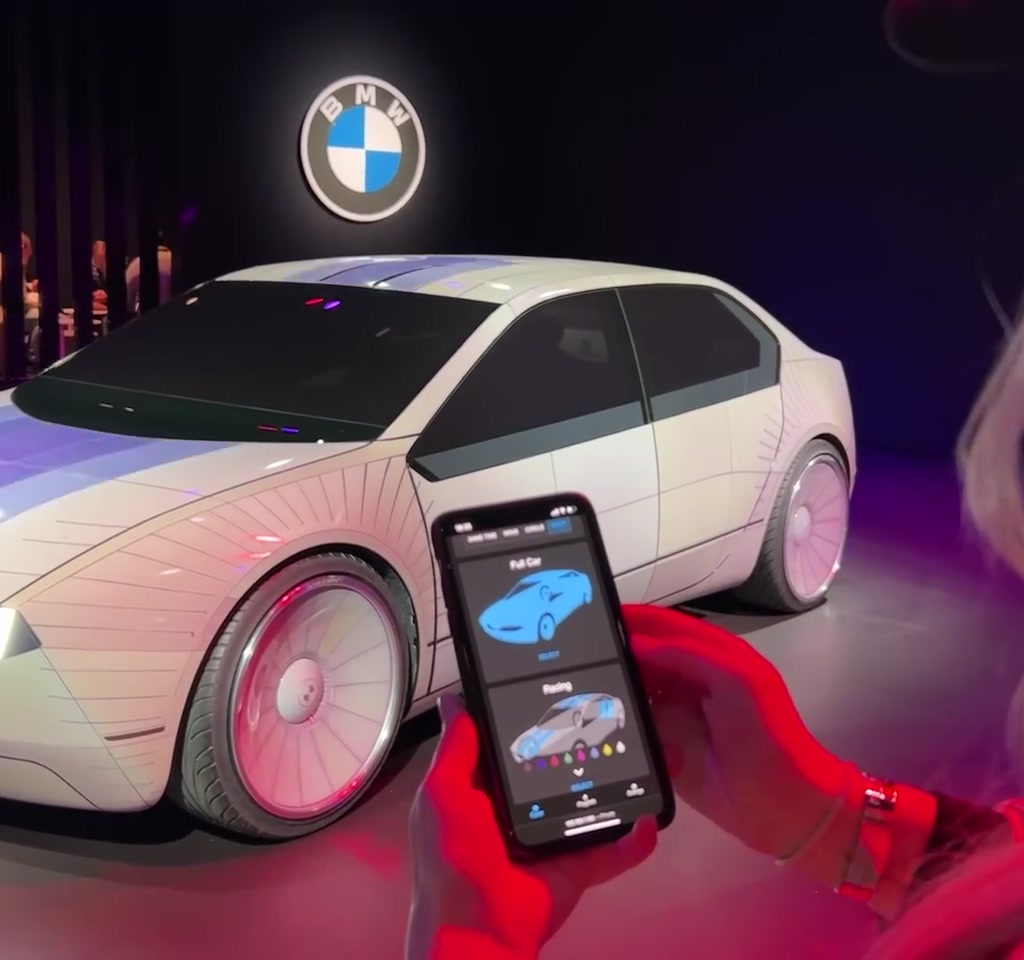
At CES in Las Vegas BMW unveiled something that looks like a prop from a science fiction film but behaves like a design and systems experiment at scale. The BMW i Vision Dee is a concept car whose exterior can change color across a 32 color palette, and whose interior intentionally erases buttons in favor of projected, context-aware interfaces. It is spectacle, yes, but the deeper move here is making the vehicle itself into a communicative surface that participates in personal identity and situational awareness.
The real significance is not only that a car can flash yellow or wear racing stripes on command. What actually determines whether this matters is how that surface integrates with safety systems, interior feedback, and production realities. The i Vision Dee pairs body-mounted E-Ink panels with a projected, immersive cabin, haptic seat alerts, and shy tech controls that appear only when you reach for them. That combination reframes a car as both an expression and an instrument.
Most people will see the avatar projected onto the window or the car winking an angry face and think novelty. The part that changes how the technology should be understood is the engineering tradeoffs underneath. BMW moved from a two-color proof of concept last year to a four-pigment system that can produce 32 distinct colors, and the team says that step required intense work over months. Those are the kinds of engineering thresholds that tell you this is more than a showstopper, it is a prototype for a new design language.
What becomes obvious when you look closer is that the i Vision Dee is about emotion as a communication channel. The exterior can greet you by name, the HUD and projections can pulse with the car s speed, and the seat can vibrate to flag a nearby cyclist. That emotional layer creates use cases that range from personalization to safety augmentation, and it introduces new constraints that will decide whether this idea ever leaves showrooms and makes it into production cars.
How The Color Changing Skin Actually Works
The headline tech is an advanced form of E-Ink applied as discrete panels across the car s body. Rather than paint and pigment in the classical sense, each panel is a stack of electrode layers and a sealed cell full of charged color particles. By changing the electric field the particles migrate to the surface or sink away, and the visible color changes.
E-Ink Layers And Voltages
BMW described the current cell as containing four color particles: cyan, magenta, yellow, and white. With those four primaries the system can create 32 apparent colors. The team explained how different voltages push different particles to the surface. In the demonstration they used rough examples such as a lower voltage producing yellow and a higher one producing a red tone. Those are illustrative numbers that underline a key constraint, which is that color selection is not binary but analog and dependent on precise voltage thresholds. The company also confirmed the engineering ramp to 32 colors took about eight months of concentrated work.
Panel Segmentation And Curvature
Instead of one continuous skin the car is covered in many panels, and in areas of tight curvature the panels use small joiner stripes to handle wrap. Those joiners are visible design features and they solve a mechanical problem: the particles live inside flat, layered cells that do not stretch like paint.
Where the body curves sharply you either need more panels, smaller panels, or flexible seams. BMW chose segmentation, which means the system gains control and complexity at the same time. Depending on how finely the body is divided, a production car could contain anywhere from hundreds to perhaps thousands of addressable panels, each requiring wiring, control logic, and quality assurance.
What Is A Programmable Car Skin
A programmable car skin is an exterior surface that changes appearance under electrical control rather than relying on fixed paint. In practice this means addressable E-Ink or similar panels form a configurable outer layer, enabling color shifts, patterns, and simple graphics that can be synchronized with interior systems and external sensors for communication and personalization.
The Interior Is A Stage For Digital Emotion
The i Vision Dee pairs its exterior skin with a stripped-down interior that removes physical buttons in favor of projected interfaces and shy tech that appears only when you approach it. Fingerprint recognition opens the door, a projector can cast an avatar onto the window, and head-up displays can expand into a full virtual environment under certain conditions.
Shy Tech, Projection, And Haptics
Shy tech is an editorial way to describe controls that remain hidden until they are needed. In the i Vision Dee the door panel is visually blank until a hand draws near. At that point seat controls and door release functions illuminate. Those behaviors change how people expect to interact with a car and they reduce clutter, but they also demand more dependable sensing and fail-safe states. If the proximity sensing misbehaves a common action like seat adjustment becomes frustrating.
BMW also uses small projectors to extend the cabin s visual field. In the demonstration several projectors rendered both HUD elements on the windshield and immersive imagery on the side windows. The experience reacts to acceleration and braking and it ties seat vibration into collision warnings, so perception is multi-sensory. The result is a blended augmented reality where virtual creatures and real cyclists can appear in the same visual field.
Benefits And Use Cases
Programmable exteriors and immersive interiors unlock personalization, dynamic signaling, and new service models for vehicles. Owners can change a car s visual identity without repainting, HUDs can present context-aware safety cues, and fleets can adapt appearance for branding or seasonal campaigns, all while the same systems surface human-centered feedback for drivers and pedestrians.
Personalization And Identity
Color-changing skins let owners modulate appearance on demand, from subtle tones to bolder patterns. That changes how cars function as personal objects and how brands think about configurable options versus fixed editions.
Safety Augmentation And Situational Awareness
Exterior visuals combined with interior haptics and HUD cues create redundant channels for warnings and intent communication. Subtle exterior signaling can complement brake lights and turn signals but cannot yet replace regulated lighting systems.
Fleet, Rental, And Marketing Uses
Fleets could recolor vehicles for events, or ride-hailing cars could display idle advertising when parked. Those uses require easy remote control and operational policies to avoid distraction or misuse.
Constraints, Tradeoffs, And What Limits Usefulness
No innovation operates in a vacuum. The i Vision Dee surfaces several clear constraints that will determine where the idea is practical and where it remains theatrical.
First, transition speed. Color changes are visible and attractive, but they are not instantaneous. BMW’s demo showed shifts that take several seconds and often pass back through white as an intermediate state. That temporal behavior is acceptable for personalization and staged effects, but it limits applications that require rapid signaling, such as instant hazard warnings.
Second, energy and thermal impact. The prototype uses multiple projectors, active panels, and haptic systems. Projectors and active HUD hardware typically draw on the order of tens of watts each. Run several of those systems together and the additional continuous draw becomes noticeable over long drives, especially in battery electric vehicles where every watt reduces range. That means designers will need to choose where the visual experience is mission-critical and where it should be powered down to conserve energy.
Third, durability and repairability. An exterior made of sealed E-Ink panels must survive rain, sun, road debris, and frequent washing. Protective layers will be necessary, and when damage occurs individual panels will likely need replacement. Production segmentation implies repairs could range from replacing a single small panel to swapping dozens if seams or joiners are involved. That is a cost and logistics tradeoff that will affect insurance, resale value, and fleet adoption.
Fourth, color fidelity and control complexity. Even with four pigments the car produces 32 colors, not an infinite palette. Some hues, especially green and certain blues, proved harder to achieve because the particles carrying those colors require different electrical motivation to reach the surface. That means a claimed color may be an approximation and achieving exact brand colors will require careful calibration and likely iterative software updates.
Finally, regulatory and social boundaries. Exterior displays that emulate signage, simulate headlights, or flash emotive faces may conflict with traffic laws that restrict moving or attention-grabbing lighting on vehicles. Beyond law there is user etiquette to consider. A car changing to a vivid color in heavy traffic could be a distraction rather than a communication aid. Those behavioral and legal dimensions will define where programmable skins are welcomed and where they have to be tamed.
BMW i Vision Dee Vs Traditional Paint And Vinyl Wraps
Programmable skins trade permanence for flexibility. Traditional paint and vinyl wraps offer continuous surface coverage, long-established repair processes, and color fidelity that meets brand standards. By contrast a segmented E-Ink skin delivers on-demand changeability, patterned animation, and low energy hold states, but it adds electronic complexity, repair fragmentation, and a finite color palette.
Durability And Repairability Compared
Paint is scratch-resistant and repair workflows are well established. E-Ink panels require sealing and individual replacement strategies, which can be more complex and potentially more expensive depending on how bodies are segmented and how spare parts are managed.
Color Fidelity And Update Speed Compared
Paint can be precisely matched to brand colors and applied uniformly. E-Ink systems achieve many colors but depend on voltage thresholds and may need software calibration. Color transitions on E-Ink are attractive but often take seconds, limiting their utility for instant signaling that paint or conventional lights handle better.
Key Technical Considerations
Panel Segmentation And Wiring
Segmenting a body into hundreds or thousands of panels demands robust routing of electrodes, waterproofing, and software that synchronizes many channels. Those are solvable engineering problems but they lengthen the path to production and increase quality assurance work.
Energy Use And Thermal Considerations
Active projectors and multiple display systems draw power continuously when active. Tens of watts per projector accumulates and can affect electric vehicle range over long durations. Designers will need power policies and user defaults that balance spectacle against efficiency.
Software, Calibration, And Maintenance
Achieving consistent color and coordinated motion across panels requires sophisticated calibration tools and over-the-air updates. Maintenance processes must account for both hardware replacement and software versioning to keep visible output predictable.
Who This Is For And Who This Is Not For
Best Suited For Designers, Premium Buyers, And Fleet Operators. This technology appeals to brands and customers who value configurable identity, early adopters who accept complexity, and fleet operators seeking flexible marketing or seasonal recoloring without repainting.
Not For Cost-Constrained Buyers Or Environments With Tight Regulation. If simplicity, lowest possible repair cost, or strict traffic lighting rules are top priorities, programmable skins in their current form are likely a poor match until costs fall and rules are clarified.
Behind The Scenes And The Road Ahead
BMW attributes the engineering of the multi-color E-Ink system to a team that included an engineer identified in the demonstration as Stella. She confirmed the transition from a two-color cell to a cell containing four pigments was significantly more difficult and took about eight months to get production ready enough for display. She also underscored why some colors were harder: the color particles have different charges and some need more electrical motivation to migrate to the viewing surface. That is a material physics problem as much as a software one.
The company is framing the i Vision Dee as a Digital Emotional Experience. That is not marketing fluff. The car intentionally mixes personalization, projection, and haptic feedback to create emotional signals that are legible to people. Whether those signals become product features will depend on cost, regulation, and customer demand. The prototype already shows one operational threshold: color changes sometimes require cycling back through white, which means designers will need to account for visual intermediates in any animation or safety script.
There are also manufacturing thresholds to cross. Addressing hundreds of panels requires robust sealing, reliable electrode routing, and software that can coordinate thousands of voltage channels reliably across temperature ranges. That is achievable, but it is not trivial. Expect a multi year path from CES show car to mainstream production appearance, with incremental steps along the way such as limited exterior accents, interior projection suites, or optional exterior packages for premium models.
Two Concrete Constraints To Watch
The development clock is one. Moving from two colors to a 32-color palette took approximately eight months on this project, which gives a sense of the engineering lead time for new color capabilities. That suggests new visual features will arrive in measured phases rather than overnight.
The energy clock is another. Projectors and active displays consume continuous power in the tens of watts. Combine several systems and the energy cost becomes visible on battery range over hours of driving. Designers will need to balance spectacle against efficiency, and that becomes the threshold for real-world adoption.
Industry Implications And Cultural Ripples
Programmable exteriors open business models. Imagine rental cars that match an event s color scheme, ride-hailing vehicles that advertise only when idle, or subscription color services. For urban planners and regulators it creates a new category of vehicle signaling to supervise. For culture it makes cars more like wearables, extending identity beyond interior trim into the public space the vehicle occupies.
There are also social tensions. A car designed to be expressive might amplify class or identity signaling in ways that provoke pushback. Equally, the eyes on the street might resize privacy boundaries when vehicles can project avatars that follow people or flash messages at passersby. Those are the kinds of conversations that will follow availability.
During the CES demonstration, the team drove the concept on the Las Vegas Strip at night. Observers on the street were drawn to the changing skin and projected visuals. That public reaction is an early proof of cultural appetite, but appetite alone does not resolve the technical and legal boundaries that will define any mainstream rollout.
What to watch next is how BMW and other manufacturers choose to productize elements of this concept. Will the first production moves be limited interior projection and shy tech, or will we first see small exterior E-Ink accents on wheel arches or roof lines? The timeline will reveal whether automotive design adopts programmable skins as a norm or keeps them as a high-end option.
Programmatic skins like the one on the i Vision Dee ask us to rethink what a car should communicate. They reorder priorities, from pure mechanical prowess to emotional clarity and contextual signal. That changes who the car speaks to, and when it should stay quiet.
The idea is not that every vehicle will become a billboard overnight. The larger point is that material innovation combined with digital interaction creates new kinds of value and new technical thresholds. For designers and engineers the work is now to translate a compelling prototype into robust, energy-efficient, and legally compliant features that people can live with every day.
The next chapters will be about refinement, regulation, and consumer calibration. If the industry navigates those tradeoffs successfully the automobile may become a new kind of personal canvas and a more expressive partner on the road.
That future invites more questions than answers, and that is where the real conversation starts.
Frequently Asked Questions (FAQ)
What Is The BMW i Vision Dee?
The BMW i Vision Dee is a concept car that combines multi-color E-Ink exterior panels with immersive interior projection and haptic feedback to create a configurable, communicative vehicle surface and cabin experience.
How Does The E-Ink Car Skin Work?
The skin is made of sealed panel cells containing charged color particles. Changing the electric field causes specific particles to migrate to the viewing surface, altering visible color based on precise voltage thresholds and layer chemistry.
How Many Colors Can The System Display?
BMW demonstrated a system using four pigments – cyan, magenta, yellow, and white – that together produce a 32-color palette in the prototype on display.
Does The Color Change Affect Battery Range?
The prototype uses projectors and active systems that draw power in the tens of watts. Running multiple projectors and active displays continuously will have a measurable effect on electric vehicle range, so designers must balance energy use against visual features.
How Durable Are E-Ink Panels On A Car Exterior?
E-Ink panels must be sealed and protected against weather, road debris, and washing. Repair will likely involve replacing one or more panels depending on segmentation. The prototype raises durability and repairability as active design considerations.
Will Programmable Skins Be Legal On Public Roads?
Regulatory acceptance is uncertain. Displays that mimic signage, headlights, or that flash attention-grabbing visuals could conflict with traffic laws. Acceptance will depend on legal decisions and standards that balance communication against distraction.
When Might This Technology Reach Production Cars?
There is no definitive timeline. BMW s prototype shows technical progress, but manufacturing, regulation, calibration, and cost issues suggest a multi-year path with incremental first steps rather than immediate widespread availability.
COMMENTS