


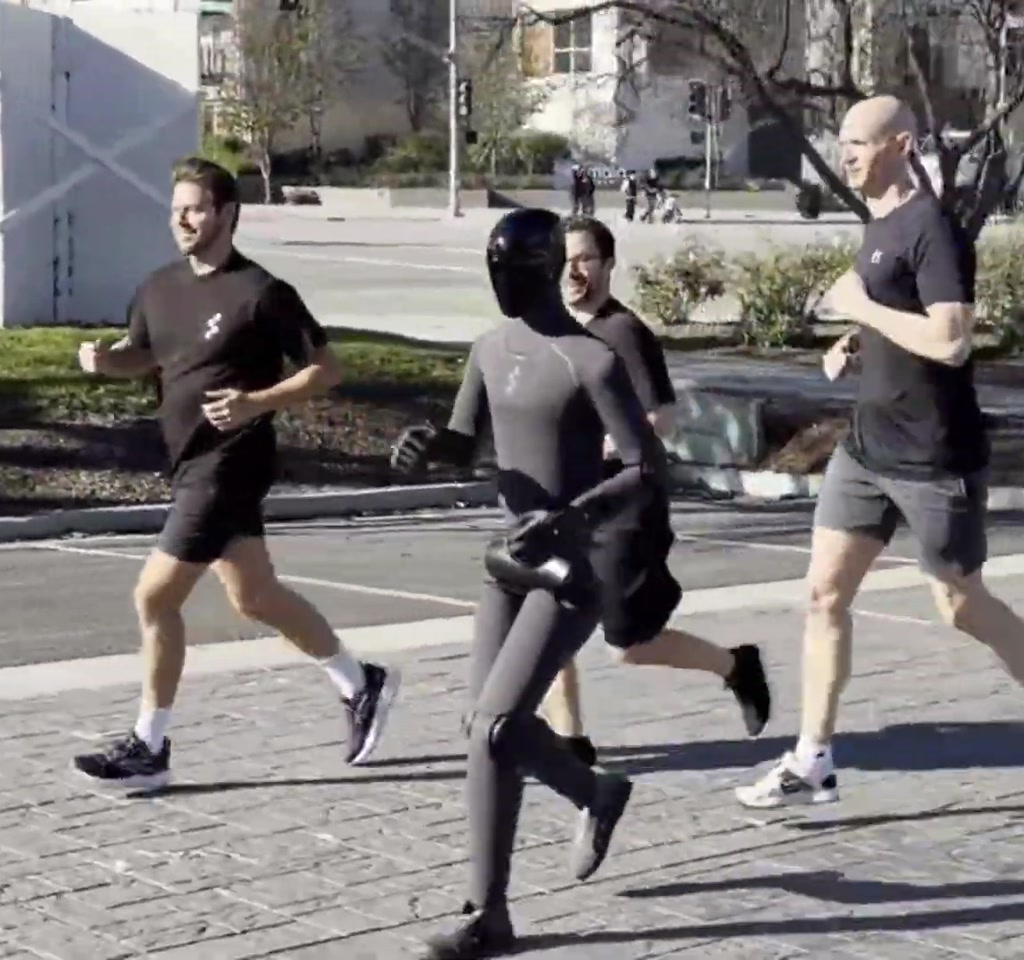
Seen in motion, the robot no longer looks like a prop. It reads like a person moving through space: feet lift, arms counterbalance, and tiny corrections appear in the joints without a visible command sequence. That shift matters because locomotion determines the environments where a robot can actually be useful.
Humanoid robot running is visible early in the footage: stride length adapts, balance persists when both feet are off the ground, and the torso stays controlled. Those cues make the motion feel human rather than theatrical, and they hint at a real change in where robots can safely operate.
Why This Running Feels Different
The simplest explanation is rhythm instead of sequence. Rather than a string of discrete commands, the robot shows coordinated timing across joints, proportional limb motion, and balance that survives brief flight phases. Those qualities produce a gait that observers instantly interpret as natural rather than mechanical.
The running feels different because sensing, timing, and motor control are coordinated to produce continuous micro corrections and proportional limb motion. That coordination gives the robot balance and rhythm during brief flight phases, making its movement read as humanlike instead of a series of jerky commands.
Definition Of Humanlike Biomechanics
Humanlike biomechanics here means using gait economy, counterphase arm swing, and torso stabilization to reduce wasted motion and preserve balance. It is not about matching human speed but about reducing energy loss, smoothing force profiles, and reacting to disturbances before they become falls.
Micro Corrections And Rhythm
The footage suggests micro corrections occur across multiple joints with subcycle timing. Those corrections are predictive and reactive: perception updates inform phase-aware control so the robot adjusts torque and joint positions almost continuously rather than in wide intervals.
How Humanoid Robot Running Works
The technical picture is a close pairing of perception, onboard decision systems, and refined motor control. Sensors map pose and terrain, control loops run in short time windows to maintain balance, and actuators apply phase-aware torque to keep motion smooth and proportionate.
Running is enabled by continuous sensing and low-latency control loops that predict center of mass and apply corrective torques in real time. Perception feeds motion plans rapidly, and coordinated actuators execute phase-aware commands so stride, arm swing, and torso stability remain proportional and adaptive.
Sensing And Perception
Real-time perception gives the robot a live map of its pose and the terrain underfoot. That data is used to predict where the center of mass will be and when corrective torque is required, enabling micro corrections that keep the torso stable while the legs drive forward.
Motor Control And Timing
Motors and actuators are coordinated by phase-aware controllers that manage torque and joint position together. The result is timing across joints that feels instinctive, with arms and legs responding without visible lag and with force profiles that avoid abrupt, binary reactions.
Control Loops And Latency
Control systems operate in short windows to feel natural, with perception and control loops running in the tens of milliseconds. Low latency allows adjustments before a misstep becomes a fall, but it also increases hardware and software complexity and integration cost.
Benefits And Value Of Humanlike Running
Humanlike running expands where robots can work. The ability to stop, change direction, and handle uneven ground opens use cases beyond highly controlled spaces, including emergency response, last-mile logistics, and facilities where human-style motion is required.
The primary benefits are improved access to human environments, reduced surprise for nearby people, and motion economy that can lower long-term mechanical stress. These advantages make humanoid systems more practical for tasks that require interaction with people or complex, unstructured terrain.
Access To Human Environments
When locomotion mirrors human biomechanics, a robot can navigate stairs, narrow corridors, and cluttered areas without the infrastructure changes wheeled platforms often need. That reduces the cost of integrating robots into existing facilities where human behavior and layouts remain unchanged.
Energy And Motion Economy
Humanlike gait reduces wasted motion, which helps energy efficiency at given speeds. That does not eliminate the power cost of running, but it means designers can prioritize endurance and predictable force profiles over raw burst performance for real-world tasks.
Limitations And Problems
No technical milestone erases tradeoffs. Energy use rises with speed, maintenance schedules get tighter under repetitive stress, and initial unit cost limits early adoption to high-value scenarios. The gap between spectacle and sustained operation is still measurable.
Key limitations include high energy draw at running speeds, scheduled mechanical maintenance after hundreds to a few thousand hours of duty, and significant upfront cost for sensors, actuators, and integration. These constraints shape deployment choices and total cost of ownership.
Energy And Runtime
Runtime for mobile humanoids at high activity levels tends to be measured in minutes unless systems carry large, heavy batteries. Designers must balance endurance with payload and cost when choosing power solutions for operational deployments.
Cost, Maintenance, And Wear
Hardware, sensors, and integration will likely place initial units in the tens to low hundreds of thousands of dollars range for first commercial deployments. Running imposes repeated stress on actuators and transmissions, with wear expected after hundreds to a few thousand hours, implying scheduled servicing and parts replacement.
Reliability And Failure Modes
Unexpected terrain, sensor occlusion, and long-term wear are realistic failure modes. Low-latency control reduces some risk, but fleet operations will reveal new challenges in uptime, mean time between failures, and service cost per operating hour.
Humanoid Running Vs Alternatives
Choosing a locomotion platform is a real decision, not a slogan. Wheeled robots excel at efficiency on flat, predictable floors. Quadrupeds provide dynamic stability on varied terrain. Humanoid running offers compatibility with human spaces and behaviors, but at the cost of higher complexity and maintenance needs.
Humanoid Running Vs Wheeled Robots
Wheeled robots are more energy efficient and cheaper to maintain on smooth surfaces, while humanoid runners can handle stairs, narrow passages, and environments designed for people. The decision depends on whether the work environment can be adapted or whether the robot must fit into existing human infrastructure.
Humanoid Running Vs Quadruped Robots
Quadrupeds are mechanically simpler for dynamic balance and often more rugged for rough terrain. Humanoid systems trade some robustness for the ability to use human tools and spaces without modification. Real-world choice hinges on task shape, environment complexity, and cost tolerance.
Who This Is For And Who This Is Not For
Humanoid running is best suited for organizations that need robots to operate in human-designed spaces without expensive facility changes, such as emergency response teams, facilities with multi-level access, or companies requiring humanlike interaction. Early adopters will accept higher unit cost and tighter maintenance cycles.
It is not for cost-sensitive deployments where floors are uniform and tasks are repetitive, nor for teams that lack service infrastructure. For warehouse applications that can be reconfigured, wheeled or simpler legged systems may provide better total cost of ownership.
What To Watch Next
Focus on metrics beyond top speed: uptime under realistic duty cycles, mean time between failures for actuators, service cost per operating hour, and the evolution of power solutions. Those figures will determine whether humanoid runners move from technical milestone to operational infrastructure.
For now, this is the moment locomotion stopped being a spectacle and started looking like infrastructure for real tasks in messy, human places. Humanoid robot running signals a shift in design priorities toward endurance, predictability, and safe interaction in human environments.
FAQ
What Is Humanoid Robot Running? A concise description: running that uses humanlike biomechanics, coordinated sensing, and low-latency control to produce balance, rhythm, and micro corrections across joints, allowing brief flight phases while maintaining torso stability.
How Does The Robot Maintain Balance While Running? Balance is maintained through continuous perception of pose and terrain, predictive center of mass estimates, and phase-aware torque control that applies corrective forces in tens of milliseconds to keep the torso stable.
Is This Running Faster Than Humans? The footage emphasizes humanlike biomechanics rather than top speed. The real advance is motion quality, balance, and adaptability, not necessarily outright speed compared to human athletes.
Can Humanoid Runners Operate All Day? Not yet. Runtime at high activity levels tends to be limited to minutes unless large batteries are carried. Energy draw rises with speed, so endurance improvements require power system advances.
What Are The Main Costs To Consider? Expect significant upfront cost for hardware, sensors, and integration, likely in the tens to low hundreds of thousands of dollars for early commercial units, plus ongoing maintenance and service costs driven by actuator wear.
Does Humanlike Running Reduce Wear? Humanlike gait reduces wasted motion and produces more predictable force profiles, which can lower some kinds of mechanical stress. However, running still imposes repeated loads that will require scheduled servicing.
When Will Humanoid Runners Be Widely Deployed? That is uncertain. The technical milestone is clear, but widespread deployment depends on improvements in power solutions, service models, and business cases that justify the initial cost and maintenance of fleet operations.
How Should Organizations Decide Between Humanoid And Alternative Platforms? Base the decision on environment and task. Choose humanoid systems when compatibility with human spaces and tools matters. Prefer wheeled or quadruped platforms when cost, energy efficiency, or rugged terrain are top priorities.
COMMENTS