


ROVAR X3 arrived at CES as a small, friendly machine that did not try to be a talking appliance. What becomes clear when you look closer is that Sentigent has made a deliberate choice: treat the outdoors as the primary arena for companionship and optimize for motion and presence rather than conversation. That decision rewires every engineering tradeoff and every meaningful question about whether this class of device is useful to everyday people.
The real significance here is not that a robot can follow you or take photos. What actually determines whether ROVAR X3 matters is how reliably it moves and how predictably it behaves in messy outdoor conditions. When following someone across grass, up a low step, or past a cluster of picnickers, perception and locomotion are the primary experience, not voice UX or a clever chatbot script.
This early look synthesizes what Sentigent and reporting at CES disclosed: a compact platform roughly 40 to 45 centimeters tall and around 15 kilograms, an emphasis on multimodal following, and an onboard compute partnership with Black Sesame Technologies. It also outlines the practical constraints that define the robot’s usefulness in real life, from battery endurance to safety and payload ambiguity.
The part that changes how this should be understood is a simple reframing. Companion robots that succeed outdoors must first be mobile companions. ROVAR X3 is interesting because it treats social presence and functional assistance through shared action. That creates opportunities and also clear limits, both of which are worth untangling before the product reaches consumers.
Why ROVAR X3 Matters
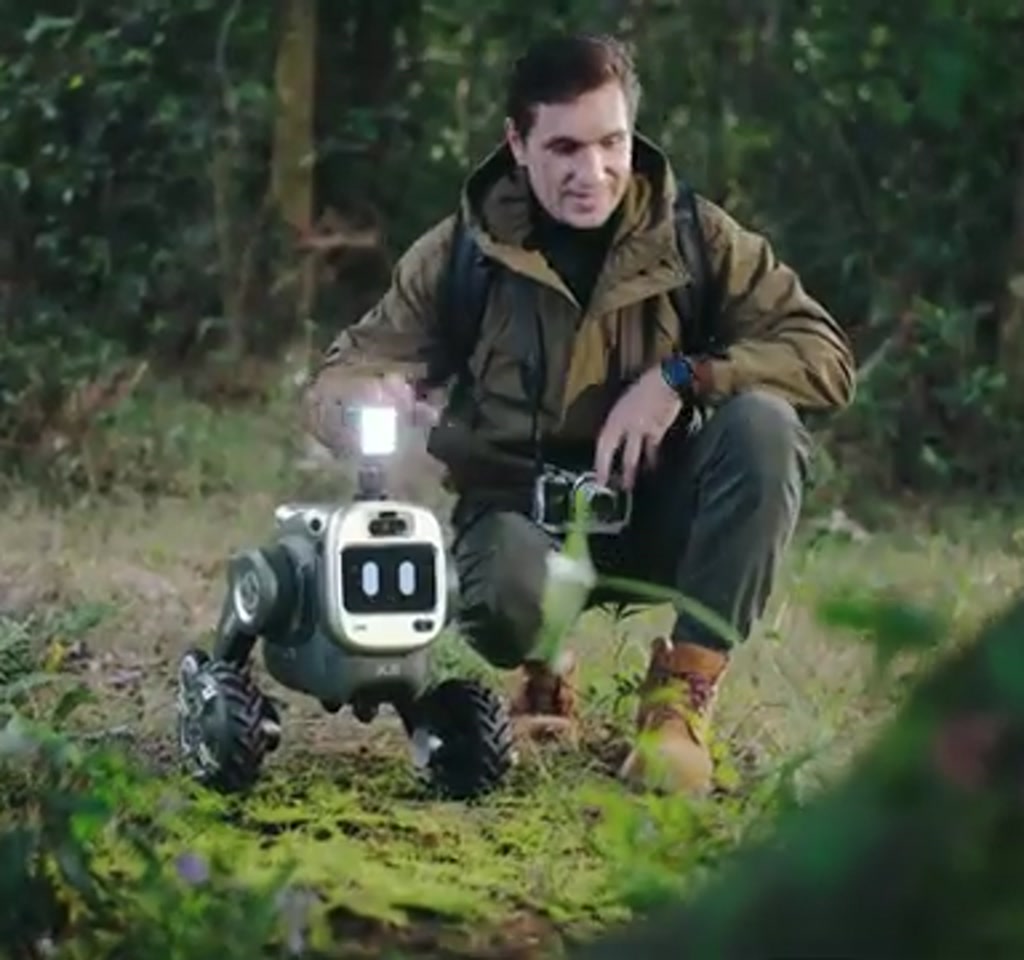
Most consumer robots to date have been indoor tools or social chat companions. ROVAR X3 flips that script and makes the environment the feature. Sentigent positions the robot as a portable partner for walks, park days, camping, and road trips, a device that follows, records, and carries stuff while remaining visually expressive through a front display.
From an editorial standpoint, the distinction matters because outdoor use changes failure modes and user expectations. Outdoors there are moving crowds, changing light, variable traction, and water, all of which make continuous, dependable operation harder. If Sentigent can deliver reliable following and predictable social navigation in those conditions, it opens a use case space that sits between indoor home assistants and utility-focused field robots.
What ROVAR X3 Is And How It Works
ROVAR X3 is a compact dual-wheeled outdoor companion robot roughly 40 to 45 centimeters tall and about 15 kilograms. It combines lidar-style perception, cameras, and a multimodal following stack to track people, maintain distance, and act as a mobile media platform while running core functions on board via the Black Sesame Aura module.
At its core, the system fuses face ID, appearance reidentification, and gait recognition to reduce single-point failures in the field. Onboard processing lowers latency and dependence on cellular connectivity but raises power and thermal demands, which interact directly with runtime and the robot’s operational limits.
Design And Mobility
ROVAR X3 is described as a compact dual-wheeled rover, approximately 40 to 45 centimeters tall and weighing near 15 kilograms. That size targets portability and storage in a passenger vehicle, while still providing an elevated sensor mount for better line of sight during walking scenarios.
Physically, the chassis favors a low center of gravity and a relatively small footprint. Those choices support stability across uneven surfaces and under load. Sentigent claims the robot can handle grass, gravel, pavement, low steps, and even shallow streams, and that adaptive motion control helps it preserve balance while carrying items.
Mobility Tradeoffs And What They Mean
The mobility approach brings two concrete constraints into focus. First, weight and size are a portability tradeoff. At roughly 15 kilograms, ROVAR X3 is light enough to fit in a car and be moved by an able adult, but heavy enough that frequent lifting or hauling becomes a chore for some households. The practical implication is that portability becomes a two-person task in many real scenarios, especially when including accessories or extra batteries.
Second, terrain capability has bounds even if sensors and control are sophisticated. Sentigent lists surfaces like lawns, gravel, and low steps, but the robot is clearly not intended for extreme wilderness or alpine trails. That boundary means the device is optimized for parks, campsites, and neighborhood hikes rather than multi-mile backpack routes or technical off-trail terrain.
Sensing, Following, And Social Navigation
The tracking system is one of ROVAR X3’s signature claims. Rather than relying on a single biomarker, Sentigent has built a multimodal following stack that fuses Face ID, visual reidentification, and gait recognition. That redundancy is purposeful: outside, faces are not always visible, lighting shifts rapidly, and similar-looking passersby appear.
Multimodal systems like this reduce the probability of target loss by switching between cues. If the face signal drops, appearance reidentification or gait can maintain continuity. What becomes obvious when you examine those design choices is that they are as much about user experience as they are about raw perception accuracy. Continuous, predictable following creates trust in the device.
Multimodal Following Explained
Face ID provides high confidence at short range and when the subject looks toward the robot. Reidentification uses clothing, silhouette, and appearance features to follow across temporary occlusions and in crowds. Gait recognition analyzes walking patterns and cadence, offering a complementary signal that is robust to head orientation. Combining these three reduces single-point failures in the field.
That said, fusion is not magic. Environmental changes such as heavy rain, mud splatter, or very low light will still reduce sensor fidelity. Sentigent’s choice to process much of this on board via the Black Sesame Aura core reflects a clear product constraint: the system must avoid cloud latency for core following behaviors. Onboard compute reduces dependence on connectivity, but it increases power draw and thermal design demands.
Interaction, Expressiveness, And Media Capture
ROVAR X3’s social interface relies on motion, gaze, and a front display that can show expressions. Show floor demos emphasized small behavioral cues, such as pausing when people take photos, swaying gently, and changing facial expressions to match context. Those micro behaviors help the robot feel present and predictable in public settings.
Media capture is an explicit use case. The robot can support a phone or use an onboard panoramic camera to act as a mobile tripod and scene recorder. That capability turns the rover into a creative tool for road trips, family events, or athletic practice where a hands-free recording platform is useful.
Benefits And Value Proposition
ROVAR X3 offers a clear set of benefits: hands-free recording during outings, a mobile platform to carry light loads, and expressive behaviors that support social predictability in public. Its outdoor focus expands companion robotics into activities where movement and framing matter more than conversation.
For families and creators the robot reduces friction in capturing moments. For users who prioritize privacy, local onboard processing lessens the need to stream raw camera data to cloud services. Those advantages form the product’s value story, but they also introduce tradeoffs in energy and payload management.
Limits, Tradeoffs, And Real World Questions
No early product is without constraints, and ROVAR X3 makes its tradeoffs visible. Two practical constraints stand out and shape the product story: battery life and safety supervision.
The Verge reported an operational runtime of roughly six hours under mixed use conditions. That number is a concrete tradeoff. Six hours is long enough for most daily routines such as several walks, a lengthy park visit, or a road trip outing, but it is a limiting factor for full-day hikes or continuous event recording. Battery management therefore shapes user behavior: owners will likely recharge between outings or plan device use in multi-segment trips.
Second, supervision and safety boundaries matter. Sentigent’s public materials and reporting indicate the product is intended as a supervised companion device. Any autonomous moving machine near children or in chaotic public spaces raises questions about safety margins, behavioral predictability, and liability. The system enforces software limits on speed, torque, and proximity, but human supervision remains a practical requirement.
There are additional, less quantified tradeoffs that will determine adoption. Payload capacity has been suggested in demos, but exact rated limits were not published at CES. Without a published payload spec, consumers cannot know how much weight the robot can carry without compromising stability or runtime. That ambiguity matters for users who imagine carrying camping gear or groceries.
Compute choices introduce power and heat tradeoffs as well. Integrating the Black Sesame Aura core from the SesameX platform places heavy perception and decision-making on the robot itself, which reduces cloud dependence. The consequence is higher onboard energy consumption, which interacts directly with the six-hour runtime and influences how aggressively the robot can use cameras, sensors, and motors during operation.
Quantified Practical Constraints
To make the limits tangible: battery life is reported near six hours, a runtime that typically supports single-day outings and multiple short sessions but not extended wilderness use. Weight is roughly 15 kilograms, which keeps it portable for car travel but means frequent lifting will be non-trivial for some users. Price signals suggest a target under 5000 US dollars, which would place ROVAR X3 in consumer territory but still at a premium compared with basic home gadgets.
These numbers let buyers assess whether the robot fits their routines. If a family needs unattended all-day recording or someone plans to carry heavy loads across long distances, the current constraints push the device out of scope. If a user wants a companion for neighborhood walks, picnics, and mobile recording, ROVAR X3 sits in a compelling middle ground.
ROVAR X3 Vs Alternatives
Compared To Indoor Home Assistants, ROVAR X3 prioritizes mobility and physical presence over sustained conversational breadth and smart-home control. Compared To Enterprise Field Robots, it sacrifices heavy payloads, ruggedized chassis, and full autonomy for a lighter, more consumer-friendly form factor and expressive behaviors.
Decision factors to weigh include runtime, terrain capability, payload expectations, and price. If you want extended unattended monitoring or heavy-duty transport, field robots and drones remain better fits. If you want a social, mobile recorder for daily outings, ROVAR X3 targets that niche more directly than stationary smart devices.
Market Positioning, Partnerships, And Roadmap Signals
ROVAR X3 appears to be in a pre-launch or early commercialization phase. Media coverage cites founder Wang Tao suggesting a future price under 5000 US dollars. If Sentigent can ship terrain capable autonomy, expressive behaviors, and media recording near that price point, the product could undercut many enterprise-style mobile robots while offering a consumer-friendly form factor.
The technical partnership with Black Sesame Technologies and the inclusion of the Aura core module signals Sentigent’s intent to scale onboard perception. Placing high-performance vision and decision-making on the robot itself is a design philosophy that privileges immediate responsiveness and privacy, since less data needs to be streamed to cloud services for basic navigation and following.
The next milestones to watch are straightforward: a formal launch timeline, detailed payload and environmental specifications, rigorous demonstrations in wet and loose terrain, and clear privacy and data handling practices for camera recordings. Those items will decide whether this is a demonstration platform or a product ready for mainstream family use.
Who This Is For And Who Should Avoid It
Who This Is For: Users who want a mobile companion for neighborhood walks, park days, road trips, and hands-free media capture. Content creators, families, and privacy-conscious buyers who value local processing and predictable social motion will find the proposition most compelling.
Who Should Avoid It: People who need heavy payload hauling, full day unattended monitoring in remote areas, or true all-weather, alpine-capable autonomy. Buyers who require published payload ratings, extended runtime beyond six hours, or enterprise-level ruggedization should consider alternatives.
What To Watch Next
The product narrative around ROVAR X3 is clear and deliberate. Sentigent frames companionship as shared action, and the team has prioritized the hardest part of that promise: steady, predictable outdoor mobility in the presence of people. The moment this approach breaks down is likely to be in extreme weather, steep terrain, or in scenarios where sustained unattended operation is expected.
From an editorial perspective, the detail most people miss is how much of the experience hinges on small motion cues and reliable following. People judge companion behavior by tiny moments of predictability. A robot that stops smoothly, holds framing while recording, and maintains a steady gap in a crowd will feel friendlier than one with faster raw compute but jittery motion.
Sentigent still needs to clarify several operational points. How does the robot handle prolonged rain or mud accumulations on sensors? What is the rated payload and how does carrying heavy objects affect runtime and balance? How will charging be handled in consumer contexts, and will swappable batteries or fast charging be part of the offering? Answers to those questions will change how owners integrate the robot into routines.
Bit Rebels will follow the rollout, watch for specification updates, and observe demonstrations that stress the system in messy, real environments. For now, ROVAR X3 is an intriguing example of a company choosing mobility and social motion as the core of companionship. That is a design position with clear potential and clear limits.
Sentigent’s product page provides additional details and will likely be the place where final specs and pricing appear as the product nears launch. For readers tracking developments at CES, the coverage from outlets such as The Verge also captures first impressions and demo descriptions.
Sentigent Technology Product Page for ROVAR X3
FAQ – Frequently Asked Questions
What Is ROVAR X3?
ROVAR X3 is a compact outdoor companion robot from Sentigent that emphasizes mobile presence, multimodal tracking, and onboard perception. It is roughly 40 to 45 centimeters tall and weighs about 15 kilograms.
How Long Does ROVAR X3 Run On A Single Charge?
Reported runtime is roughly six hours under mixed-use conditions. That supports single-day outings and multiple short sessions but not extended wilderness use.
Can ROVAR X3 Handle Rain And Mud?
Public demonstrations suggest capability on lawns, gravel, and shallow streams, but specifics on prolonged rain, mud accumulation, and IP ratings were not published at CES. Sentigent needs to release detailed environmental specs.
How Does The Following System Work?
The robot uses a multimodal stack combining Face ID, visual reidentification, and gait recognition. These signals are fused on board to maintain continuity when single cues fail.
What Is The Payload Capacity?
Sentigent showed the robot carrying items in demos, but a formal, rated payload specification was not published at CES. Exact limits remain unclear and will be important for buyers who need to carry gear or groceries.
Is ROVAR X3 Fully Autonomous And Unsupervised?
The product is positioned as a supervised companion device. Software limits exist for speed and proximity, but human supervision is recommended for safety in public spaces.
How Much Does ROVAR X3 Cost?
Founder comments and media reporting suggest a target price under 5000 US dollars, but final pricing and shipping details were not finalized at the time of CES coverage.
Where Can I Find Official Specifications And Updates?
Sentigent’s product page and future press releases will be the primary source for final specs, pricing, and launch timelines. Independent media coverage from outlets like The Verge captured early demos and impressions.
COMMENTS