


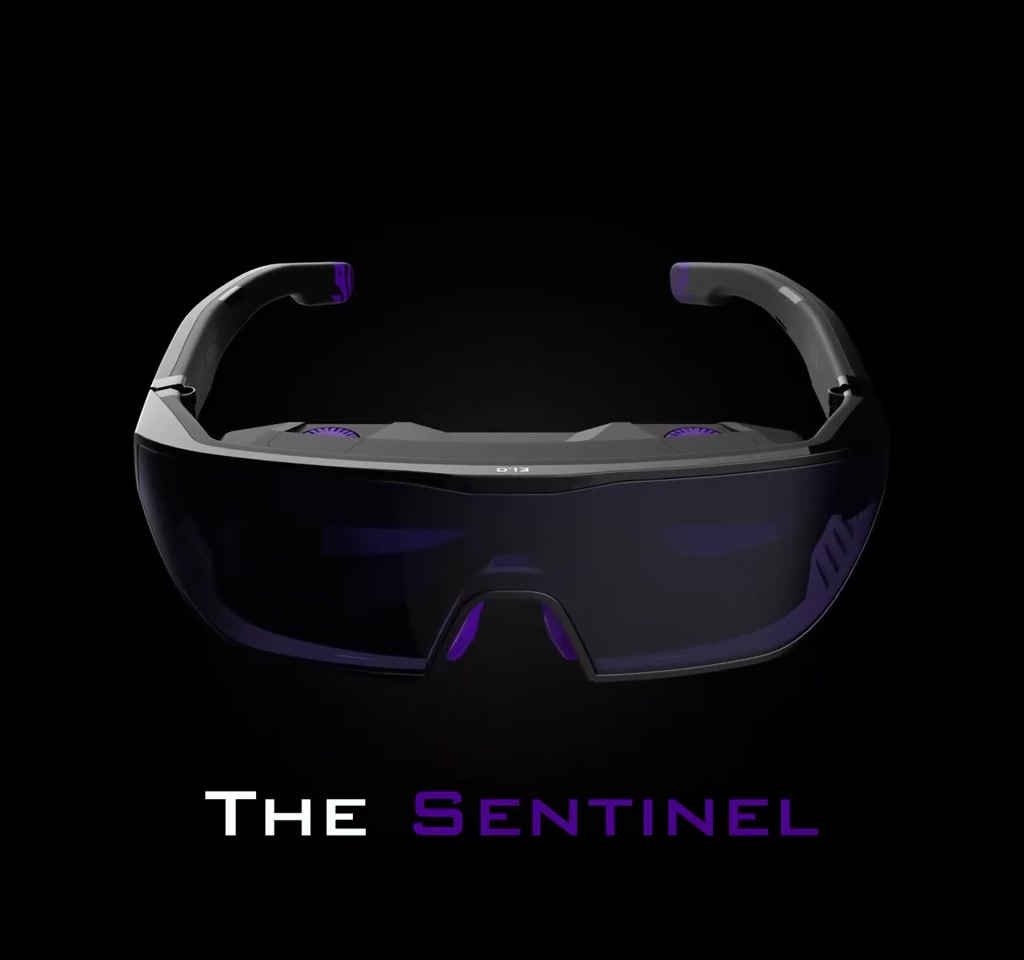
The creators behind a popular elite mobile controller have launched an audacious follow up. They call it the Sentinel XR, billed as the first glasses built explicitly for gamers, and the pitch does not mince words. A virtual 180 inch display, a 52 degree field of view, 1 millisecond response time and 1080p clarity per eye. All powered by what the team says is the largest Sony OLED module available at 0.68 inches.
The real significance here is not that another display can be strapped to your face. What actually determines whether this matters is how the Sentinel handles the hard constraints that make mobile gaming miserable for players right now. Lag and latency, thermal pain, battery life and comfort are the reasons many gaming ideas fail the moment you try to make them portable.
This article unpacks what the Sentinel XR promises, where those promises collide with physics and ergonomics, and what the broader implications are for mobile play. Most people assume a wearable display that quotes 1080p per eye and a tiny panel means immediate immersion. That assumption needs scrutiny.
What The Creators Are Promising
At the center of the launch are a few bold claims that shape the product story. The team says the Sentinel XR projects a virtual screen equivalent to a 180 inch display. They state the glasses deliver a 52 degree field of view, 1 millisecond response time, and full 1080p per eye. The panel cited is a Sony OLED module at 0.68 inches, which the creators describe as the biggest on the market for this kind of device.
Those specs are attractive when presented as a lineup. 1080p per eye reads as a promise of clear images. A 52 degree field of view signals a wide pane of vision compared to old headset prototypes that cropped the world. And 1 millisecond response time is the kind of low latency gamers revere.
Why The Details Still Matter More Than The Headline
What becomes obvious when you look closer is that a specification list does not automatically produce a great experience. There are three intersecting realities that decide whether this feels like a revolution or a clever compromise.
Optics Are A Tradeoff Between Field Of View And Perceived Resolution
Field of view, panel size and pixel density form a triangle. Stretch a tiny 0.68 inch panel across a large virtual screen and the angular resolution drops. The Sentinel XR lists a 52 degree field of view. For context, many consumer virtual reality headsets measure field of view in a range often between about 90 and about 110 degrees. A narrower field of view like 52 degrees can still feel immersive for focused gameplay and menus, but it will not wrap peripheral vision the way a high FOV headset does.
The implication is concrete. If you want a big readable virtual display at armchair distance you are trading the wide immersive sweep that full VR headsets deliver. That tradeoff can be fine for people who want a living room sized movie or a productivity screen, but for competitive players who rely on peripheral cues the narrower FOV matters.
Latency And Connection Architecture Dictate Real World Responsiveness
Companies can quote module response times like 1 millisecond as panel latency, but system latency is a different quantity. End to end responsiveness includes the phone or console frame processing time, the transport layer whether wired or wireless, and any compositor or compositor buffering inside the glasses. Streaming video over Wi Fi or Bluetooth often adds tens to potentially hundreds of milliseconds. Wired connections, for example using a direct USB link, typically push system latency down into single digit milliseconds. That difference changes whether a twitch shooter feels crisp or floaty.
This is not hypothetical. Gamers can calibrate for small, consistent latencies but variable latency and jitter are the real killers. The team behind Sentinel leans on current smartphones as the compute engine because phones now rival prior generation consoles in raw power. That is true, but coupling a high frame rate phone with a wireless stream remains a systems engineering problem.
Two Concrete Constraints That Will Decide Adoption
Any device that puts electronics near your face will be judged against two hard constraints. These are not marketing metrics. They are practical limits that determine if people will actually use the gear.
First, battery life and thermal management. Mobile workloads, especially sustained gaming at high brightness and frame rates, draw significant power. For wearables this typically means battery life is measured in hours rather than minutes. Brightness and wireless streaming can reduce that to the low end of the range. The tradeoff is clear. Push for long run time and you increase weight and bulk. Prioritize lightness and you limit session length to a few hours at best. Expect practical session windows to be bounded and plan around recharges.
Second, comfort and wearability. Fit and weight distribution determine how long a player can keep the glasses on. Comfort failures show up after repeated use cycles. Even small pressure points become unbearable over long sessions. The creators claim no discomfort, but real world comfort depends on strap systems, padding materials and weight, things that rarely translate directly from prototypes to mass shipping units.
How The Sentinel Fits Into A Mobile Gaming Ecosystem
The team explicitly frames the Sentinel as part of a larger ecosystem that includes an updated Vagabond V2 controller and an Omnibase hub. That positioning matters. What changes when you treat a display as a modular accessory rather than a self contained console is that each element can compensate for the others.
For players who already use external controllers a large virtual screen is immediately useful. The creators point out that modern phones are powerful enough to be the brains of the system. That unlocks an important real world benefit. Instead of reinventing compute and input the ecosystem approach leverages devices players already own while adding specialist hardware for display and control.
Controller And Display Synergy
A high quality controller like the Vagabond V2 reduces reliance on touchscreen controls and restores precision. Paired with a wearable display, it recreates the ergonomics of a living room setup without a TV. This is the kind of human centered design that can make a mobile experience feel intentional rather than compromised.
That said, the ecosystem approach creates new points of friction. Ownership thresholds rise because buying an entire setup tends to cost in the hundreds rather than the tens. Compatibility questions appear. Does the Omnibase require proprietary drivers on the phone? How does the Vagabond V2 pair in shared social spaces? These details shape adoption more than any single spec sheet claim.
Reality Checks And Risks The Team Needs To Manage
There are at least three practical risks that could limit the Sentinel XR’s impact.
First, the creators must manage heat. Keeping an OLED panel bright enough for indoor use and any local electronics nearby requires active thermal design. If the glasses transmit heat into the contact points it will shorten the times players are willing to use them. Expect thermal management to show up as a limiting factor before mass adoption.
Second, the wireless user experience is fragile. Wireless streams are convenient but come with variable latency depending on router, interference and phone model. If the team intends to sell the device as a seamless mobile companion they need to be explicit about supported connection modes and what performance to expect under different conditions.
Third, content and user expectations. The pitch that phones are as powerful as prior generation consoles is accurate as a raw compute statement for many devices, but that does not mean the gaming ecosystems align. Mobile ports, cloud streams and native apps each behave differently and will produce divergent experiences. The Sentinel will feel excellent for some game classes and less compelling for others.
What The Experience Might Actually Feel Like
From an editorial standpoint, the detail that stands out is the clarity of the promise: escape the tiny screen. That human itch is real. Putting a readable 1080p canvas in front of a player while they hold a proper controller may convert frustrated mobile sessions into something enjoyable.
Expect the best case scenario to feel like a private micro theater coupled with a handheld console. For strategy games, single player adventures and racing sims where peripheral vision is less critical the Sentinel could be a revelation. For competitive multiplayer, where millisecond timing and wide peripheral awareness matter, the narrower 52 degree field of view and any added system latency are meaningful constraints.
The Business Angle And What Kickstarter Means
The creators are asking backers to support a Kickstarter campaign. Crowdfunded hardware offers advantages and known pitfalls. It buys early adopter capital and community input. It also moves manufacturing risk from the company to backers. When a device claims ambitious optics and tight thermal tolerances, the difficult work is scaling those prototypes into a reliable product at volume.
Backers should treat promises about module size and panel supply as conditional. Component availability, quality control and final assembly are where many hardware launches falter. The company behind Vagabond has shipping experience, which is an important credibility signal, but the leap from a controller to an integrated wearable with optics and thermal constraints is non trivial.
What To Watch For Next
If the Sentinel XR is going to alter mobile gaming, three early signals will reveal whether the claim is real or aspirational.
- Clear data on measured end to end latency under both wired and wireless modes.
- Battery life numbers tied to specific use cases such as streaming video or native game play at target brightness and frame rate.
- Weight, fit and comfort metrics and how they change after repeated use cycles and adjustments.
Those are not marketing niceties. They are the operational details that determine if the product can move from novelty to habitual use.
Final Thought
The Sentinel XR is not interesting because it repeats an old formula. It is interesting because it tests whether a modular mobile ecosystem can trade portability for an experience close to what gamers expect from larger setups. The risk is clear. Comfort, battery and system latency are the choke points. If the team can manage those constraints without turning the glasses into a heavy or short lived accessory the idea could reshape how people carry their play.
There is no single right answer here. The Sentinel may become the device that convinces casual players to stop squinting at tiny screens, or it may prove that some compromises remain too costly to ignore. Either outcome will be instructive for the future of mobile gaming.
Learn more about the campaign and the technical claims on the project page to see how the creators address the latency, power and comfort questions that will ultimately decide whether the Sentinel XR is a revolution or a sophisticated prototype.
COMMENTS