


You might not have heard of him, but it’s very likely you’ve seen one of his videos. For Jay Neo, storytelling is an obsession, a pursuit that has taken him from his bedroom in the UK to sleepless nights in Tokyo obsessing over the perfect camera angle.
After years of shaping internet culture from behind the camera — directing the most liked video on YouTube and advising top creators and institutions — Neo is now building Palo, an AI system that captures his creative process in code. It’s his next experiment in understanding what truly makes people not just watch but feel a video.
I caught up with him for a quick chat, and the following is a transcript of our conversation.
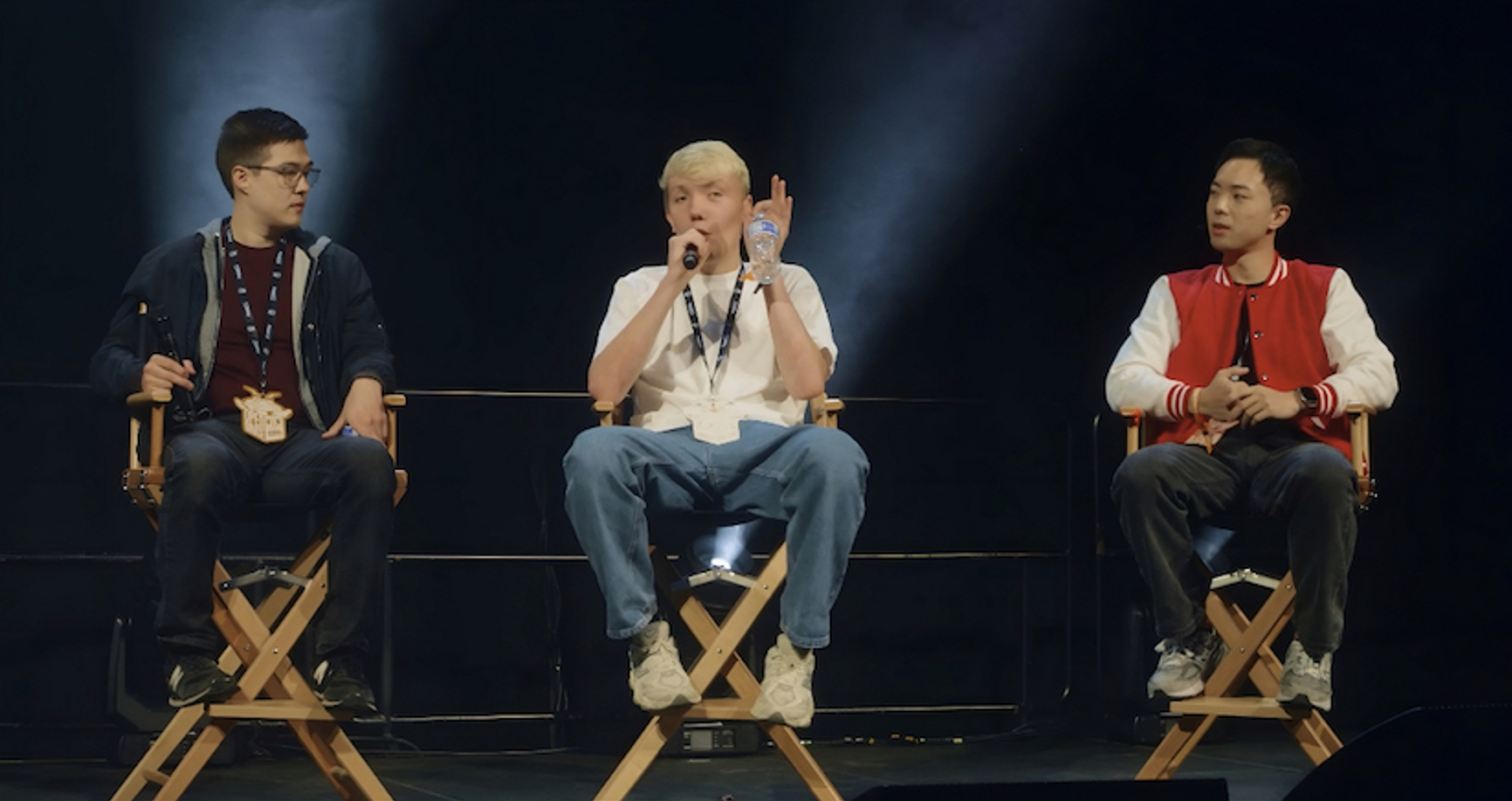
JAY NEO SPEAKING AT OPENSAUCE 2024 – IMAGE: OPENSAUCE
Q: A video you directed, “Would You Fly To Paris For A baguette,” just passed Despacito to become the most liked video on YouTube with over 50 million likes. Can you let us in on the secret, how did you execute it to such massive success?
Well, number one is the team … these things are a team effort, and I don’t think I’m allowed to reveal names, but they know who they are. My memories of that period are a mixture of agony and obsession.
We were in Paris for four nights and filmed three different videos there. I didn’t sleep more than three total hours during the whole trip, as each night I couldn’t stop looking at the footage we had captured and questioning whether it was good enough. I even broke my tailbone on a seatbelt buckle in the production van. I still can’t sit properly [Laughs.]
I had so much footage on my phone of him doing all these things in Paris, and with each subsequent edit, we cut more and more until it reached the form it did. It’s really all about simplicity. But simplicity is not just cutting footage … it’s using the score and the moments to give the video a form that’s instantly understandable and evokes emotion. I was very conscious of that at the time.
If you watch the video closely, you will notice how fast we progressed through the exposition. All of your questions are answered in the first ten seconds by the contestant asking things like “Right now?” and “Flight included?!” Then it just cuts to this aggressive music from Vivaldi that pushes you through the video.
Q: Across the past few years, the content you’ve worked on has generated over 15 billion views. What do you think makes your approach stand out from others in the space?
To make a video that people will watch, it has to be a good video. To make a good video, you need to really care. Every video that I’m behind, I truly care about … to quite a ridiculous level. There are moments when I feel super illuminated and creative, and that’s the entire reason I do it: just chasing the moment when all angles seem to open up. I know that sounds incredibly corny, but it’s true, and I think viewers can subconsciously feel when something is made with genuine care.
Q: At one point, you were running a TikTok story pipeline that was pulling in a billion views a month. How did you manage the scale, and what did you learn from leading such a large operation?
Well, again, it was a team effort and a lot of work. I had an extremely talented, creative, and good friend named Kai. He had set up one of those pages that had videos with gameplay backgrounds and subtitles covering a random story. At the time, that was new and original. It was a format where there wasn’t much production, and you could repeat it as many times as you wanted, as long as there was quality of story there.
I left MrBeast in North Carolina and moved to New York City to join forces with him and set up systems to scale it up. From my memory, we had about ten writers who were each doing six videos a day, and Kai and I would review each of them to maximize their viral potential. Then we would spin it off to a team of 15–20 editors.
There’s a science to going viral, and we trained each writer every day on it. We got it to a billion views a month after about two months, and then a bunch of people started to copy us, so we slowly shut it down after a few months. It made a ton of money, but it wasn’t very fulfilling for either of us, I think.
Q: You say there’s a science to going viral? Can you break the science down?
Well everything under the sun can be broken down as a science. You can deeply study the psychology of your viewers to discover certain triggers and storytelling elements that you can use for your next video.
After enough experimentation, the learnings compound, and you can start to get really consistent at driving high retention, which results in high views. Obviously, there’s a bunch of taste and aesthetic sensibility involved, but these are short-attention-span things you know … it’s far from the highest point of art.
Q: Today, you’re working on Palo. Can you share more about what’s on the inside?
Sure. Well, you know, I remember spending many sleepless nights studying retention graphs and studying patterns I could use. We figured we could put our brains into an AI system that goes out and does that drudgery for us so that we’re left with just an interface to talk to the data and maximize our time spent creatively.
A good way to describe it in its current state is that it’s a Personal AI … a machine that understands patterns in your videos that you can’t see and integrates its knowledge into your toolkit. We’ll see where it goes.
Q: What are your opinions on AI in the creative sphere in general?
I don’t know … my opinions change every day. It’s too early to know, and it’s too glib to claim you do know. One thing I have learned, and that has always remained true, is that storytelling is the only thing that matters. People want to watch something that they actually enjoy.
Go and watch Up by Pixar again, and see how fast they get through the exposition and the character development, ten minutes in, and you’re already crying. I doubt LLMs in their current form will ever truly be able to do that, but who knows what other developments are going to come out of this space.
Q: You’ve quietly advised some very high-profile figures, though you keep those projects off the record. Without naming names, how different is it to apply your strategies to political or institutional content compared to creator-led media?
Well, if you look around, anywhere you are, you’ll see people scrolling through short-form content. It’s where culture spawns today. Having a good strategy and an organic presence is the way to reach the zeitgeist. There’s not much more I need to say.
Q: And what exactly is a good strategy?
Just make great and authentic videos.
COMMENTS