


They set out to solve one of humanity’s dramatic hypotheticals: what do you do if a charging shark is faster than the personal propulsion you can buy. The answer, in their case, was to build the fastest one-person underwater vehicle they could imagine, then test whether it could actually outrun a shark or the commercial AquaDart 770 Xtreme that claims a top speed of 25 kilometers per hour.
The real significance here is not the headline top speed or the eye-catching hardware. What becomes clear when you look closer is that speed underwater is decided by a delicate balance between thrust, the human shape dragging behind it, and the electronics that must deliver and survive those power spikes. Raw motor torque is only step one.
Most people assume adding bigger motors is the path to victory. The team learned otherwise, quickly and expensively. A small initial motor produced about 25 kilograms of thrust, then a much larger, more costly motor pushed that to roughly 50 kilograms.
Doubling that pair put the theoretical thrust near 100 kilograms, comfortably above the 79-kilogram thrust figure the AquaDart team cites. Yet the practical obstacle was not simply making thrust; it was managing the power to use it.
The project exposes a common misunderstanding: achieving more thrust is necessary, but it only becomes useful when the power delivery system, thermal path, and the combined hydrodynamic profile of human plus machine are solved together. Ignore any link in that chain and the system stops being a faster vehicle and starts being a liability.
What Is An Underwater Jetpack And How It Differs From An Underwater Scooter
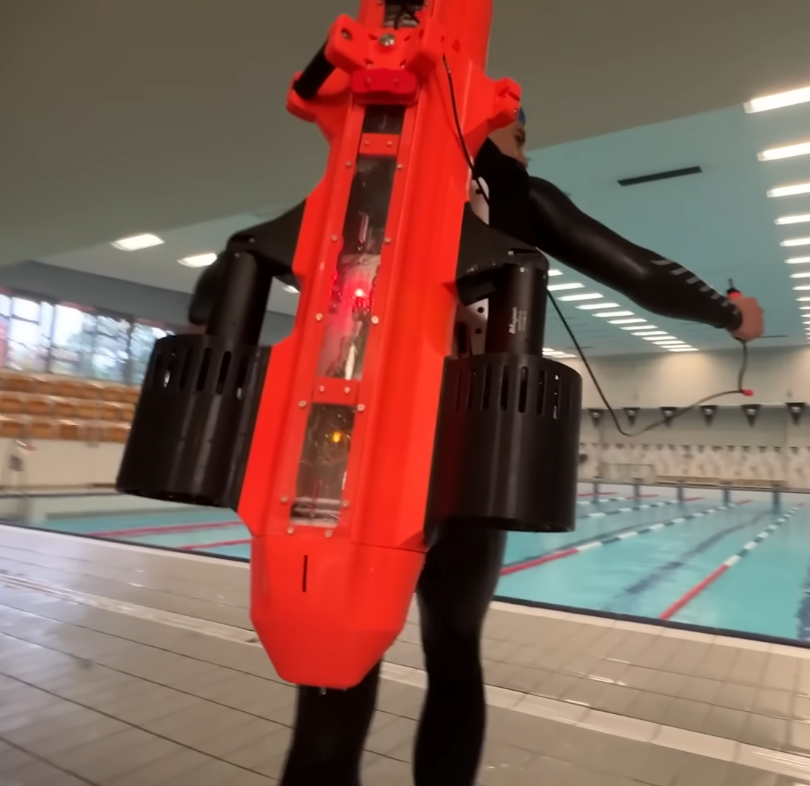
An underwater jetpack is a backpack-style personal propulsion device that mounts motors and propulsors behind a rider. An underwater scooter is a handheld or towed platform that places the propulsor ahead of or below the rider and usually reduces frontal area. The two share propulsion components but differ dramatically in human integration and drag.
Definition And Key Distinctions
Underwater jetpack refers to a back-mounted propulsion system where the human body is exposed to the flow, increasing frontal area. An underwater scooter concentrates the rider behind or around the propulsor, often yielding a narrower drag profile. Those geometry differences translate directly into how much thrust is needed to reach a given speed.
Thrust Tests In A Tank And Why Numbers Matter
From Small Motor To A 100 Kilogram Target
Their early tank tests were brutally informative. The small motor showed about 25 kilograms of thrust, which the team described as not even enough to escape a baby shark. Stepping up, a much larger motor reached about 50 kilograms in the same tank. That led to a working target: two of those motors would provide about 100 kilograms of thrust, comfortably above the AquaDart 770 Xtreme’s claimed 79 kilograms.
Measured thrust is a first-order metric for overcoming drag, but it does not automatically predict speed. Propulsor efficiency, rig geometry, and how the human rider presents to the flow change how thrust converts into velocity in open water.
Why The Tank Is A Good But Limited Tool
Tank testing gives immediate comparative numbers, but the team realized the tank can mask transient behavior and thermal issues that show up in larger reservoirs or in open water. They observed near 50 kilograms in a punch test, then adjusted for rig geometry to call it exactly 50. Even precise tank measurements left open how those motors and controllers would behave under sustained or repeated acceleration.
Design Choices And The Convertible Concept
Safety concerns forced a design tradeoff. Strapping powerful motors to a person’s back creates a failure mode where the vehicle could pin someone underwater. The team adopted a convertible concept that transforms between a backpack-style jetpack and a handheld scooter configuration.
Human-Vehicle System Matters More Than You Expect
The scooter turned out to be notably faster in pool tests. In jetpack configuration the rider increases frontal area, producing more drag. The team did not bother calculating the jetpack speed in the pool because it was visibly slower than the scooter. That observation nails one of the most actionable truths in personal underwater propulsion: the hydrodynamics of the human and vehicle combined often outweigh incremental thrust gains.
They tried to address this with shaping, adding front and rear domes and a triathlon wetsuit intended to reduce surface roughness. Those choices are helpful but incremental when the human body still dominates the drag profile.
Built-In Safety Systems
The design layered redundant safety features. There was a deadman switch that must be pressed to allow throttle, a kill cord implemented with a magnetic switch that shuts off the vehicle if the rider separates, and motor outlet grills to prevent accidental contact. The team also added multi-mode speed settings with LED feedback so accidental mode changes would be visible immediately.
These are practical design choices that reflect an awareness of human factors. The human is not separate from the machine, and the safety systems are a direct response to the risks created by accelerating power and proximity to spinning propulsors.
Electronics, Heat, And The Moment The System Stops
The narrative pivoted from mechanical to electronic when the team discovered integration hell. They built a custom PCB, a BMS, and chose powerful ESCs. Because the MOSFETs and controllers get hot under load, they used a large heatsink and placed some of the ESCs outside the sealed electronics tube to allow water cooling.
Despite those measures, their testing in the pool revealed a harsher constraint. In the highest throttle mode an ESC would cut one motor within roughly half a second. One motor quitting at full throttle effectively destroyed the chance to reach the claimed top speed. The team attributes that to the motors demanding more instantaneous power than the ESCs and BMS could deliver reliably.
These controller shutdowns are a practical signal about the limits of hobbyist electronics under extreme transient loads. It also explains why the team replaced all damaged parts after a failed troubleshooting step, costing them time and a one-week delay before the next round of tests.
Scooter Vs Jetpack Compared To The AquaDart 770 Xtreme
Scooter Vs Jetpack is a useful lens because it frames a real decision: where to spend engineering budget. The scooter won in pool trials because it reduced the rider’s frontal area and delivered cleaner hydrodynamics. The jetpack increased drag despite similar thrust numbers, so its real-world speed lagged significantly.
How The DIY Setup Stacked Up Against Commercial Claims
The team aimed to exceed 79 kilograms of thrust and approached 100 kilograms on paper, yet measured pool speed topped at about 10.8 kilometers per hour in mode 3. The practical gap to the AquaDart’s 25 kilometers per hour claim shows that commercial top speeds are achieved with a different balance of cooling, controller robustness, propulsor efficiency, and rider integration.
Two Core Constraints That Decide Success
The first constraint is power delivery and thermal management. The team tried to feed enough energy to reach top speed, and the result was that ESCs and the BMS became the bottleneck. Controllers shut down within about half a second under peak demand. This is not a minor nuisance. It is a limitation that scales with the motors you choose.
The second constraint is hydrodynamics of the human plus vehicle system. The scooter was faster than the jetpack because the latter increased frontal area and drag. Even with domes and a smoother suit, the jetpack configuration could not overcome the additional body drag at the speeds measured.
Tradeoffs, Costs, And Reliability
Cost and weight are unstated but real tradeoffs. The larger motor was the biggest the team could afford, and the battery pack they used was said to deliver roughly 90 times more power than the small Li ion cells they use in simpler projects. Moving into this power class pushes the project budget and mass upward, and it trades ease of assembly for tougher thermal and integration problems.
Reliability also becomes a core constraint. One failed double click, one submerged button acting up, or one overheated ESC can turn a promising prototype into a no-go. The team mitigated this with LEDs to show modes, a quintuple click safety for mode changes, and external water-cooled ESC placement. Those are effective but they also raise the complexity and points of failure.
What Comes Next And The Open Engineering Questions
The project provides a transparent, instructive case study. The scooter beat the jetpack in practice. The electronics failed at the moment of maximum demand. The team came away with a clear roadmap of what to upgrade for a genuine top speed run: stronger, more robust ESCs, improved thermal design, and possibly different propulsors or gearing that reduce instantaneous current spikes.
That roadmap leaves the central tension in view: can engineers close the gap between recreational pool speeds and commercial or biological benchmarks by focusing on power distribution and hydrodynamics rather than merely more motor? The next hardware iteration will test that hypothesis.
Who This Is For And Who This Is Not For
Who This Is For: Enthusiasts and makers interested in the systems engineering of personal underwater propulsion, teams looking to learn about ESC thermal limits, and small groups focused on human factors and safety in aquatic prototypes.
Who This Is Not For: Casual hobbyists seeking an off-the-shelf speed upgrade, anyone without the budget or expertise to manage high-current battery systems and thermal design, and operators who need guaranteed commercial reliability on day one.
FAQ
What Is An Underwater Jetpack?
An underwater jetpack is a back-mounted propulsion device that places motors and propulsors behind the rider, increasing frontal area compared to handheld scooters. It trades compactness for potential maneuverability but usually suffers higher drag around the human body.
How Does An Underwater Scooter Differ From A Jetpack?
An underwater scooter reduces the rider’s frontal area by placing propulsion ahead or below the rider, which typically yields lower drag and higher real-world speed for the same thrust. The team found the scooter configuration faster in pool tests.
Is Thrust Alone Enough To Reach High Underwater Speeds?
No. Thrust matters, but without matching power delivery, controller robustness, cooling, and low-drag human integration, extra motor power will not translate into sustained higher speeds.
Why Did The ESCs Cut Out At Peak Throttle?
The ESCs and BMS reached thermal or instantaneous current limits under peak transient loads, causing a motor to be cut within about half a second. The team attributes this to the motors demanding more instantaneous power than the controllers and battery system could reliably supply.
Can Hobbyist Electronics Be Upgraded To Avoid These Failures?
Yes, in principle. The team plans to upgrade to more robust ESCs, improve thermal design with external water cooling and larger heatsinks, and possibly change propulsors or gearing to spread current draw. Those changes increase cost and complexity.
How Fast Did The DIY Rig Go In The Pool Tests?
Mode 3 produced a measured top speed of about 3 meters per second, or 10.8 kilometers per hour. Mode 4 failed due to controller shutdowns, so the higher speed claim was not validated in testing.
Will Upgrading Controllers And Cooling Close The Gap To Commercial Machines?
It may narrow the gap, but the team acknowledges that commercial machines reach advertised speeds through an engineered balance of propulsion, cooling, controller design, and rider integration. The next test will show how much of the gap the upgrades can close.
Where Should Teams Starting On This Kind Of Project Focus First?
Start with systems thinking: match motors to controllers and batteries, design for thermal paths early, and prioritize human-vehicle hydrodynamics and safety. Expect to iterate hardware and testing from tank to pool to open water.
COMMENTS