


The Cyberpunk Watch matters because it changes the terms of the conversation about what a wrist wearable can be. This is not a thinner fitness band or a smarter notification surface.
It is a continuous, animated band of pixels that encircles the wrist and treats timekeeping like a theatrical afterthought. That ambition reframes the problem: wearable design becomes as much about choreography, power distribution, and mechanical sympathy as it is about pixels per inch.
The real significance here is not simply that the hardware exists. What actually determines whether this matters is how the project exposes the limits that define practical wearables. The creators chose spectacle over robustness on purpose, and that choice reveals the engineering thresholds that usually remain hidden: cost per pixel, heat sensitivity, power spikes, and the brittle tradeoffs of low-temperature assembly.
What becomes obvious when you look closer is the human story behind those thresholds. The team behind the watch treated every failure as data. An oscilloscope did not show neat lines, it showed violent current dips when many tiny displays refreshed at once. Paper mockups became routing constraints. Flights and suitcases became part of the supply chain. It is an experiment that only exists because someone refused to accept the practical answer.
The part this article ultimately reveals is simple: a Cyberpunk Watch can be built today, but the conditions that make it possible are narrow and costly. Most people misunderstand the cost of spectacle. The watch succeeds as an idea by pushing conventional tradeoffs into the open, and by making those tradeoffs the point of the object rather than an accident of engineering.
How The Design Turns Fiction Into Hardware
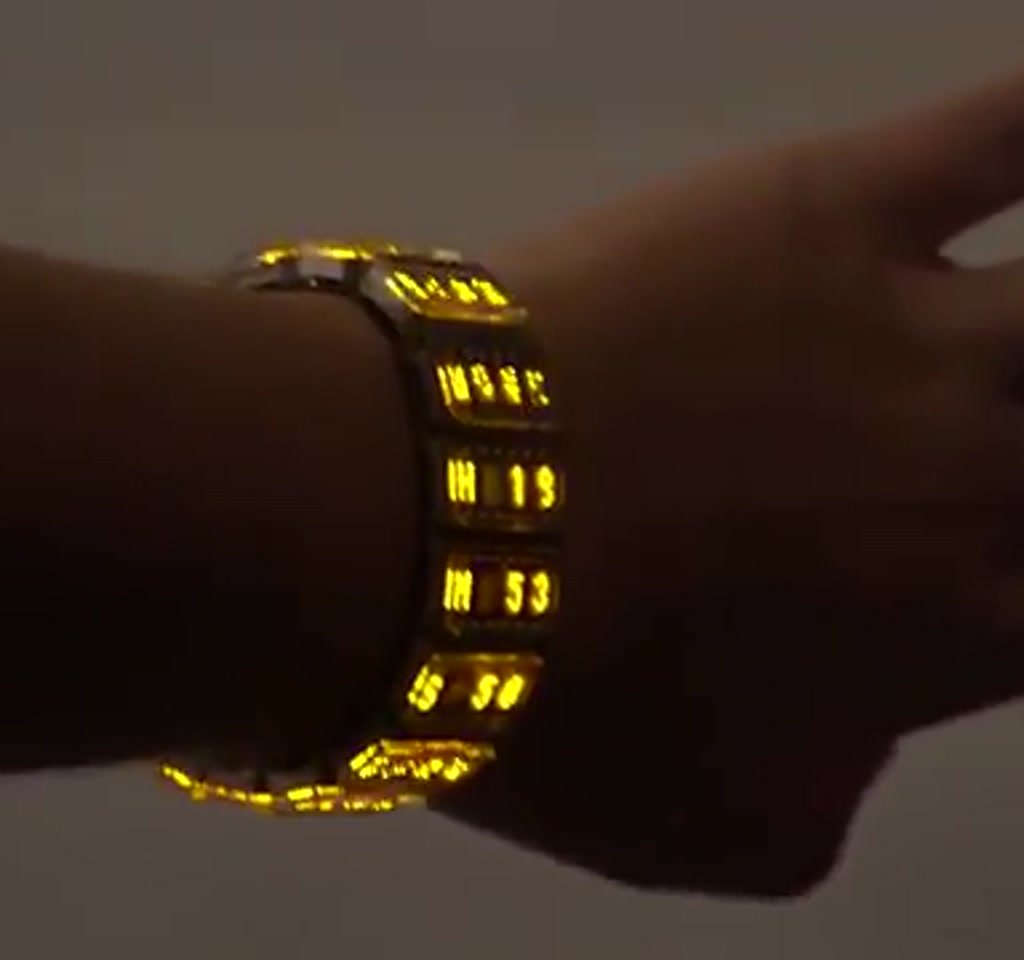
The visual idea is pure fiction rendered in polyimide and copper. Rather than a single face, fifteen miniature displays are arranged in series along a single flexible PCB long enough to wrap around an average wrist. The startup is deliberately performative: cascading animations, a waterfall of pixels spinning around the arm, then a quiet transition into time display. That sequence is the device’s soul.
What A Wraparound Animated Display Actually Is
A wraparound animated display is a continuous, addressable sequence of display modules arranged to encircle the wrist and present motion that reads as a unified loop. In practice this requires synchronized data streaming, distributed power rails, and mechanical design that tolerates repeated flexing while keeping fragile display modules electrically connected.
How It Was Built: Flexible PCBs And Tiny Displays
Flexible PCB Design Challenges
Designing a board that can bend comfortably around a wrist while carrying power and data across its full length imposes multiple constraints. The substrate is polyimide, with copper traces sized to minimize voltage drop. Rigid components live on reinforced sections with stiffeners to keep solder joints from flexing during wear. Paper mockups determined length and spacing long before routing began, because small miscalculations on a flexible ribbon cannot be fixed after fabrication.
Display Selection And Adaptation
The displays were not chosen for ease of manufacturing. They were high-brightness modules, originally through-hole parts. Legs were bent, trimmed, and surface-mounted by hand.
That adaptation is a practical detail that cannot be abstracted away: it increases assembly time, heat sensitivity, and the chance of mechanical failure. Yet it is also what gives the watch its character – the displays are individually addressable pixels in a continuous loop, and that decision drives nearly every other tradeoff.
How The Electronics Work And Why They Matter
At its core the watch is minimal electronics stretched across a flexible substrate. A small STM32U083 series microcontroller handles timing and display streaming without external crystals or flash, which keeps the flexible sections simple and reduces connector density. That minimalism is a deliberate tradeoff between board complexity and the ability to physically bend the device.
Microcontroller Choice And Minimalist Interface
The STM32U083 was selected because it needs almost nothing beyond power to run. Charging and programming are routed through pin header contacts rather than conventional connectors, which reduces mechanical strain during daily removal but increases friction during development. It is a clear design choice that favors the survival of the flexible ribbon over ergonomic polish.
Power Tradeoffs: Brightness Versus Runtime
Voltage Spikes And Capacitor Fixes
When many displays refresh simultaneously, current demand spikes. On an oscilloscope those spikes appear as sharp voltage dips, enough to reset logic downstream. The fix was pragmatic: local decoupling capacitors placed where failures occurred.
Those capacitors smooth the spikes by providing short-term current, and they were discovered through iterative failure rather than theoretical calculation. This highlights a practical truth: on flexible, high-density wearables, power distribution is often the gating factor long before display resolution or microcontroller speed.
Battery Choices And Charging
Powering the watch is a study in reuse and compromise. The battery is a salvaged lithium cell taken from disposable vapes. These cells are compact and can deliver high current bursts, but they bring variability in capacity and long-term reliability. At full brightness the combined displays can draw close to one amp of current, and that level of draw can drain the watch in under an hour.
Two Concrete Constraints That Define Its Usefulness
The project surfaces explicit tradeoffs worth stating plainly:
- Cost Per Pixel: Each miniature display costs around $30, so fifteen displays push display component cost into the low hundreds of dollars before accounting for microcontroller, battery, and assembly.
- Runtime And Thermal Limits: At peak brightness the device approaches a one amp draw, leading to run times under an hour and visible heat and solder stress that require low temperature assembly and ongoing repairs.
Assembly, Fragility, And Real World Wear
Fragility is not an accidental property here, it is an explicit boundary. The displays cannot tolerate standard reflow temperatures, which forces hand soldering or controlled hot plate techniques.
Low temperature solder was used to protect sensitive modules, but that choice made joints more brittle and more likely to crack when the flexible board bent. Sections of the flatflex had to be rebuilt using salvaged displays and careful mechanical reinforcement.
Thermal Limits And Solder Choices
Heat sensitivity constrained every step of assembly. A conventional surface-mount process would have cooked the displays. Using low-melting-point solder kept temperatures down, but traded long-term mechanical resilience for short-term assembly success. That is a clear tradeoff: protect the component today and accept that repeated flexing will demand repairs tomorrow.
Repair And Maintenance Reality
During public demos the watch failed repeatedly. Displays went dark, solder joints cracked, and entire sections detached. Repairs were frequent and improvisational.
The clasp doubles as an electrical contact using pin headers, which is clever because it reduces connector stress on the flexible board, but it also means the mechanical interface is part of the repair surface. Selling the watch as a kit would be irresponsible without redesigning for robustness.
Cyberpunk Watch Versus Conventional Smartwatches
Compared to sealed consumer smartwatches, the Cyberpunk Watch prioritizes spectacle and open experimentation over durability and battery safety. Conventional smartwatches use integrated displays, certified batteries, and tested mechanical sealing. The Cyberpunk Watch inverts that model: modular displays, salvaged batteries, and a design that invites hands-on repair and iteration.
Practical Decision Factors For Buyers And Builders
When choosing between the Cyberpunk Watch and typical wearables consider repairability, runtime, visual impact, and safety. If uninterrupted daily use and battery certification matter, conventional smartwatches will dominate. If visible movement, performative animation, and an ethos of hacking and repair are the goal, this watch offers a unique canvas despite its limits.
What This Experiment Signals For Wearables
The Cyberpunk Watch is a provocation more than a product. It demonstrates that continuous, animated, wraparound displays are possible, but only within a narrow window of cost, assembly skill, and maintenance willingness. The experiment makes visible the engineering boundaries that normally recede into product polish.
That visibility is valuable because it invites redesign: stronger interconnects, display modules built for flex, smarter power rails, and batteries with known capacity and safety characteristics.
From an editorial standpoint, the detail that stands out is how many common engineering choices are socialized into product expectations rather than technical inevitability. The team behind this watch chose different priorities: spectacle over durability, improvisation over scale, and ethnography over ergonomics. Those choices tell a story about what wearable culture values when it is given permission to be raw.
For anyone thinking beyond polished devices, this watch points to a larger implication. Flexible displays and ultra-compact power systems will get cheaper and more rugged, but they will also expose new failure modes. Power distribution, thermal sensitivity, and mechanical strain will remain the gating factors.
In practical terms that means serious consumer adoption requires components redesigned for flex, display modules that tolerate reflow, and batteries that deliver predictable capacity without hazardous unpredictability.
A quotation worth saving: “Sometimes the best projects are the ones that almost fall apart while you are wearing them.” That sentence is quotable because it captures the experiment’s intent in a single image – design as performance, failure as data.
Who This Is For And Who This Is Not For
Who This Is For: Makers, display artists, hardware hackers, and creative technologists who value visual spectacle and iteration over long-term robustness. It is also useful to designers studying power distribution and mechanical tradeoffs in flexible systems.
Who This Is Not For: Everyday consumers who need reliable daily wear, certified batteries, or long runtimes. It is not suited to users who cannot accept frequent repairs or who require products that meet standard safety and durability expectations.
Next Steps And Open Questions
What happens next is open. The team plans to share designs and code freely so others can iterate, strengthen, and reimagine the idea. Expect the next versions to trade some spectacle for durability, and also expect versions that push spectacle even further.
The unresolved question is which compromises future designers will choose, and which of those compromises will define the next generation of wearable aesthetics and usability.
Frequently Asked Questions (FAQ)
What Is A Cyberpunk Watch?
The Cyberpunk Watch is a wraparound animated wearable built from multiple miniature displays mounted on a flexible PCB, designed to present continuous, looping animations around the wrist rather than a single static face.
How Does The Wraparound Display Work?
Displays are individually addressable modules arranged in series along a polyimide flexible PCB. A microcontroller streams data to each module while power rails and local decoupling capacitors handle transient current spikes during refresh.
Is The Battery Safe And Reliable?
The prototype uses salvaged lithium cells from disposable vapes, which provide compact high-current bursts but introduce variability in capacity and long-term reliability. That makes them unsuitable for certified consumer products without redesign.
How Long Does The Watch Run At Full Brightness?
At peak brightness the combined displays can draw close to one amp, which can drain the device in under an hour. Defaulting to darkness or low-brightness modes extends runtime substantially.
Can The Watch Be Repaired?
Yes, but repairs are frequent and often improvisational. Fragile solder joints and hand-adapted displays require ongoing maintenance. Shipping the design as a kit would demand significant redesign for robustness.
What Are The Main Engineering Constraints?
The primary constraints are power distribution, thermal sensitivity during assembly and operation, and mechanical strain on solder joints and display modules. These factors limit runtime, durability, and manufacturability.
Will This Design Become A Consumer Product?
That is uncertain. The prototype proves the concept but relies on compromises that are impractical for mass consumer products. Future iterations could address those limits with purpose-built flex-ready displays and certified batteries.
How Does This Compare To Conventional Smartwatches?
Conventional smartwatches emphasize sealed construction, certified batteries, and long runtimes. The Cyberpunk Watch emphasizes visual spectacle, modular displays, and repairability, trading durability and runtime for performative impact.
COMMENTS