


There are moments when progress does something subtle and surprising: it removes texture. In entertainment, that texture used to be literal. Selecting a tape, feeling its weight, hearing a mechanical click these were small rituals that framed what came next.
The project at the center of this piece deliberately restores that friction. It swaps another click in a long list for the deliberate gesture of inserting a cartridge, and in doing so it makes the decision to watch something feel like an occasion again.
The surprising insight is not just nostalgia for its own sake. The real significance is that bringing back a tangible ritual alters how people choose, share, and value media.
This is not a retro relapse. The system replaces all of the old format’s technical limitations with modern convenience. No rewinds, no degraded tape, and no need to port video files into cartridges. Instead, simple electronics identify an object and tell a modern media stack what to play. That small difference is what makes the idea both practical and powerful.
What becomes clear early is that the rearrangement of attention matters more than the novelty of the parts inside. An NFC tag, a compact microcontroller, a printed enclosure and a satisfying mechanical action combine to produce something that feels culturally meaningful.
This article explains how it works, why it matters, and which tradeoffs define whether it will fit into a given home.
Why VHS Nostalgia Still Resonates
VHS nostalgia names a desire to recover the contextual scaffolding that made media feel deliberate, social and memorable. It is less about picture quality than it is about reintroducing cues that structure attention and create shared moments around what we watch.
Physical media carried a set of rituals that streaming does not. Those rituals created pacing. Choosing a movie involved scanning a shelf, reading spines and perhaps arguing over whose turn it was.
The decision was anchored in objecthood: a tape or cartridge existed in space, with weight and surface, and it could be shown off or loaned. That social and spatial texture shaped memory.
VHS Nostalgia is not literal longing for poor picture quality. It is the wish to restore the ceremonial scaffolding around an activity. The cartridge project reframes that scaffolding without reintroducing the format’s practical penalties. It captures the anticipatory pause between action and playback, and it turns milliseconds of latency into emotional space.
Most people misunderstand nostalgia as a backward-looking impulse. The maker behind this system treats it as design material. The point is not to live in the past, but to borrow the rituals that helped media feel special and recompose them for a digital world.
How The Cartridge Player Works
The cartridge player functions as a symbolic controller: an NFC tag in a physical cartridge identifies a selection, an ESP32 reads that identity, and a connected home automation platform triggers playback or other scene-setting actions.
The cartridge itself does not contain video but acts as a tangible key to networked media.
Electronics Inside
The architecture is straightforward and deliberately minimal. A compact ESP32 microcontroller acts as the local brain. An NFC reader interprets a tag embedded in each cartridge. When a cartridge is inserted the reader identifies the tag ID and the ESP32 broadcasts that identity to the home media system.
That broadcast is typically handled through Esphome integrated into Home Assistant. Home Assistant receives the event and triggers automations that can power on displays, switch inputs, launch a media app and begin playback. The cartridge itself never stores the movie. It functions as a physical key that maps to an action or a playlist stored on the network.
How Home Assistant Fits
Using Home Assistant gives the build flexibility. The same physical gesture can do different things: launch a Plex movie, cue a YouTube playlist, turn on lights for movie mode or even boot a game console. The mapping between tag ID and action lives in the automation layer, not in the cartridge. That decoupling turns the object into a symbolic controller rather than a storage medium.
The consequence is extensibility. Want parental-curated cartridges for children? That can be a simple automation. Want a “box set” of cartridges that sequentially advance through episodes? That is also a matter of scripting rather than flashy hardware redesign.
Cartridge Player Vs Streaming Alternatives
Choosing between a cartridge player and more conventional streaming systems is a question of goals. If the aim is speed and infinite choice, pure streaming wins. If the aim is curation, ceremony and social presence, the cartridge player offers unique value by turning selection into a shared, physical act.
Versus Pure Streaming
Pure streaming prioritizes instant access and breadth of content. The cartridge approach intentionally trades some immediacy for ritual, which can improve perceived value and reduce choice overload when curation is the goal.
Versus Classic Physical Media
Unlike legacy cartridges or tapes, these cartridges do not store video and avoid format degradation. They retain objecthood and shelf presence while offloading media storage to networked services. Practically, that means the experience is tactile without inheriting old-format penalties.
Versus Smart Remotes And Voice Control
Smart remotes and voice interfaces remove friction by offering fast selection, but they also make choices ephemeral. A physical cartridge creates an exchangeable token that invites sharing, gifting, and display in ways invisible interfaces do not.
Design Choices And Sensory Details
Design here is about signaling. Shape, label area, tactile guides and mechanical feedback are chosen to read as a collectible object, not merely as an electronic accessory. These choices change behavior by making selection visible and performative.
Cartridge Aesthetics
The geometry borrows cues from multiple eras without copying any one device exactly. Proportions, label surfaces and tactile guides are designed so the object reads as a show-and-tell artifact. Each cartridge is a small canvas: a printed sleeve, a handwritten note, or a family logo can make it feel personal in ways a filename cannot.
Making the cartridge look like a thing that belongs on a shelf matters because it changes behavior. When items sit on a visible shelf people tend to browse them, to show them, and to build collections. That transforms media from ephemeral files into social tokens.
Mechanical Feedback And Ritual
Sensory detail is where the emotional return on engineering investment is highest. A print-in-place spring arm, a soft audible thump and a small buzzer all contribute to a sense of completion. Those cues signal that the system acknowledged the action. That short pause between insertion and playback is not a bug. It is the feature that restores anticipation.
From a practical standpoint the insertion response also helps with accessibility and clarity. The mechanical motion gives users confirmation when screens or networked indicators might be delayed or invisible.
Tradeoffs, Costs, And Practical Limits
Restoring ritual introduces tangible tradeoffs: added cost, visible shelf space and some maintenance. For people who prize instant access and scale, these constraints are signaling that the design is a choice, not a universally superior solution.
No design is neutral. Bringing back ritual imposes costs and introduces constraints that determine whether the approach succeeds in different homes. Two concrete tradeoffs matter most: cost and integration complexity.
Parts and fabrication range widely depending on choices. A basic parts list with an ESP32 board and an NFC module can be sourced for roughly $20 to $60. Adding custom 3D printing, higher quality materials or a resin-printed case pushes the build into the $50 to $200 neighborhood.
Prebuilt or commercially assembled kits from the creator will naturally cost more because of labor and shipping. Those are bounded ranges rather than fixed prices and will vary by region and finish.
Integration demands vary as well. The system expects a modern home media stack: a local network, some familiarity with Home Assistant or equivalent automation tools and the patience to wire up automations. Setup time is typically measured in hours rather than minutes.
Network latency and the sophistication of target devices can add delay. In practical tests the full sequence from insertion to visible playback usually takes a couple of seconds and can occasionally stretch to up to 10 seconds depending on the state of devices and the complexity of automations.
Another practical constraint is physical space. Cartridges reclaim shelf real estate. That is part of the point, but it also means the collection is finite. Most people will plausibly maintain tens of cartridges rather than hundreds, which is the psychological limit where the ritual remains manageable and browsing stays satisfying. That scarcity is intentional; the system depends on a smaller, curated library rather than infinite choice.
Maintenance is another boundary. Firmware updates, tag replacement and occasional mechanical wear mean the system is not purely forgettable. Expect periodic attention, measured in occasional updates and minor repairs rather than continuous upkeep.
That maintenance burden tends to surface after repeated use cycles rather than immediately.
What This Means For Interface Design
The cartridge player is a compact manifesto for an often-overlooked idea: not all reduction of friction is beneficial. Reintroducing small, meaningful barriers can increase perceived value and encourage deliberate interaction, which matters when the product goal is curation rather than speed alone.
There are broader cultural signals here too. Vinyl, mechanical keyboards and film photography each demonstrate a renewed appetite for sensory-rich interfaces. The cartridge player sits within that trend and makes a practical claim: designers can combine material ritual with digital convenience to produce new kinds of delight.
That claim is also conditional. The strategy succeeds where the goal is curating attention. It becomes fragile when scale or instant access are the primary requirement. If the use case demands rapid sampling of thousands of items the approach will feel restrictive. The tension is not a flaw but a definition: this design deliberately privileges meaning over mass availability.
Social And Emotional Effects
One simple observation is quotable and central: the act of inserting a physical object is not a gimmick, it is a psychological lever. Physical selection changes the balance between stumbling on a show and choosing one. That shift matters in family rooms, in shared households and for anyone trying to shape how time is spent.
Handing someone a cartridge is a different social move than sending a link. The object carries presence. It invites conversation, exchange and memory.
Over time, these little tokens can become markers of taste, of shared experiences, and of rituals that persist across households.
The maker behind the project also shows how customization can reinforce those social patterns. A “kids” stack, a date-night stack and a curated director shelf can all coexist. The same small piece of plastic can mean different things to different people, and that malleability is where design meets culture.
How Makership Changes The Product Landscape
Projects like this make a case for why maker culture matters beyond hobbyist aesthetics. They are laboratories where interaction vocabulary is invented, tested and refined. Mainstream manufacturers rarely experiment with small, intentional frictions because mass markets reward immediacy and simplicity.
When individuals prototype alternatives they reveal possibilities for larger shifts. A cartridge player is a low-risk experiment with outsized social consequences.
It asks product designers to consider whether speed should always be the metric of success, and it warns that eliminating all barriers can hollow out meaning.
Those explorations often feed back into consumer products indirectly. Touch, weight and sound can be subtly reintroduced into interfaces without adding complexity. The maker example demonstrates how that reintroduction might work in practical terms.
Next Steps And Where This Could Go
There are many directions this idea can take. The physical token could become a key for ambient experiences that start beyond the TV: playlists in different rooms, lighting presets, or even location-triggered automations. The mapping between object and action is the real canvas.
Practical extensions include better tooling for nontechnical users, streamlined kits that lower cost and robust community libraries of cartridge art. On the technical side a focus on reducing startup latency and improving cross-device compatibility will make the experience feel more seamless without erasing the ritual.
The maker provides code, printable files and parts lists for those who want to try. That sharing is itself part of the cultural value: it invites iteration rather than attempting to literalize nostalgia as a product.
The result is an open question about how much of our technological future will be reclaimed as something to be touched.
The cartridge player is more than a novelty. It is a reminder that interaction design can intentionally slow us down in useful ways. The next step is watching whether this small reintroduction of ceremony scales into broader interface thinking or remains a cherished maker artifact.
For a closer look at the builder’s resources and a walkthrough of the files and automations, the project author documents the tutorial and code on their site for those who want to replicate or adapt the idea.
Looking ahead, the interesting question is not whether nostalgia can be replicated, but which of its rituals are worth keeping and how they can be recomposed to enrich our digital lives.
Who This Is For / Who This Is Not For
Who This Is For: People who value curated collections, social rituals, and sensory-rich interfaces will find the cartridge player compelling. It suits households that want to shape shared viewing, parents who prefer limited, preselected options for children, or makers who enjoy customization and tangible artifacts.
Who This Is Not For: If instant access, infinite browsing, and zero setup friction are the primary needs, this approach will feel burdensome. Large-scale libraries, rapid discovery or purely ephemeral consumption favor traditional streaming interfaces and may be better served by smart remotes or voice control.
FAQ
What Is The Cartridge Player?
The cartridge player is a DIY system that uses NFC-tagged cartridges as physical tokens. An ESP32 reads the tag and notifies a home automation platform, which then triggers media playback or scene changes. The cartridge itself does not hold video files.
How Does The NFC Cartridge Work?
An embedded NFC tag carries an identifier. When the cartridge is inserted, an NFC reader connected to an ESP32 reads that identifier and broadcasts it to the home automation layer, which maps the ID to a media action or playlist.
Do Cartridges Store Video?
No. Cartridges act as physical keys that point to content stored on networked services. They map an object to an action rather than acting as a storage medium.
How Long Does It Take From Insertion To Playback?
Typical timing depends on network and automation complexity. In practical cases the sequence usually takes a couple of seconds and can occasionally extend up to about 10 seconds when devices need to boot or network latency is present.
What Are The Main Costs Involved?
Component costs vary. A basic ESP32 and NFC module can be sourced for roughly $20 to $60. Adding custom cases, better materials or assembly pushes a build into the $50 to $200 range. Commercial kits will cost more due to labor and shipping.
Do I Need Home Assistant To Use It?
Home Assistant is the commonly used automation layer in the project and provides flexible mappings between tag IDs and actions. Equivalent automation platforms could be used, but some familiarity with automations and a local network is assumed.
Is The Project Suitable For Nontechnical Users?
The current maker project expects some technical comfort for setup. The author provides code and printable files to help, but wider adoption would benefit from simplified kits and better nontechnical tooling.
Can The Ritual Scale To Large Libraries?
Scaling changes the design intent. The system is optimized for small, curated collections rather than thousands of items. If your priority is mass cataloging and rapid sampling, traditional streaming interfaces remain more practical.
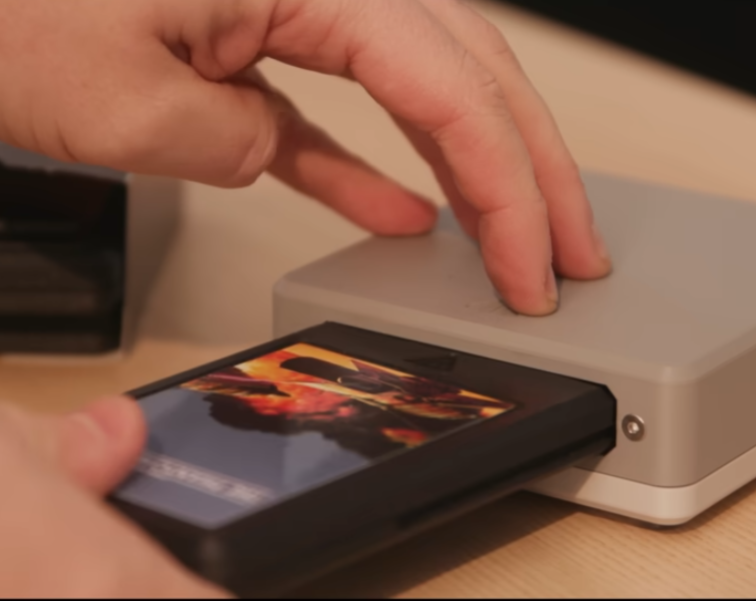
A cartridge-style VHS player reintroduces tactile tape-handling rituals to contemporary streaming.
COMMENTS