


Project Hail Mary lands in theaters as a space movie with an unusual boast: most of what you see was built to be touched, moved, and filmed in camera. From the cramped cockpit the size of a telephone booth to a medical bay that flips orientation during flight, production designer Charlie Wood and his team prioritized practical solutions over blanket digital fixes.
The real significance here is not only that the sets look authentic, but that the design process made authenticity inevitable. Keeping the environments physically real forced a set of engineering conditions that then dictated dramatic rhythm, camera blocking, and even the actor’s business. That constraint is the point: the ship had to feel like a character, so it had to behave like one under multiple physical regimes.
What most people misunderstand about practical-heavy science fiction is that it is an aesthetic choice and an engineering project at the same time. The Hail Mary production demanded systems that work under three different gravity conditions, that break down into hundreds of replaceable panels, and that present thousands of tactile controls and hundreds of live screens, all without losing the story’s grounded, believable touch.
That means the production solved design problems with numerical limits, not just taste. The cockpit, for example, is only about eight feet in diameter. That physical limit changed everything, from lens choice to how puppeteers and cable runs were routed. What becomes obvious when you look closer is how much of the ship’s personality emerges from wrestling with those limits.
Definition: What A Practical Cockpit Means For Project Hail Mary
In this context a practical cockpit is a physically built, fully rigged space that actors and cameras can interact with directly. The Project Hail Mary cockpit is roughly eight feet across, mounted on motion rigs, modular for access, and populated with working screens and controls so the set behaves as a functional prop rather than a painted backdrop.
Project Hail Mary Spaceship Explained
The spaceship in Project Hail Mary is not designed as a sleek science fiction fantasy but as a compact engineering system built under severe constraints. The story requires a single astronaut to operate a vessel that must survive deep space travel while maintaining life support, navigation systems, and scientific instruments inside extremely limited physical volume. That requirement shaped the entire design philosophy of the ship.
Instead of relying on the smooth futuristic interiors common in many space films, the Hail Mary spacecraft is built around the logic of real spacecraft architecture.
Components are layered densely, cables remain visible, and equipment is mounted wherever structural surfaces allow. This visual clutter is intentional. It mirrors the way real orbital laboratories like the International Space Station evolve over time as new systems are added and older ones are adapted rather than replaced.
Another defining feature of the ship is its ability to operate under multiple gravity conditions. During different phases of the mission the interior must function under normal gravity, zero gravity, and centrifugal gravity generated by rotation.
Designing a believable spacecraft under those conditions means every hatch, hinge, tether, and storage system must work regardless of orientation. A mechanism that works perfectly when the ship is upright may fail completely once the environment rotates ninety degrees.
Because of those constraints the Hail Mary ship behaves less like a background set and more like a mechanical character. Controls respond to physical interaction, lighting changes reflect system states, and the interior structure constantly communicates the ship’s operational status. The result is a spacecraft that feels engineered rather than imagined, which is precisely what gives the film’s visuals their unusual authenticity.
Design Tools And Reference Points
3D Printing And Rapid Prototyping
One of the earliest production tools the team leaned on was simple 3D printing. These were not museum‑level sculptures but quick, highly accurate models to test scale and detail in small spaces. The ability to produce multiple iterations quickly helped the directors and designers decide which visual choices read at a human scale when shrunk down to an eight-foot capsule.
What Charlie Wood emphasized was that detail sells believability. When you are aiming to convince a viewer that a tiny space contains a functioning spacecraft, a handful of convincing knobs, vents, or rivets changes how a director imagines a camera move or an actor interacts with the environment.
Aircraft, The ISS, And International Modules
The International Space Station was the mainstay reference. Its mix of cramped working volumes, visible hardware, and varied vendor equipment gave the design team scale and a working vocabulary for airlocks and hatches. From there they branched out to Soyuz and recent Chinese modules to collect visual cues.
They also pulled inspiration from commercial aircraft cockpits, notably the 747-400 control lighting and tactile density. The result is not a replica of any one craft but a collage that reads like believable engineering across nations and eras.
How Practical Cockpits Work On Set
Making a practical cockpit function for cameras requires integrated motion, access, and live interfaces. Project Hail Mary combined a gimbal, shudder rig, removable wall sections, and hundreds of practical screens to let a single camera pass capture both performance and changing moods without relying on later fixes.
Engineering The Cockpit: Small Space, Big Requirements
The Coke Can: An Eight-Foot Tube Of Light
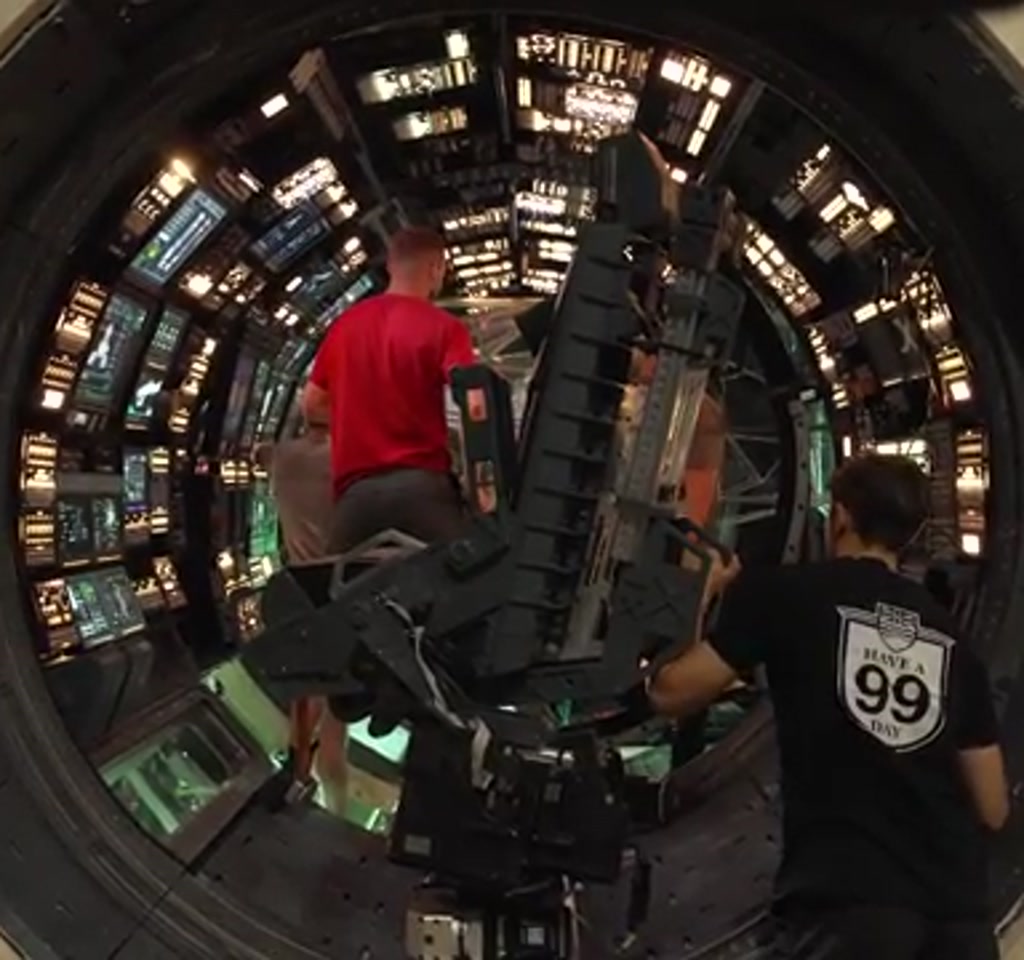
The cockpit, nicknamed the coke can, is roughly eight feet in diameter. That is a firm, measurable constraint. Cameras, lenses, puppeteers, and actors all have to operate in that circle with very little forgiveness. To make the space function cinematographically, the team mounted the cockpit on a gimbal and a shudder rig so the set could pitch, roll, and vibrate practically rather than being simulated later.
Seats are functional. Instrument panels can slew, pitch, and yaw. The complexity scales quickly: Charlie mentions thousands of buttons and many hundreds of screens across the ship. Those numbers are not decorative; they are operational targets that determined wire runs, power distribution, and heat management.
Removable Panels And Puppeteer Access
Filming in tight practical sets requires predetermined access. Walls had to fly out in sections so camera heads and puppeteers could reach interior spaces during zero gravity sequences. The entire interior sits on an external exoskeleton that supports hundreds of individually removable panels. That modular approach made rehearsal and camera blocking possible without cutting the set on the day.
The tradeoff appears as construction complexity. Each removable element must be structurally sound while detached pieces still allow other systems to remain live. In practice that meant many weeks to months of planning and engineering integration before the first camera rolled.
Three Gravity States And The Mechanics Of Believability
The ship on screen has to behave under three condensed physical regimes: normal gravity, zero gravity, and centrifugal gravity. That is a design condition with real implications, because a single hinge, hatch, or tether must function reliably as the set changes orientation and motion modes.
For example, a hatch that functions perfectly when the set is in one orientation may not latch when the whole module is rotated ninety degrees. Charlie describes hinges made from aluminum that should have been steel because small changes in pinion alignment prevented the hatch from closing after the set changed orientation. That anecdote is an engineering lesson rendered cinematic: orientation matters as much as form.
The medical bay illustrates the point. The beds live in a stacked tube when the ship is in one mode, then reorient or even deploy on tethers during different flight conditions. The same physical object has to present legible behavior whether it is static, pitching on a gimbal, or spinning under centrifugal force.
Lighting, Screens, And The Ship As Character
Color Systems That Tell Story
One of the clearest creative decisions was to give the cockpit a tube of light with distinct lighting personalities. The team built a palette that shifts with narrative beats: monochrome black and white for sterile computation, warm amber for a dawn-like emotional state, cyan for relaxed sequences, and green for moments that feel hostile or alert.
Those lighting changes are practical, not just color grading choices. The fixtures and monitors were set up so a single camera pass can capture different moods by changing which lights and screens are active. That reduces later compositing work and gives actors immediate cues to respond to.
Screen Graphics As Performance Drivers
Unlike the common approach of replacing displays in post, the Hail Mary team built a dedicated graphics workflow so screens could show real data in scene. They hired a specialist to manage graphics and set up color systems for different moods. The result is practical, legible content that the director can use to stage beats and the actor can touch and read.
There is a subtle but critical lesson here. Practical screens change the scene’s energy. When a button is pressed and a real panel reacts, the actor’s movement feels anchored. That interactivity also imposes constraints: powering and controlling hundreds of monitors requires cable management, rack space, and engineering time that scale into weeks of integration and tens to hundreds of discrete power circuits depending on the final count of screens.
Benefits Of Practical Set Design
Practical design delivers immediate tactile feedback for performers, a textured visual complexity that reads as age and use, and a camera-friendly environment where lighting and motion occur in the same physical space. These benefits shorten certain editorial loops and create on-set choices that digital workarounds struggle to emulate convincingly.
Constraints, Tradeoffs, And The Numbers That Matter
This production is defined by constraints that force creative decisions. Two stand out with quantifiable scale. The eight-foot-diameter cockpit creates fixed camera and movement budgets, and the hundreds of removable panels and many hundreds of screens create logistics costs that require dedicated engineering and planning.
- Physical Volume Constraint: The eight-foot diameter cockpit creates fixed camera and movement budgets. Lenses, camera rigs, and puppeteers all must operate within that circle. That size boundary converted into precise blocking and forced the use of gimbal and slew mechanisms rather than relying on virtual camera tricks.
- Complexity And Modularity Hundreds of removable panels, thousands of buttons, and many hundreds of screens create logistics costs. These elements require weeks to months of planning, dedicated engineering support, and substantial cabling and power distribution. Maintenance tends to surface after repeated use cycles, so the team created modular sections to swap faulty parts quickly during a shoot day.
There is another unavoidable tradeoff. Practical systems demand more up-front engineering but reduce certain post-production costs in exchange for higher on-set integration time and risk. The team chose that balance deliberately because practical performance gave better actor feedback and a more convincing visual texture.
Practical Cockpit Vs Digital Sets
Practical cockpits prioritize tangible interaction, while digital sets prioritize flexibility and late-stage alteration. Project Hail Mary favored the former to secure authentic performance and visual clutter that speaks to lived-in engineering, accepting higher front-loaded technical work and modular maintenance as the cost of that authenticity.
When Practical Beats Digital
Practical is strongest when actor interaction, incidental lighting, and physical motion directly influence a scene’s rhythm. It reduces the need for simul-wings in post and anchors performances in a way that virtual displays or green screens often do not.
When Digital Makes Sense
Digital sets retain the advantage for vast exterior scale, last-minute script changes, and scenarios where safety or budget make full-scale practical builds impractical. The decision is a production-level tradeoff rather than a categorical judgment.
Why Practical Still Wins For This Story
What becomes obvious when you look at these sets is that the ship is not just a location, it is a character with moods, behaviours, and failures. The textures of fabric in the medical bay, the tactile chaos of mismatched instrument facings, and the variable chroma across monitors all add to a sense of accumulated use and international origins.
Charlie Wood’s emphasis on combining soft and hard surfaces is an aesthetic and functional choice. Insulation fabrics and stitched panels make some spaces feel safe and embryonic. Industrial airlocks and armored windows make others feel lethal and precise. That contrast supports the film’s emotional architecture.
From an editorial standpoint, the detail most people miss is how these physical constraints shaped performance. Practical screens and moving hardware give the actor something to manipulate and react to, which changes timing and allows subtle physical beats that would be harder to achieve if everything were simulated.
Logistics, Collaboration, And The Human Factor
Productions of this type require intense cross-department coordination. Art, engineering, visual effects, lighting, and camera had to align on blocking, access, and what remained practical versus what visual effects would augment. Charlie describes it as a constant learning process, with new problems arriving daily that needed solutions from a very amenable team.
That kind of collaboration is itself a constraint. Decisions were not made in isolation; they had to factor in how many people would be needed to rig a panel, the time required to swap a screen, and how many rehearsal cycles a camera operator gets. Those practical scheduling limits often determine what ends up on screen more than grand design flourishes do.
What is instructive for makers and designers is that constraints can be generative. When you have to solve how a hatch works under three orientations, the solution yields a prop that reads as engineered and believable. When you must route wiring for hundreds of monitors, you end up with visual clutter that sells decades of operational life.
Who This Is For And Who This Is Not For
Best Suited For: Filmmakers, production designers, and prop engineers who prioritise actor-driven performance, tactile detail, and on-set atmosphere. This approach rewards teams who can commit engineering resources up front and coordinate cross-department work over time.
Not Recommended For: Shoots with extreme budget constraints, productions that need rapid scope changes late in post, or films that require vast exterior environments where digital methods are clearly more efficient. In those cases a hybrid approach is often the safer choice.
The Forward Look
Project Hail Mary shows a direction production design can take when the aim is not only spectacle but mechanical agency. Practical sets require more planning, more engineering, and more modular thinking, but they return a kind of presence that visual effects struggle to replicate.
As filmmaking tools evolve, the lesson is not that practical is always better, but that choosing practicality forces the team to solve physical problems that then become narrative strengths. The ship behaves like a character because the crew built it to behave, and that decision ripples through cinematography, performance, and emotion.
In the end, the film invites a simple question worth following: what other stories become more truthful if their environments were required to actually work? That is a design challenge that will keep production teams busy for some time to come.
FAQ
What Is A Practical Cockpit In Film Production?
A practical cockpit is a physically constructed set that actors can touch and that contains working or responsive elements like screens, buttons, and moving parts. In Project Hail Mary, it refers to a roughly eight-foot-diameter capsule built for direct interaction, motion, and live lighting effects.
How Did The Production Simulate Zero Gravity?
Zero gravity and other motion states were achieved through a combination of a gimbal and shudder rigs, removable wall sections for puppeteer access, tethers in the medical bay, and carefully choreographed camera and actor movement rather than relying solely on post-production tricks.
Why Were Practical Screens Used Instead Of Replacing Them In Post?
Practical screens provide immediate visual cues for actors and directors, reduce some compositing work, and create interactive moments where a real panel reacts to a touch. The tradeoff is increased cabling, power distribution, and on-set engineering complexity.
What Are The Main Constraints Of The Cockpit Set?
The primary constraints are the physical volume (an eight-foot diameter), the need for modular, removable panels for access, the requirement to operate under three gravity states, and the logistics of powering and managing hundreds of live screens and thousands of controls.
How Did The Designers Reference Real Spacecraft?
The team studied the International Space Station for scale and vocabulary, referenced Soyuz and recent Chinese modules for visual cues, and borrowed tactile density from commercial aircraft cockpits such as the 747-400 to create a believable, multinational engineering collage.
Is Practical Set Design Cheaper Than Digital Effects?
Not categorically. Practical sets demand higher up-front engineering and integration time, which can increase production-day costs. They can reduce certain post-production expenses and improve performance capture, so the comparison depends on project priorities and the kinds of scenes required.
Can Practical Sets Handle Multiple Gravity States Reliably?
Yes, but only with significant engineering forethought. Examples from the production include hinge material changes and gimbal integration to ensure latches, beds, and tethers function across orientations. Those solutions required weeks to months of planning before filming began.
COMMENTS