


What the project ultimately reveals is not a gadget trick but a design lesson: when a physical effect resists invention, nature can sometimes supply the missing mechanism. Most people assume glowing piano visuals must come from screens or CGI. The part that changes how this should be understood is that a convincing, three-dimensional, responsive glow was achieved by harnessing a living organism rather than pixels or synthetic particles.
The build ran from January 2023 to December 2025 and included repeated studio moves and a catastrophic tank failure. For three years the team iterated through smoke, vortex rings, paint underwater, and micro droplets. The final solution used a tank full of bioluminescent algae disturbed by bubbles triggered by key presses. That living reaction rises, emits light when stimulated, and fades away in a way cameras and displays struggle to reproduce.
What Is A Bioluminescent Piano?
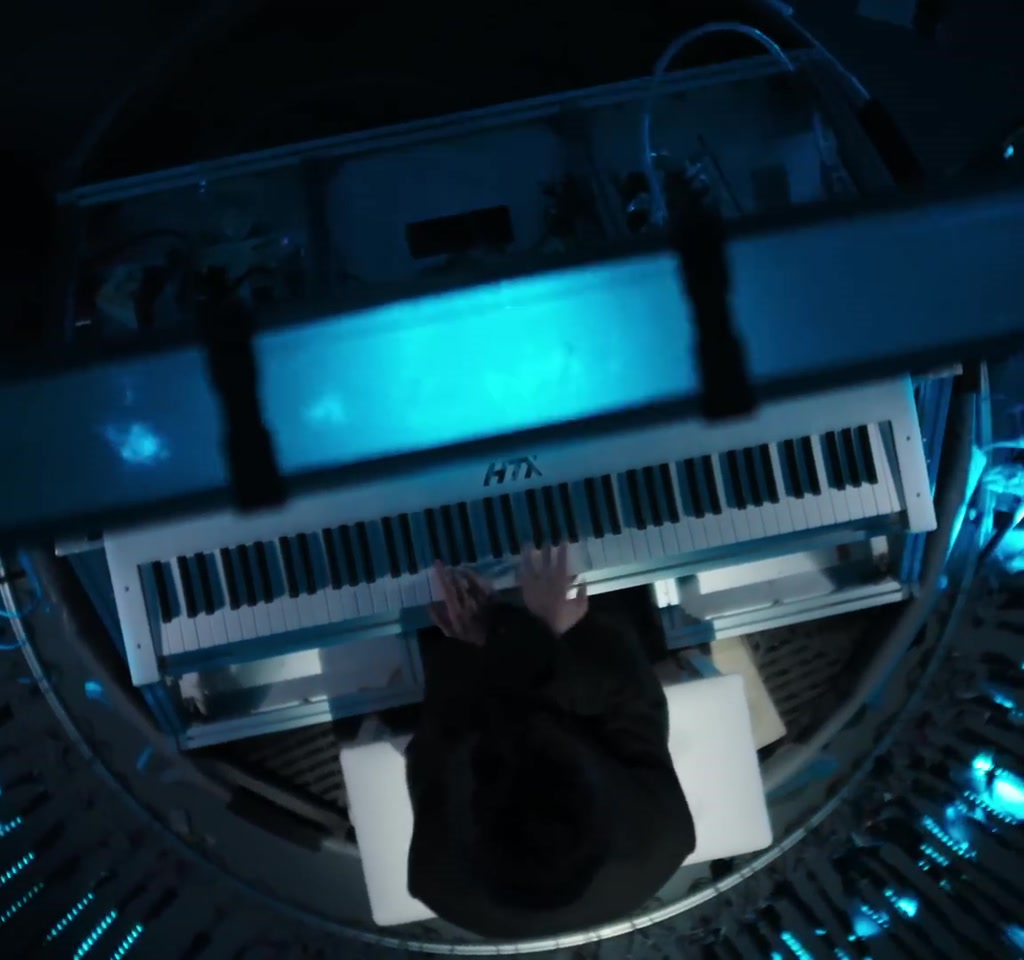
A bioluminescent piano uses living bioluminescent organisms in a liquid tank so that bubbles and agitation triggered by key presses produce visible bursts of light. The effect creates three-dimensional, rising glows rather than flat screen imagery, and it reacts naturally rather than being pixel-driven.
How The Bioluminescent Piano Works
Mechanically the system uses a reinforced glass tank, bubble generators or agitators tied to key events, and a live culture such as Blue Tears. Pressing keys produces bubbles or disturbance that stimulates the organisms to emit light, which then rises and fades naturally.
Tank, Structure, And Safety
The project rebuilt the glass with double-layer tempered panels after an earlier one-inch-thick pane shattered. The finished rig required a gantry crane and at least eight people to assemble, and it demanded reinforced floors, safety redundancy, and careful electrical layout to protect electronics from catastrophic flooding.
Living Culture And Triggering
The studio used a live culture commonly called Blue Tears. The organisms glow when physically disturbed; in this installation bubbles and agitation timed to key presses produce visible pulses that travel up to the surface. Maintaining water quality, temperature, and agitation patterns is essential for consistent glow.
Lighting And Perceptual Design
Unlike backlit screens, the surrounding lighting scheme was tuned so the glow retained depth. The team adjusted external illumination to avoid making the tank look like a flat, backlit image and to preserve the organic feel of motion from multiple viewing angles.
The Four Failed Prototypes That Taught The Team How Not To Do It
Prototype One: Smoke And Lasers
First they tried emitting smoke on key presses and illuminating it with lasers. In practice the smoke drifted and merged, smearing patterns into incoherent clouds. The experiment showed that diffusive materials make single-note mapping unreadable and that smell and residue become practical problems for prolonged runs.
Prototype Two: Smoke Vortex Rings
Next they sculpted air into vortex rings using speaker-driven emitters and shutters. Visually better, but the units were large: scaling to 88 keys would have required roughly 4 meters of hardware. Miniaturization killed ring stability, revealing a fundamental size versus stability tradeoff.
Prototype Three: Paint Vortex Underwater
Underwater colored-fluid vortex rings looked beautiful in isolation, but paint dissolved and clouded the medium within minutes. Oil-based dyes reduced dissolution but introduced surface tension effects that favored spheres over rings. The tests taught the team about fluid coherence and surface chemistry limits.
Prototype Four: Droplet Piano
Droplets solved scale because tiny needles can map droplets one-to-one with keys. The studio built a heavy glass tank, tuned 250 kg of glycerin, and used LED strips to illuminate rising drops. The footage was stunning, but droplets faded and drifted; guiding tubes ruined the organic feel, and a safety failure destroyed the tank and electronics.
Why Seeing Music Matters
Sound is temporal and intangible. The creator, who also spent roughly three years learning piano, felt notation and performance had not given music a visible, physical presence. The goal was to make notes appear as luminous particles in space that can be perceived from many angles and feel present in the same physical space as the pianist.
Bioluminescent Piano Vs Screen And Droplet Alternatives
This section frames real decision factors: realism, scale, maintenance, and safety. The living tank prioritizes perceptual truth and depth. Screens and CGI are predictable and low maintenance but flatten depth and break from off angles. Droplet rigs offer scale but introduce fragility, optical limits, and safety hazards.
Realism And Presence Compared To Screens
Screens show notes but flatten space and look synthetic from many viewpoints. The living tank provides three-dimensional motion, unpredictable microbehavior, and depth that the eye reads as real.
Droplet Systems Compared To Living Light
Droplet systems can map keys precisely and look controlled at close range, but droplets fade, drift, and require enormous optical and structural solutions. Living light trades absolute control for a reliable natural reaction that behaves the way the team needed.
Safety And Scale Tradeoffs
Scaling a tank-grade installation requires heavy glass, gantry cranes, and reinforced spaces. Alternatives like screens avoid these logistics but also avoid the tactile spectacle that the living approach delivers.
Benefits Of Using Living Light For Music Visualization
Using bioluminescence delivers depth, motion, and a life-like randomness that audiences accept as real. It supports multi-angle viewing, integrates naturally with performance, and creates an experiential spectacle that screen-based solutions struggle to match.
Limitations And Operational Challenges
The living approach adds operational limits: culture health, water quality, temperature control, and session length. It requires maintenance, restocking, and ecology-aware scheduling. Practically this means runs last hours rather than continuous operation, and installations demand rigged safety and trained staff.
Cost, Complexity, And Practical Constraints
The project used large quantities of glycerin in tuning tests, custom glass, and bespoke mechanics. Equipment, failed prototypes, and recovery multiply cost into the thousands of dollars rather than the tens. Iteration becomes expensive in time and money, which constrains creative experimentation for most studios.
What The Rig Reveals About Design Thinking
The build prioritized perceptual truth over elegant engineering illusions. The team rejected screen tricks and transparent displays because the effect would be two-dimensional and dark from off angles. Repeated failures narrowed design choices until a living system proved practical within the remaining constraints.
Who This Is For And Who This Is Not For
Who This Is For: Artists and studios seeking a one-of-a-kind, physical spectacle who can invest in safety, maintenance, and logistics. Makers who value perceptual depth and are comfortable with ecology-aware operation will find the approach rewarding.
Who This Is Not For: Casual builders, home hobbyists, or production teams needing low-maintenance, high-uptime displays. If you need continuous, plug-and-play operation or cannot accommodate heavy glass and reinforced floors, consider screen or LED alternatives.
What Comes Next
The project acts as a proof that spectacle can be physical while also warning that real-world magic is expensive, fragile, and messy. The team partnered with a brand known for pushing cooling and design limits on phones, suggesting future collaborations that mix show and engineering. Open questions remain about whether living light can be standardized or adopted more widely.
The final image of music made visible is not the end of a technical roadmap but the start of a practical conversation about whether spectacle should be engineered or borrowed from nature. That conversation will shape what audiences see and what risks creative teams choose next.
Frequently Asked Questions
What Is The Magic Piano?
The Magic Piano is a studio project that makes music visible by using a tank of bioluminescent organisms. Key-triggered bubbles and agitation cause bursts of living light that rise and fade, creating three-dimensional visualizations synchronized to performance.
How Does The Bioluminescent Effect Trigger?
Physical disturbance, such as bubbles or agitation produced by the piano mechanism, stimulates the organisms to emit light. The glow is a natural chemical reaction in certain marine organisms and is triggered reliably by mechanical disturbance.
Is A Bioluminescent Piano Safe To Build?
Safety is a major concern. The project required reinforced glass, gantry cranes for assembly, reinforced floors, and safety redundancy. A single shattered panel can flood electronics and destroy equipment, so professional rigging and contingency planning are essential.
How Much Does It Cost To Build?
Costs scale into the thousands of dollars rather than the tens, because of heavy custom glass, bespoke mechanics, and the expense of failed prototypes and recovery. Exact budgets will vary by scale, site, and safety requirements.
Can I Replicate This At Home?
Replicating this installation at home is impractical for most people due to weight, safety, maintenance, and ecology requirements. The build is a studio scale project that needs reinforced spaces and trained personnel.
How Long Do Sessions Last?
Sessions are typically measured in hours rather than continuous operation. Biological constraints like culture health, water quality, and temperature control limit practical run times and require downtime for regeneration or restocking.
What Alternatives Exist To Make Music Visible?
Alternatives include screens and CGI, smoke and lasers, vortex rings in air or water, and droplet-based rigs. Each has tradeoffs in realism, scale, maintenance, and cost; the team tested many of these before adopting living light.
Will Artists Adopt Bioluminescent Displays?
Adoption depends on whether artists and venues can accept the maintenance, safety, and cost tradeoffs. The approach offers a unique perceptual effect, but it may remain a studio-scale spectacle unless methods for robustness and standardization improve.
COMMENTS