


When a three-story house in the Riyadh region crossed the 9.9-meter mark and landed in headlines, the immediate reaction was celebration of a new vertical record for on-site construction printing. The project, a collaboration between developer Dar Al Arkan and the Danish firm COBOD International, is visible proof that the basic mechanics of large-format printing can be pushed beyond single-story prototypes and executed at building scale.
What becomes obvious when you look closer is not just that a machine deposited walls layer by layer, but that the milestone only matters if the technique can be repeated, integrated with conventional trades, and measured against transparent performance claims. That is the article’s main point: the headline about height is a milestone, not the endgame.
The real value of the approach will be determined by repeatability, verified thermal and structural performance, and whether the workflow reduces total project cost on a per-unit basis.
The villa is interesting because it bundles several real-world constraints into one demonstrator. COBOD published dimensions and a basic program: roughly 345 square meters of total area across three levels, printed wall work done over 26 days, and a suite of conventional finishes, services, and smart home features layered onto the printed shell.
Those figures are useful because they let us convert a milestone into concrete performance metrics and tradeoffs that matter to builders and planners.
From an editorial standpoint, the most common misunderstanding is that printing walls automatically replaces most on-site trades. It does not. The printed shell is a strong industrial step forward in the wall-forming process, but foundations, reinforcement strategy, roof structure, windows, doors, plumbing, electrical, finishes, and inspections remain essential.
Where printing becomes interesting is when it reliably reduces the time and labor of the wall system enough to change the economics of whole developments, particularly in large masterplans where repetition is high.
When a project bundles a new machine, a tuned printable concrete mix, and a dense development plan, it exposes both potential and operational friction. The Riyadh villa is a clear example: technical capability is proven, but adoption depends on repeatable throughput, climate-aware materials, and transparent measurement of energy and structural performance.
How They Built It
A gantry-style construction printer provided the technical foundation: a frame assembled around the footprint, a print head that follows machine paths, and a pumping system delivering printable cementitious material. The workflow centers on translating CAD or BIM into reliable, repeatable deposition at scale while managing curing, bonding, and geometry across three levels.
Printer And Workflow
Printing a three-story villa is not only about a bigger machine. It is about a coordinated workflow where CAD or BIM models are sliced into machine paths, mixing and pumping systems feed the print head with consistent material, and operators tune layer height, bead width, and extrusion rate so each layer bonds without sagging or cold joints. In hot climates the mix has to be tuned for curing behavior, which requires tight control over admixtures and water ratio.
Hybrid Construction Trades
The project shows typical hybrid integration. The printer builds the wall system on site while conventional trades complete the rest. Reinforcement placement, foundations, the roof and its structure, service penetrations, windows and doors, interior finishes, and final inspections are delivered through traditional methods.
That hybrid nature is a central boundary condition for adoption: printing replaces the formwork and many manual masonry hours, but it does not eliminate structural engineering, roofing, or MEP work.
Why The Height Milestone Matters
Moving from single-story experiments to a three-story, 9.9-meter structure changes the technical and logistical test. It challenges machine stability, hose and pump reliability over longer vertical runs, and the consistency of layer bonding across many cycles. That is why height is more diagnostic than celebratory.
Height forces coordination across trades and schedules. Print crews must manage access and scaffolding as the machine climbs, trades must avoid fresh prints, and inspectors need protocols for multi-floor printed assemblies. Administrative complexity is a meaningful adoption barrier and one that echoes in project metrics later on.
Claims, Materials, And Measured Performance
Public reporting attached several performance claims to the villa: a reflective exterior coating linked to heat resistance, assertions about wall strength, and solar plus smart controls for energy. Those claims are plausible but require independent measurement and transparent baselines to be actionable for developers.
Heat Performance
Reflective coatings reduce facade surface temperature by reflecting solar energy, which can lower cooling demand. The mechanism is valid; what remains uncertain without published data is the baseline used for any percentage gains and whether performance holds during prolonged Saudi summers when wall thickness, insulation, glazing, and internal gains also drive cooling loads.
Strength And Durability
Statements that the exterior is multiple times stronger than conventional walls can refer to different metrics: compressive strength, impact resistance, or continuous geometry benefits. Without an independent test protocol and published results, those numbers should be treated as positioning rather than definitive proof. Printing does allow monolithic, thicker shapes that can outperform thin cavity walls in some respects.
Concrete Constraints And Tradeoffs That Define Usefulness
Two operational truths stand out: printing scales where repetition is high and is limited by integration with conventional trades. Neither is a fatal flaw; both are practical constraints that determine where printing produces measurable value.
Pace, Productivity, And Measurable Rate
COBOD and press reports list 26 days of active wall printing for roughly 345 square meters. That arithmetic suggests an average delivery near 13 square meters of floor area per printing day. This simple metric exposes scaling needs: to reach developer targets for dozens of units requires multiple printers, predictable material supply, and trained crews for setup and maintenance.
Setup, Curing, And Nonprinting Work
Printing time is often only a portion of total schedule. Site mobilization, protective enclosures for fresh prints, pauses for reinforcement insertion, and curing extend calendars from days to weeks. When those elements are inconsistent, the speed advantage can evaporate; when they are optimized, printing becomes significantly more attractive.
Material Sourcing And Climate Constraints
Emphasizing local aggregates and binders reduces transport cost and lets mix recipes be tuned for Riyadh’s high temperatures. Local sourcing shortens lead times but raises the need for batch testing because aggregate variability affects setting and cracking behavior; quality control becomes an ongoing operational cost as projects scale.
Energy, Sustainability, And Resource Efficiency
The villa includes nine roof panels reported to power many home systems, which likely provides modest peak generation but would not cover full cooling loads without storage or larger arrays. Printing also promises waste reduction by depositing material only where needed, yet robust life cycle assessments comparing printed shells to conventional walls are absent for this project.
Meaningful sustainability claims require data on embodied carbon, transport emissions, and operational energy. Until life cycle comparisons are published, the sustainability case is potential rather than proven for this demonstration.
3D Printing Vs Traditional Wall Construction
Comparing printed wall systems to traditional masonry highlights real decision factors: speed of repetitive work, labor substitution, formwork elimination, and design freedom versus established supply chains, predictable inspection regimes, and known long-term performance. Each approach has tradeoffs tied to scale, regulatory acceptance, and contractor skill sets.
Cost And Labor Considerations
Printed walls can reduce manual masonry hours and cut formwork waste, but total cost savings depend on whole-project accounting: foundations, roofs, services, finishes, and inspections. If printers do not reliably shorten total delivery time, labor savings in walls may be offset elsewhere.
Regulatory And Quality Assurance
Traditional construction benefits from long-established codes and inspection frameworks. For printed walls to substitute meaningfully, regulators must accept new assemblies and third-party testing must verify thermal, structural, and fire performance under recognized standards.
Where This Becomes Interesting And Where It Remains Experimental
The villa proves the method’s technical viability for a three-story shell, but scaling depends on predictable material supply, contractor training, and developer willingness to optimize sequences around new workflows. A 12 million square meter masterplan like Shams Al Riyadh supplies repetition density that improves the economics of printing.
Open questions remain: can the same team reproduce the quality and speed across multiple adjacent units, and will independent measurements validate the thermal and structural claims? The answers to those questions will determine whether this is a one-off milestone or the start of a practical method.
What To Watch Next
Focus on three measurable signals: neighborhood-scale rollouts that show reproducible output, independent third-party data on thermal and structural performance, and transparent cost breakdowns that separate wall printing from total project delivery. Those disclosures will convert headlines into procurement-ready evidence.
Granular metrics that matter include printing rates as built wall area per day, material cost per cubic meter using local inputs, and the number of trained crew hours required per printer for setup and maintenance. Those figures will let developers calculate unit economics beyond the height record.
Who This Is For And Who This Is Not For
Who This Is For: Developers running high-repetition housing programs, contractors with experience in digital workflows, and regions where local materials can be consistently tested and supplied. Printing pays when setup overhead is diluted across many similar units and when teams can learn quickly.
Who This Is Not For: Small bespoke projects, one-off luxury builds that prioritize custom finishes over repetition, or markets where regulatory acceptance and inspection frameworks for printed assemblies are absent. If a project cannot absorb setup, testing, and training costs, conventional methods remain more predictable.
FAQ
What Is A 3D Printed Villa?
A 3D printed villa is a residential shell where layer-by-layer material deposition creates loadbearing or enclosure walls on site using a large-format printer, typically combined with conventional foundations, roofs, and building services.
How Does On-Site Construction Printing Work?
Digital models are sliced into toolpaths, a gantry or robotic printer follows those paths while a pump and mixer supply printable cementitious material, and operators tune deposition parameters to ensure bonding and geometry. Conventional trades complete reinforcement, roofing, MEP, and finishes.
Is The Riyadh Villa Actually 9.9 Meters Tall?
Public reports and project details released by COBOD and Dar Al Arkan indicate the structure reached 9.9 meters across three stories. That figure has been widely reported in media coverage cited by the project.
Does Printing Replace All On-Site Trades?
No. Printing replaces the formwork and many masonry hours for walls but does not eliminate foundations, reinforcement, roofs, windows, MEP work, inspections, or finishes. It integrates with traditional trades in a hybrid workflow.
Are The Heat And Strength Claims Verified?
Claims about reflective coating performance and relative strength were reported by project partners, but independent third-party test data has not been published in the sources cited. Verification through standardized testing is still required.
Will This Method Reduce Construction Waste?
Printing reduces waste by depositing material only where needed and minimizing formwork. However, comprehensive life cycle assessments comparing printed shells to conventional walls were not published for this project, so the net waste and embodied carbon impacts remain to be quantified.
What Metrics Should Developers Request?
Developers should ask for built wall area per day, material cost per cubic meter using local inputs, crew hours for setup and maintenance per printer, and independent thermal and structural test results. Those metrics reveal whether the method is repeatable and cost-effective.
Can On-Site Printing Scale For Mass Housing?
Scaling is plausible where repetition is high and supply chains, regulatory acceptance, and trained crews are in place. The Riyadh villa illustrates potential, but neighborhood rollouts and transparent independent data are the next necessary steps to prove scalability.
Sources: Project details and claims released by COBOD International and Dar Al Arkan; media coverage in Construction Week, 3D Natives, and VoxelMatters. These sources informed the technical context and the constraints discussed above.
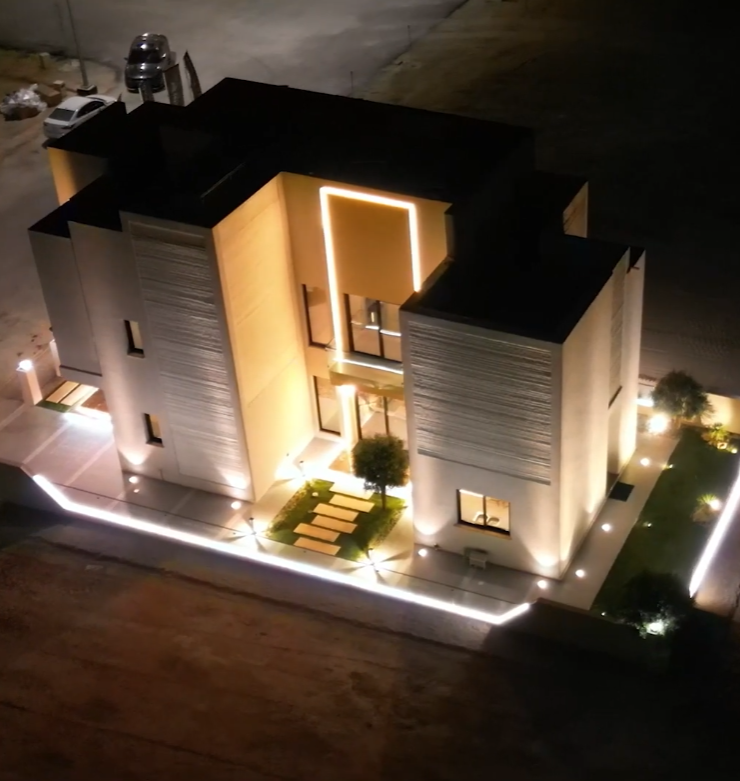
On-site printing reached 9.9 meters, exposing structural and logistical limits of large-scale construction printing
COMMENTS