


The moment a portable speaker stops needing to be set down, its role shifts. It stops being an object you accommodate and becomes an object that rearranges the space around it. That is the central idea Momax built into the Momax 1 Vibe Go: a tiny Bluetooth speaker whose defining feature is magnetic attachment.
This matters now because phones, cases, and daily surfaces have become the natural stages for small accessories. The Momax 1 Vibe Go is not trying to compete with party speakers. The real significance here is not the 3 W rating or the 40 mm driver. What actually determines whether this product matters is how it reduces friction in everyday audio moments by snapping to your phone or sticking to metal surfaces.
What becomes obvious when you look closer is how that single mechanical choice reshapes use cases. It turns background music, short watch sessions, and hands-free calls into frictionless experiences. Instead of finding a place for the speaker, the speaker finds a place on the things you already use.
That shift brings advantages and clear tradeoffs. The device prioritizes convenience and integration over raw acoustic ambition. The rest of this article walks through the design, the acoustic constraints, the wireless behavior, and the real-world tradeoffs you should expect when you choose magnetic mounting as the central feature.
Reading beyond specs matters here. This piece is not a how-to. It is an argument about where small speakers live and why magnetic attachment is a meaningful product decision. Expect comparisons, clarified expectations, and practical scenarios rather than marketing claims.
Design And Magnetic Attachment As A Feature
The Momax 1 Vibe Go is deliberately small. Momax reports dimensions of about 60 mm diameter and 37.3 mm height, with a weight near 86 g. Those numbers place it in the micro speaker category where pocketability, tactile quality, and perceived solidity matter more than large radiating surface area.
Materials are ABS plastic plus aluminum elements. ABS keeps weight down and provides impact resistance. Aluminum elements add structural stiffness and a more premium feel where it counts. The result is a compact cylinder with a fabric-style grille that reads as intentional rather than toy-like.
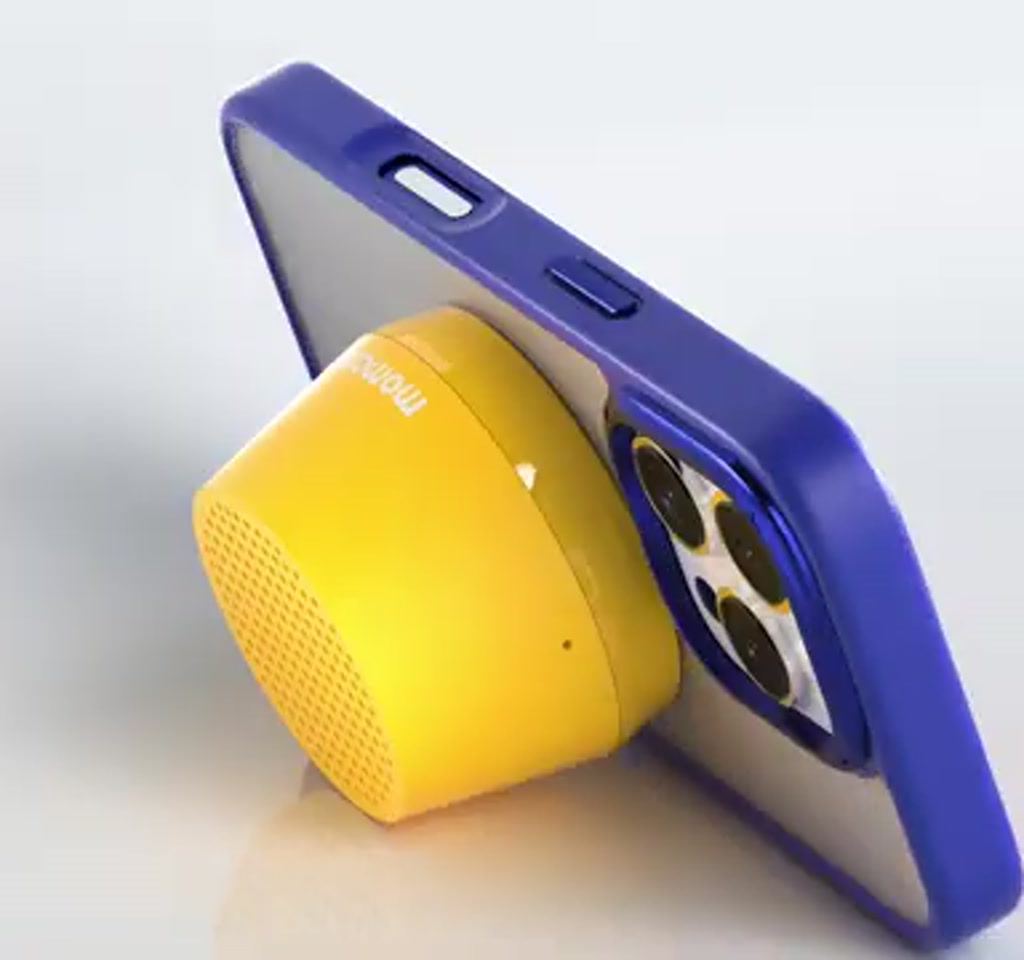
Magnetism is the product pivot. On phones and cases that support magnetic mounting the speaker snaps on, and Momax supplies a magnetic patch plus protective film for cases that lack native support.
The manual describes applying the film, smoothing it, and attaching the magnetic sheet, after which the speaker fastens and releases without clips or straps.
The mounting logic extends beyond phones. Because the unit adheres to ferromagnetic surfaces, it can live on a fridge, a metal shelf in a workshop, or a steel-backed furniture piece. That changes how the device is positioned and how listeners relate to sound. Instead of placing a speaker on a counter and angling it, users can magnetically position the speaker to face them or to couple with a resonant surface that accentuates bass presence.
What The Momax 1 Vibe Go Is
The Momax 1 Vibe Go is a pocketable Bluetooth speaker built around magnetic mounting and designed for near-field listening. It pairs a single 40 mm driver and 3 W RMS output with Bluetooth 5.3, IPX6 splash resistance, and a magnetic patch option so the device can attach to phones and metal surfaces for hands-free use.
How Magnetic Mounting Works And Why It Matters
Magnetic mounting converts surfaces into active acoustic partners. By fastening to phones, cases, or metal objects, the speaker can direct sound more predictably or couple vibrations into larger surfaces for perceived bass reinforcement. That coupling is situational, depending on the surface material, shape, and where the speaker is placed.
Magnetic Patch Compatibility
Momax includes a magnetic patch and protective film for cases without native support. This retrofit enables attachment but introduces tradeoffs, such as potential interference with wireless charging or changes to the case profile. The patch is a pragmatic answer to compatibility, not a universal fix.
Placement And Acoustic Coupling
Where you put the speaker changes what you hear. A steel surface or thick wooden shelf can act as a secondary radiator, increasing perceived low end. On soft or isolated surfaces, the speaker behaves more like a tiny mono unit. Understanding this gives the magnetic approach practical value beyond novelty.
Acoustics And What The Specs Actually Mean
Momax specifies a single 40 mm driver and 3 W RMS output with a frequency response listed as 120 Hz to 20 kHz. Those are not aspirational studio numbers. They are honest physics of small drivers and small enclosures.
In practical terms this means the speaker emphasizes midrange clarity and vocal presence. The 120 Hz lower bound signals that deep sub bass is outside the design intent.
What you get instead is presence, punch above the lowest octaves, and volume that will reliably outpace a phone speaker in a kitchen, bathroom, or small living room.
Placement matters more for small speakers than for larger systems. Attaching the unit to a large solid surface can make the low end feel fuller because the surface couples vibrational energy into a larger radiating area. That is a feature and a constraint. The magnetic mounting adds an acoustic multiplier in some situations but remains bounded by driver excursion and enclosure volume.
Quotable point: The Momax 1 Vibe Go proves that mounting changes how tiny speakers are used; where you put it becomes as important as what it outputs.
Connectivity, TWS, And Practical Limits
Connectivity is Bluetooth 5.3 with a stated effective range up to 10 meters. Bluetooth 5.3 brings connection stability improvements and better energy efficiency compared with older revisions, which is useful in a device where battery and thermal margins are tight. The speaker defaults to Bluetooth mode on power up and reconnects automatically to known devices.
True Wireless Stereo
TWS is supported. Two identical units can be paired into left and right channels for a wider stereo soundstage. The pairing method uses inter-speaker signaling rather than requiring two separate Bluetooth streams from the source device. For small rooms and near field listening, two Momax 1 Vibe Go units will create a more convincing stereo image than a single mono unit can deliver.
Onboard Controls And Calls
Controls are intentionally minimal. A single touch button on the base handles power, play and pause, call answer and hang up, plus long-press functions for power on or off and call rejection. Triple-press clears Bluetooth and TWS settings and returns the unit to pairing. The manual also lists an onboard microphone for hands-free calls.
This one-button approach aligns with the product concept. When the speaker is mounted on the back of a phone or adhered to a shelf, you want predictable, simple controls rather than a cluster of small buttons you cannot reach without unmounting the device.
Battery, Charging And Runtime Realities
Power comes from a 700 mAh battery. Momax lists USB-C charging at 5V 350mA and a charging time up to 3 hours. The product page advertises up to 12 hours of playback, typically measured at moderate listening levels.
There are two clear constraints here. First, the 700 mAh capacity is small, which naturally limits continuous loud playback. Second, the charging input current of 350 mA indicates a relatively slow charge by modern standards. A 700 mAh battery charged at 350 mA, ignoring inefficiencies, suggests a theoretical minimum charge time near two hours. Momax specifying up to 3 hours aligns with typical charging inefficiencies and thermal management behavior.
Runtime claims only hold up under moderate volume and intermittent use. The manual warns that maximum volume reduces working time significantly.
To give quantified context, expect playback to vary from many hours at low to moderate levels down to several hours or less under sustained loud playback. Battery life often becomes the limiting factor long before connection range or driver power.
Ingress Protection And Environmental Use
Momax rates the device IPX6. That means the speaker resists heavy splashes and water spray. The rating is well-suited for kitchen counters, near sinks, bathroom use, or light rain outdoors. It does not mean submersion safe.
The charging port remains a vulnerability during charging, so users should avoid exposing the port to direct water when the unit is connected to power.
IPX6 moves the device from delicate to practical for home life. It is a meaningful upgrade over speakers with no ingress protection, but users should still treat it as water-resistant rather than waterproof.
Where The Tradeoffs Live
The tradeoffs are straightforward and quantifiable. Two specific constraints shape typical ownership scenarios.
- Acoustic constraint: With a 40 mm driver and 3 W RMS output and a lower frequency bound near 120 Hz, deep bass is not the design goal. If heavy bass or large room-filling sound is the aim, costs tend to scale into larger drivers and enclosures rather than clever mounting. In other words, the 1 Vibe Go trades low-frequency extension for a pocketable footprint and mounting versatility.
- Energy and charging constraint: The 700 mAh battery plus a 5 V 350 mA charging input means charging is relatively slow and runtime is strongly volume dependent. The advertised 12-hour runtime is a best-case at moderate volume. At maximum volume, playback time can fall to a fraction of that, so expect real-world behavior to be measured in hours rather than days for continuous use.
There are also behavioral tradeoffs. The magnetic patch solves compatibility for non-magnetic cases, but it requires adding a layer to the case surface. From an editorial standpoint, adding that patch may affect wireless charging and aesthetics on some phones. That is a condition buyers should weigh: either rely on native magnetic support or accept a retrofit that changes the case profile.
Momax 1 Vibe Go Versus Alternatives
Placed against larger portable or party speakers, the Momax 1 Vibe Go clearly sacrifices low-frequency extension and continuous loudness for mobility and attachment versatility. Compared to traditional pocket Bluetooth speakers, its magnetic mounting and included patch offer quicker hands-free placement, but similar acoustic limits. The utility depends on where you want sound to live.
Magnetic Portable Speaker Vs Freestanding Pocket Speaker
Freestanding pocket speakers deliver predictable sound from any surface but require you to find a place for them. The magnetic portable approach turns your phone or nearby metal into a mounting point, reducing setup friction and enabling oriented sound without additional stands or clips.
TWS Stereo Pairing Versus Single Unit Use
Buying a second unit changes the decision calculus. Two units in TWS mode address imaging and width, offering a more convincing stereo field for movies or music. The extra cost and need to manage two small batteries are the tradeoffs to consider.
Best Use Cases And Practical Scenarios
Where this becomes interesting is in the micro moments of daily life. The 1 Vibe Go excels when convenience and integration matter more than outright power.
Suggested practical uses include mounting on a fridge for podcast listening while cooking, snapping it to a phone during a quick video session to boost volume and directionality, sticking it to a metal shelf in a workshop for background music, or bringing a second unit for true stereo in a living room for movies and casual listening.
The device is naturally suited to near-field listening. It is also useful as a phone stand for vertical content and hands-free calls. The IPX6 rating helps it survive incidental moisture typical in kitchens and bathrooms, which broadens where you can comfortably place it.
Adoption Friction And Practical Considerations
Adoption friction centers on a few predictable points. First, if a user dislikes modifying their case with a patch or film, they lose the signature magnetic convenience.
Second, small speakers like this are highly placement sensitive; performance varies depending on the surface to which they are attached.
Third, while Bluetooth 5.3 improves stability, real-world range will be influenced by obstacles and wireless congestion, so the 10 meter figure is a practical boundary not a guaranteed performance number.
Maintenance and reliability questions also arise. With small batteries, capacity degradation over many cycles becomes the visible long-term limitation. Because the battery is small, each cycle has proportionally larger impact on overall run time compared with larger battery devices. That is a boundary buyers should expect: battery longevity and thermal management will define meaningful lifespan in practical terms.
Broader Meaning And Industry Context
Magnetic mounting as a product hinge is part of a broader trend in mobile accessories toward integration and friction elimination. Cases, mounts, chargers and small peripherals are converging around the idea that accessories should adapt to existing consumer surfaces instead of requiring users to make space for them.
From a design perspective, Momax is trading acoustic ambition for use density. The company appears to have prioritized making a speaker that lives on other objects rather than designing a freestanding acoustic solution. That is a thoughtful tradeoff and it signals how product design can open new behavior patterns even when raw specs look modest.
Where This Product May Not Fit
If you want to fill a large room with bass, expect limits. The combination of a single 40 mm driver, 3 W output, and enclosure volume means the speaker will not deliver the low-frequency energy or loud continuous SPL needed for parties or large gatherings.
Also, if you will not or cannot use the magnetic attachment because of a particular case or because you refuse to add a patch, then much of the product value is muted. The 1 Vibe Go is a device that earns its keep through attachment versatility. Without that, it becomes one of many small Bluetooth speakers competing on size alone.
Who This Is For And Who This Is Not For
Who This Is For: People who value convenience, hands-free placement, and near-field listening in kitchens, bathrooms, workshops, or on the move. Those who enjoy quick, oriented sound from their phone or who want a compact, splash-resistant speaker that can live on a surface.
Who This Is Not For: Listeners seeking deep bass, high continuous output for large rooms, long uninterrupted playback at very loud volumes, or those who will not modify their phone case with a patch or film. If party-level sound and low-frequency extension are priorities, larger speakers are a better fit.
Final Thought And Looking Forward
The Momax 1 Vibe Go reframes portability by turning surfaces into speaker real estate. It demonstrates that convenience can be the product differentiator rather than headline specs.
The constraints are clear: limited bass, modest continuous power, and battery and charging boundaries. Those are not flaws. They are the defining boundaries that make the magnetic idea valuable.
What remains interesting is how consumers adopt this pattern. If magnetic micro speakers become standard kitchen, bathroom, and pocket accessories, designers will start optimizing surfaces and cases for better acoustic coupling. That future would change how small audio devices are designed, bought, and used.
For now, the Momax 1 Vibe Go stands as a practical experiment in reducing the friction between sound and place, and that idea is worth watching as it ripples through accessory design.
FAQ
What Is The Battery Capacity And Charging Time?
The speaker uses a 700 mAh battery with USB-C charging at 5 V 350 mA. Momax lists charging time up to 3 hours and a claimed playback time up to 12 hours at moderate volume, though real-world runtime depends strongly on listening level.
How Does Magnetic Mounting Affect Sound?
Magnetic mounting can change perceived bass and directionality by coupling the speaker to larger surfaces. When attached to rigid metal or wood, surfaces can act as secondary radiators and make the low end feel fuller. Results vary by surface and placement.
Is The Momax 1 Vibe Go Waterproof?
The device is rated IPX6 for splash and heavy spray resistance, which suits kitchens, bathrooms, and light rain. It is not rated for submersion, and users should avoid exposing the charging port to water while charging.
Can Two Units Be Used For Stereo?
Yes. TWS pairing lets two identical units form left and right channels for a wider stereo image. Pairing uses inter-speaker signaling so the source device treats the pair as a single stream in stereo mode.
Will The Magnetic Patch Affect Wireless Charging?
The magnetic patch is a retrofit for non-magnetic cases and may affect wireless charging or change case thickness. The manual suggests the patch as a compatibility option, but buyers who rely on wireless charging should test the combination before committing.
What Kind Of Listener Should Buy This Speaker?
Buyers who want a convenient magnetic portable speaker for near field listening, hands-free calls, and quick mounting on phones or metal surfaces will get the most value. Those prioritizing room-filling bass or long loud playback should consider larger alternatives.
How Far Is The Bluetooth Range?
Momax states an effective Bluetooth range up to 10 meters. Real-world range will be affected by obstacles, interference, and placement, so treat 10 meters as a practical boundary rather than a guaranteed constant.
Disclaimer: Some links in this article are affiliate links, meaning we may earn a commission if you make a purchase.
COMMENTS