


Pocket Audio HiChord arrives with a simple idea and a stubborn insistence on doing one thing well: make harmony immediate. If songwriting often stalls when you hit the keyboard and search for the right voicing, HiChord flips that workflow. Seven buttons map to the seven diatonic chords of the current key, and a joystick reshapes those chords in real time so you can perform harmony the way you play rhythm.
The real significance here is not that the device is another small synth. What actually determines whether HiChord matters is how quickly it converts an idea into a playable progression and how reliably that mapping survives transposition.
Because the chord layout follows the Nashville number concept, muscle memory carries across keys. That transforms the act of songwriting from a note search into an immediate, repeatable gesture.
What most people misunderstand at first glance is the scope. HiChord is not positioned as a deep synthesis workstation. It is a chord-focused instrument that contains a synth engine, drums, and looping so you can sketch ideas end to end. From a user perspective the promise is clarity and speed, not exhaustive sound design.
From an editorial standpoint, the device is interesting because it reframes the interface problem. Instead of asking players to adapt to a keyboard, it adapts harmony to the player.
The moment this approach becomes compelling is when you want to capture a progression on the go, or when a live set needs compact chordal textures that are easy to trigger and reshape.
What Pocket Audio HiChord Is
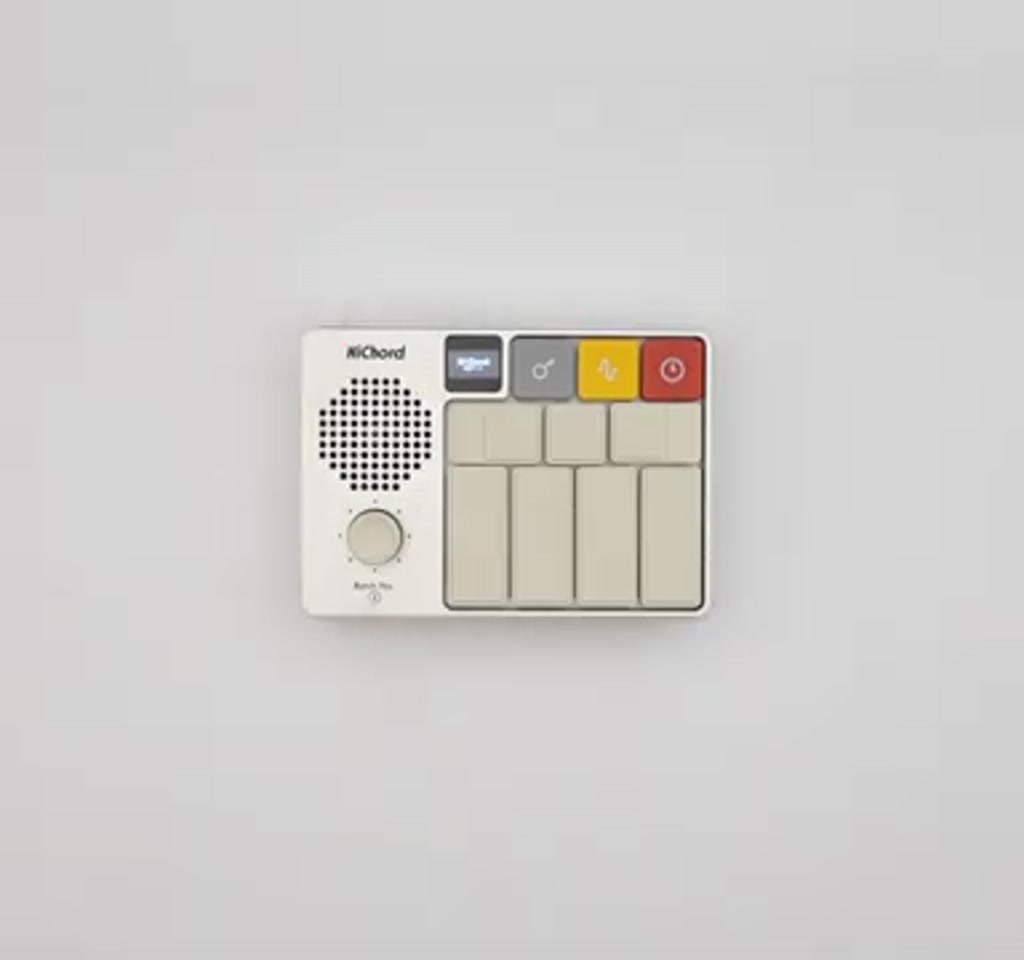
Pocket Audio HiChord is a compact harmonic controller that maps seven buttons to diatonic chords and uses a joystick to modify voicings in real time. It combines synth engines, drums, arpeggios, looping, and USB-C MIDI connectivity into a pocketable form factor focused on fast idea capture and gesture-driven performance.
How HiChord Works
Seven buttons correspond to scale degrees I through VII in the selected major key. Pressing a button triggers a complete chord voicing while the joystick lets you invert, convert major to minor, add sevenths, introduce sus voicings, or push into extended colors like ninths. The design preserves relative harmonic relationships when you transpose.
Chord Mapping And Transposition
The diatonic layout follows a number-based harmonic interface so muscle memory moves across keys. Learning a chord pattern in C translates directly to G or E without retraining, which accelerates live performance and on-the-fly songwriting where transposition is frequent.
Sound Architecture And Specs
HiChord is built from multiple digital sound sources: a twelve oscillator approach, FM synthesis, 16-bit samples, and hybrid presets. It runs at a 48 kHz sampling rate and supports up to eight oscillators of polyphony in many combinations, favoring variety for sketching over boutique analog character.
Effects And Output
Effects include reverb, delay, flanger, tremolo, a lowpass filter, LFO modulation, glide, and bass boost. A built-in speaker and these effects serve portability, while stereo 3.5 mm output and USB-C for power and MIDI out provide studio integration when fidelity or multi-track routing is required.
Performance Features
Arpeggio mode, quantized finger drumming, and loop controls let a single user sketch full arrangements. Looping is intentionally minimal: press the joystick to record, press again to stop and play, press once more to clear. That simplicity encourages capture over endless on-device editing.
Benefits And Creative Value
HiChord makes harmony immediate, lowering the friction between idea and audible result. It converts harmonic decisions into repeatable gestures, speeds transposition, and encourages rapid iteration. For songwriters and performers who prize speed over total sonic control, that immediacy is the primary value.
Ideation And Live Use
Because the joystick turns chord quality into a continuous parameter, you can create motion inside a repeating progression without changing hand position. That performative flexibility is useful for live sets, sketching hooks, or building evolving beds that remain compact and easy to manage on stage.
Constraints And Tradeoffs
No creative tool is cost-free. HiChord’s design choices concentrate power into a narrow, fast workflow, which creates clear boundaries: limited polyphony, compact speaker fidelity, a diatonic harmonic scope, and an all-random mode that can unpredictably alter your sketch.
Polyphony And Voice Allocation
Supporting up to eight oscillators of polyphony is generous for small sketches but sets a ceiling. Layered arpeggios, long reverb tails, and dense hybrid presets will compete for voices, so expect to design arrangements around a few strong layers rather than dozens of simultaneous parts.
Onboard Speaker And Fidelity
The built-in speaker and effects are optimized for portability and presence rather than full-range clarity. For critical listening or large venues route audio through the stereo output. Power comes via USB-C at 5 V DC, so phone chargers and battery packs will run the unit for short sessions but plan external power for extended use.
Harmonic Scope And Chromatic Needs
HiChord privileges diatonic harmony. For music that relies on chromaticism, heavy modal interchange, or frequent borrowed chords you will need joystick modifiers or external MIDI control. In those workflows HiChord functions best as a harmonic controller rather than an all-in-one compositional engine.
HiChord Vs Alternatives
HiChord is not trying to be a keyboard replacement or a full synth workstation. Compared to traditional MIDI keyboards it sacrifices single note control and open voicing for immediate chord performance.
Compared to grid controllers it prioritizes harmonic relationships over pad based sequencing, making it a distinct option for chord-centric workflows.
HiChord Compared To Keyboards
Where keyboards emphasize note-level expression and wide voicing choices, HiChord emphasizes relative harmony and gesture. A keyboard gives absolute pitches and detailed voicing control; HiChord gives repeatable harmonic patterns and fast transposition without note hunting.
HiChord Compared To Grid Controllers
Grid controllers excel at clip launching and step sequencing. HiChord trades grid flexibility for an interface that maps diatonic harmony to single buttons and a joystick. If your priority is chordal songwriting and live harmonic motion, HiChord occupies a tighter, more focused niche.
Integration And Workflow Patterns
Use HiChord for rapid idea capture, then export or route MIDI to a DAW or external synth for detailed arrangement and mixing.
The device is most valuable when treated as a harmonic seed that can be refined later in a larger production environment rather than as the final sound source for polished tracks.
Practical Studio Integration
USB-C MIDI out enables HiChord to control external instruments, making it a useful harmonic controller for producers. Firmware updates are supported, which allows the instrument to evolve with additional features or stability improvements over time.
Who This Is For And Who This Is Not For
Who This Is For: Beginners who want to sound musical with minimal theory, songwriters who need a travel sketchpad for chord beds and hooks, performers seeking compact chord textures for live sets, and producers who want a fast harmonic controller for external synths via USB-C MIDI.
Who This Is Not For: Musicians who need exhaustive synthesis depth, arrangers who build extremely dense, highly stacked pads or orchestral textures on device, and composers who rely on constant chromatic modulation without external MIDI routing or joystick modifiers.
Open Questions And Future Implications
One unresolved practical question is how users will balance on-device sketching with studio refinement. The device invites quick captures, but the workflow payoff appears when users adopt HiChord as the harmonic seed for deeper production using DAWs or external rigs.
Look ahead and the most interesting possibility is how a simple interface can influence songwriting practice.
HiChord suggests harmonies can be gamified into gestures, reducing cognitive load and potentially increasing idea throughput. Whether that changes long-term compositional habits remains to be seen.
FAQ
What Is Pocket Audio HiChord?
HiChord is a compact chord-focused instrument that maps seven diatonic buttons to scale degrees and uses a joystick for real-time chord modification. It includes synth engines, drums, arpeggios, looping, and USB-C connectivity for MIDI and power.
How Does The Joystick Change Chords?
The joystick acts as a modifiers layer. While holding a chord button you can invert voicings, change major to minor, add sevenths, introduce sus voicings, or access extended colors. It makes harmonic change continuous and performative rather than menu-driven.
Does HiChord Support MIDI And Studio Integration?
Yes. HiChord provides USB-C for power and MIDI out, and a stereo 3.5 mm audio output for routing to monitors or mixers. Firmware updates are supported to evolve integration and features.
What Are The Main Limitations Of HiChord?
Main constraints are limited polyphony (up to eight oscillators), a speaker optimized for portability rather than full fidelity, and a diatonic interface that favors relative harmony over highly chromatic workflows.
Is HiChord Suitable For Live Performance?
Yes. Its immediate chord mapping and joystick-driven modulation are suited to compact live setups where easy triggering and harmonic motion are more important than exhaustive sound design. For larger venues, routing to external PA systems is recommended for best fidelity.
Can HiChord Replace A Keyboard Or Full Synth?
Not entirely. HiChord reframes harmony into gestures and accelerates songwriting, but it is not a deep synthesis workstation. It works best as a creative accelerator or harmonic controller within a broader production system.
How Portable Is The Device And What Are The Power Requirements?
Pocket Audio lists dimensions of 160 mm by 90 mm by 30 mm and a weight near 250 g, placing it in a pocket-friendly bracket. It uses USB-C at 5 V DC for power, and typical phone chargers or battery packs will run it for short sessions.
Can The Randomizer Replace Intentional Songwriting?
No. The randomizer is a creativity tool that can change key, tempo, and patterns to nudge ideas out of ruts. It is best used as a spark rather than a staging tool for finalized parts, since its unpredictability can interfere with recall.
COMMENTS