


The real significance of Twopan T01 is not simply that it advertises roughly 1 gigabyte per second speeds. The part that changes how the device should be understood is that it combines sustained throughput, MagSafe-style mounting, and pass-through charging into a pocket-sized package designed specifically to fit on the back of a phone.
This matters now because modern iPhones can record high-bitrate ProRes video directly to external storage, and the friction of cables, adapters, and limited internal space has been a practical barrier for creators shooting long takes, events, or travel footage.
The T01 aims to make that barrier mostly disappear, while introducing new tradeoffs you need to measure against your workflow.
What most people misunderstand at first glance is that the core value is workflow continuity rather than raw cost per terabyte. The T01 is a purpose-built accessory for phone-first capture.
If your priority is pure dollars per gig, generic portable SSDs will hold an edge. If your priority is the least friction between phone and storage while keeping near 1 gigabyte per second performance, this form factor is where the argument becomes compelling.
Throughout this piece the editorial claim is simple: the T01 converts several common limits of phone-based capture into manageable, quantified constraints, and those constraints determine whether it is a practical tool for your shoots.
Design And Mounting That Prioritizes Phones
MagSafe Compatibility And Back Mount Use
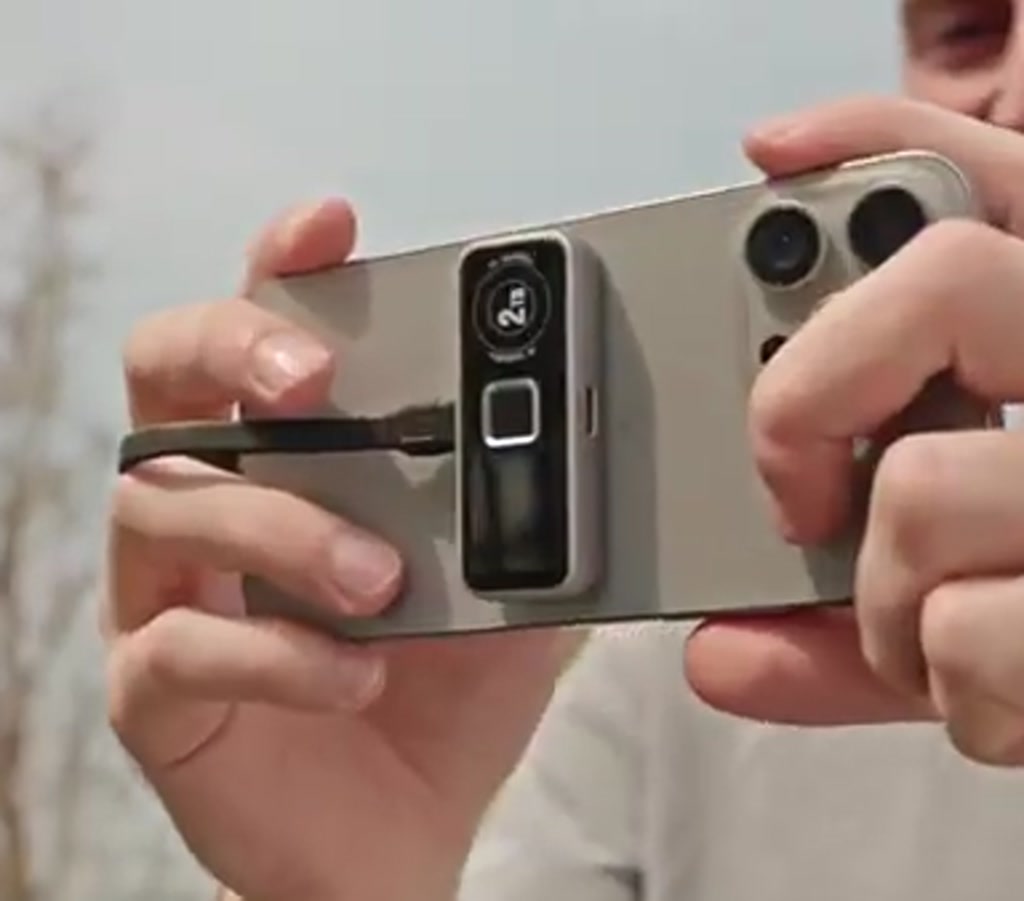
Twopan positions the T01 as MagSafe compatible so it can snap onto the rear magnetic ring of MagSafe iPhones, or onto a magnetic ring accessory on other phones. There are two practical connection styles. You can plug the drive straight into a device’s USB-C port for the most compact rig, or keep it magnetically attached and run a short USB-C cable for better clearance and handling.
AppleInsider notes the boxed kit includes two short J-shaped cables designed for back-mounted attachment. That back-mount approach keeps the SSD physically integrated while avoiding awkward port angles when the phone is in use.
Size, Weight, And The Visible UI
The T01 is built like a phone accessory, not a desktop brick. Twopan lists dimensions of about 2.5 by 1.3 by 0.5 inches and a weight of about 0.82 ounces. Those numbers place it in the same pocketable league as battery packs and camera attachments, which is the point: it can live on a phone without feeling like a burden.
The front includes a small LCD status display that reports storage usage and power status in real time. That is useful for confirming remaining space before a long take, though AppleInsider warns the display and lights can be bright in dark shooting situations. What becomes obvious when you look closer is that a status panel trades subtlety for certainty: you get immediate feedback at the cost of potential distraction in low light.
How External ProRes Recording Works With iPhone
Recording ProRes to external storage requires three things to align: an iPhone and app that support external recording, a host interface that supplies sufficient USB bandwidth, and a storage device that can sustain high write rates. When those conditions are met, external recording removes internal storage as the limiting factor for long takes.
Performance And Thermal Management
Advertised Speeds And Host Limits
Twopan advertises speeds around 1000 megabytes per second. Retail listings and reporting show maximum read speed near 990 megabytes per second and maximum write near 960 megabytes per second for the 1TB model. AppleInsider reports the drive met marketed speeds in their tests.
Those numbers map to common 10-gigabit USB connections, where real-world throughput often tops out close to the 1-gigabit-per-second range after protocol overhead. The practical translation is simple: with a suitable host port and cable you will typically see fast offloads and enough bandwidth for external recording workflows, but only if the host actually provides the required link speed.
Cooling Fan And Sustained Writes
Tiny high-speed SSDs generate heat under continuous write loads, and the T01 includes a small built-in cooling fan to reduce thermal throttling risk. AppleInsider reports the fan was not audible in their testing, which matters for quiet shoots.
The tradeoff here is clear. The fan helps maintain predictable performance during long sessions, but sustained throughput still depends on the host, file sizes, and the drive controller. In other words, thermal mitigation raises the threshold where performance becomes fragile, but it does not remove all conditions that can cause throttling.
Power, Ports, And Practical Constraints
Pass Through Charging Versus Data
The T01 adds a second USB-C port for pass-through charging, which addresses the single-port problem on most phones. Twopan states support for PD 3.0 charging on that extra port, and reporting indicates the pass-through charging tops out at about 27 watts.
A concrete constraint follows: the second port is optimized for charging, not high-speed peripherals. AppleInsider reports that data pass-through on the extra port is limited to USB 2.0 speeds. In practical numbers, that means data pass-through is limited to roughly 480 megabits per second, which is far slower than the drive itself and not suitable for chaining high-bandwidth devices.
Bus Power, Host Behavior, And Session Duration
The drive is primarily bus-powered from the host, and the availability of pass-through charging reduces a key friction when recording for extended periods. That said, PD 3.0 at 27 watts is a conditional fix. It will extend many phone sessions, but it is not the same power envelope as higher wattage chargers used for laptops or larger devices.
The practical implication is that charging will often be adequate for long phone shoots, but actual session length depends on capture settings and host behavior. The energy tradeoff becomes noticeable over hours rather than minutes, and creators should treat the pass-through port as a helpful extender rather than an unlimited power source.
Workflow Fit, Capacity Choices, And Economics
Choosing Between 1TB And 2TB
Both capacities share the same mechanical design and features. The decision is a question of capture volume and offload cadence. 1TB is sensible for creators who offload frequently and want room for ProRes headroom on trips. 2TB is aimed at heavy shooting days, events, or long trips where you want to avoid interruptions waiting to offload.
To put it in context, capture codecs like ProRes can consume tens to hundreds of gigabytes per hour depending on frame rate and codec variant. That variability means capacity is not a purely technical choice but a workflow planning variable: how often do you want to stop and offload?
Price, Value, And What You Pay For
Compared with generic portable SSDs you are paying extra for the magnetic form factor, the integrated fan, and the display. The tradeoff appears when you compare pure cost per terabyte with workflow friction. For users who prioritize lowest cost per gigabyte, standard portable SSDs typically win because their prices tend to scale into the hundreds rather than the tens of dollars per unit for similar capacities.
If your priority is minimizing interruption, avoiding adapters, and keeping a phone attached cleanly while recording, the premium buys time and convenience – and that convenience is the point where the T01 becomes interesting.
Compatibility, Packaging, And Practical Notes
Twopan lists compatibility with iOS, iPadOS, Mac, and Android, because the drive is a USB-C device. For iPhone external recording you still need a phone that supports recording to external storage and a host interface that meets speed and power requirements. The compatibility box is not automatic; the host operating system and app support remain prerequisites.
Contents vary by seller, but reporting indicates the kit often includes a USB-C to USB-C cable, a pouch, and short J-shaped cables that support the back mount method. Having a short dependable cable is important because direct plug mode can be awkward in some setups due to port orientation.
Two Concrete Constraints To Keep In Mind
First, to approach the listed maximum speeds, you need a host port and cable that provides high-speed USB, typically a 10-gigabit-class connection. Without that, real-world throughput will be lower and the drive will not deliver its advertised 960 to 990 megabytes per second numbers.
Second, the extra USB-C port supports PD 3.0 charging up to roughly 27 watts while data pass-through is limited to USB 2.0 speeds, about 480 megabits per second. That makes the port excellent for powering a phone during long takes but unsuitable as a high-speed expansion hub for additional storage or high-bandwidth accessories.
Quotable insight: The real value of the Twopan T01 is not raw peak numbers but the way it reduces friction between a phone and sustained external recording, turning a mobile handset into a more continuous, confident capture tool.
When you measure tradeoffs and conveniences together, the T01 reads like a focused tool rather than a universal replacement for desktop drives. It is a conditional accelerator of phone-first workflows that shifts the practical boundary between handheld capture and production-level continuity.
As phones take on more professional capture responsibilities, expect more accessories that prioritize integration and predictable performance. The market lesson is clear: convenience that preserves bandwidth and power will be the primary differentiator, and products that successfully manage those constraints will define the next layer of mobile production gear.
Twopan T01 Vs Generic Portable SSDs
The comparison is straightforward: generic portable SSDs tend to offer lower cost per terabyte and often comparable peak numbers, but they do not solve the phone integration problem. The T01 sells convenience, magnetic mounting, and a thermal plan that make uninterrupted phone recording more realistic.
Cost Per Terabyte Versus Workflow Friction
If your priority is the absolute lowest cost for storage capacity, generic SSDs generally win. If you value keeping a phone attached, avoiding adapters, and seeing drive status without digging into a settings menu, the T01 charges a premium for those conveniences.
Performance In Real-World Uses
Peak read and write numbers are one axis, sustained behavior under continuous write loads is another. The integrated fan and the form factor of the T01 are designed to reduce disruptions specific to phone-first capture, which some generic SSDs do not address.
T01 Compared To Other Phone-Mounted Recording Accessories
There are various attachments and hubs that route power, audio, and storage to phones. What sets the T01 apart in practical terms is that it packages high sustained throughput, MagSafe-style mounting, and pass-through charging in one pocketable unit. That combination reduces the number of separate accessories you need to manage on set.
Who This Is For And Who This Is Not For
Who This Is For: Creators who shoot long takes or high bitrate ProRes on iPhone, need minimal interruption, and prefer a single compact accessory that mounts to the phone and shows status at a glance. It suits vloggers, event shooters, and travel shooters who prioritize continuity over absolute lowest cost.
Who This Is Not For: Users whose primary concern is lowest price per terabyte, those who already have robust offload workflows and do not mind adapters, or anyone who must chain multiple high-bandwidth peripherals through a single pass-through port. Also, avoid if your workflow requires laptop-class power delivery beyond the reported 27-watt pass-through ceiling.
FAQ
What Is The Twopan T01?
The Twopan T01 is a pocket-sized external SSD designed to mount to the back of phones via MagSafe-style magnets or connect directly by USB-C. It adds a small LCD, an internal cooling fan, and a second USB-C port for pass-through charging.
How Fast Is The Twopan T01?
Retail listings and reporting show read speeds near 990 megabytes per second and write speeds near 960 megabytes per second for the 1TB model. Real-world throughput depends on host port, cable, and protocol overhead.
Can iPhones Record ProRes Directly To The T01?
Yes when the iPhone and recording app support external storage and the host interface supplies sufficient bandwidth. Modern iPhones can record ProRes to external devices, but device and app compatibility are prerequisites.
Does The T01 Provide Charging While Recording?
Yes. The extra USB-C port supports PD 3.0 pass-through charging, reported at roughly 27 watts. That helps extend sessions but is not equivalent to higher-wattage laptop chargers.
Is Data Pass Through Full Speed On The Extra Port?
No. Reporting indicates data pass through on the extra port is limited to USB 2.0 speeds, roughly 480 megabits per second, making it unsuitable for chaining high-bandwidth accessories.
Will The Built In Fan Prevent Throttling?
The fan reduces thermal stress and helps sustain performance, but it does not guarantee immunity from throttling. Sustained write behavior still depends on host speed, file sizes, and the drive controller.
Should I Buy The 1TB Or The 2TB Model?
Choose 1TB if you offload frequently and want lighter cost exposure. Choose 2TB for heavy shooting days, events, or trips where minimizing offload interruptions matters. The right choice depends on your capture rate and how often you can offload.
Disclaimer: Some links in this article are affiliate links, meaning we may earn a commission if you make a purchase.
COMMENTS