


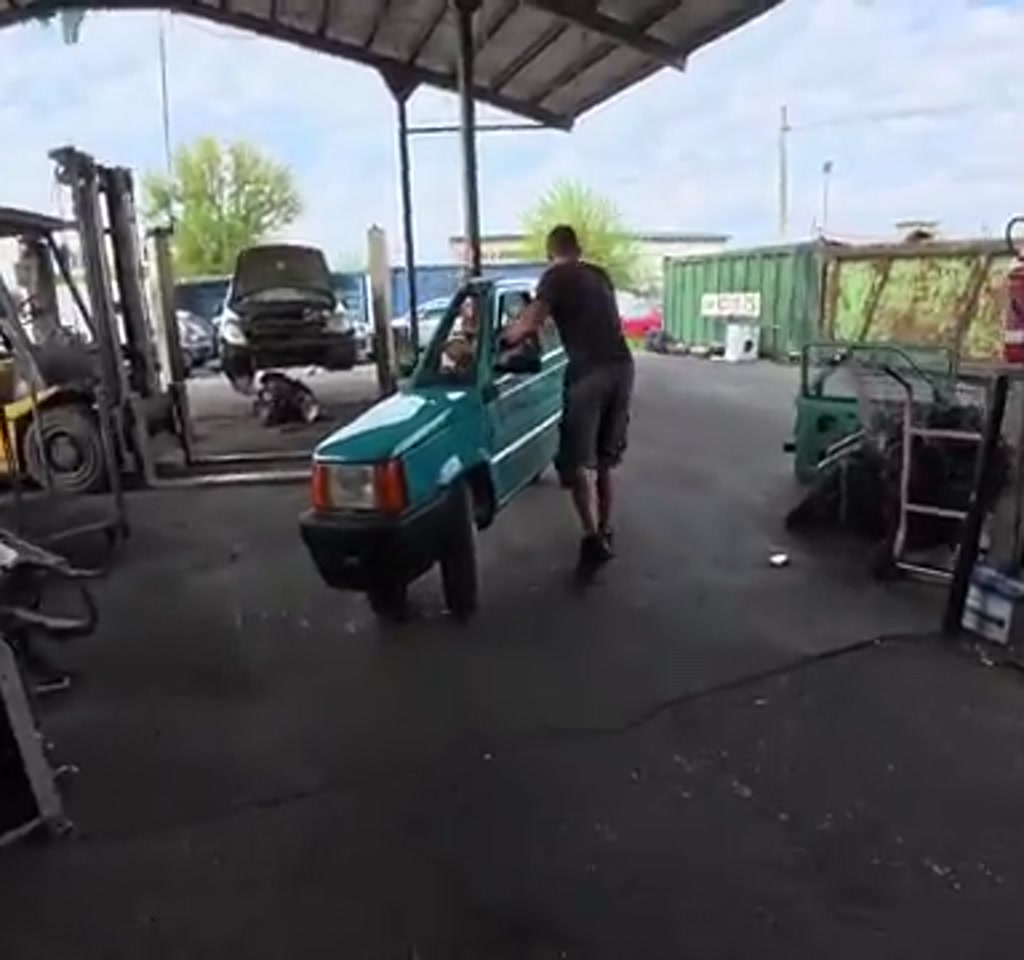
The World’s Narrowest Car arrives as a visual joke with forensic intent. At a glance it looks like a normal car sawed in half, then squeezed until only a single person can sit along the centerline. That absurd image is precisely why it matters now: it makes a blunt question unavoidable, which is how much of a car is actually essential in an era when urban space is the scarce resource.
The real significance here is not novelty for novelty sakes. What the project reveals is a set of hard tradeoffs that are usually hidden inside mass-produced vehicles: width, stability, and the cost of keeping a machine safe while stripping everything else away. Most people expect the answer to be purely theatrical, but the car’s functioning electric drivetrain and redistributed batteries show the idea can operate within real physical limits.
What most observers misunderstand is that this is not a design stunt that defies physics. It is an experiment in constraint. The build intentionally sacrifices acceleration, top speed, and passenger capacity to explore how small a four-wheeled vehicle can be while still behaving like a car. By making those tradeoffs explicit, the machine becomes a valuable test case for urban mobility thinking and for designers who want to prioritize footprint over comfort.
From an editorial standpoint, the lesson is less about whether anyone should drive one and more about how the gesture reframes priorities. The vehicle converts engineering choices into legible, even comic, form. The questions that follow are practical: what keeps it upright, how is weight balanced, and what is lost when a car becomes a vertical slice of itself. Those technical answers are where this experiment stops being a joke and starts being instructive.
How The Narrowest Car Was Built
Start to finish the project was a study in subtraction and compensation. A Fiat donor provided the chassis and basic geometry, then builders removed large lateral sections and replaced lost structural function with custom bracing. That sequence turned an aesthetic provocation into a vehicle that can be driven, at least within the tight operational limits it exposes.
The build required reimagining floor pans, mounts, and crash paths. Removing sheet metal is only the start; torsional rigidity must be restored with careful cross members and reinforced mounting points. Those added elements are the unseen scaffolding that makes steering, braking, and suspension behave predictably instead of catastrophically.
Cutting And Reinforcing A Fiat
Cutting width out of a unibody car destroys lateral stiffness, so the team concentrated on restoring that stiffness through bracing, redesigned cross members, and welded reinforcements. Those interventions are not cosmetic. They change where loads flow through the chassis and how crash energy would be managed in any impact scenario.
Electric Drivetrain Choices
The conversion favored electric propulsion for packaging freedom and controllable low-speed torque. Instead of one large battery, multiple modules were distributed fore and aft to keep the center of mass near the geometric center. That distribution mitigates roll risk and helps the narrow track behave more predictably at urban speeds.
The Engineering Tradeoffs
Every specification on this car is a constrained decision. The design deliberately exchanges high speed and passenger capacity for lateral compactness and readable engineering. The practical payoff is a machine that exposes what engineers sacrifice when footprint becomes the priority.
Narrow track width reduces the lever arm resisting roll, so the builders countered with a lower center of gravity and conservative speed limits. In practice that means mass concentrated low and centered and top speeds limited to urban demonstration ranges rather than highway use.
Stability Versus Footprint
Stability is the primary limiting factor. With a narrow stance the margin against roll shrinks fast, forcing designers to limit speed and keep weight centered. The narrower the track becomes, the more restrictive the allowable speed must be to maintain safe roll margins, which changes where the vehicle is useful.
Power And Speed Limits
Motor sizing favors smooth delivery over peak power because rapid torque spikes would create unacceptable instability. The result is modest acceleration and intentionally limited top speed, optimized for slow urban corridors and short demonstration runs rather than performance or long-distance travel.
Concrete Constraints And Costs
Two constraints dominate replication. Structural reinforcement is essential and costly because fabrication and custom bracing replace factory load paths. Operationally, narrow vehicles are limited to low speeds and short durations because sustained high-speed operation increases the risk of roll and unpredictable behavior.
Those engineering consequences are visible in component choices: smaller brakes for low vehicle mass, suspension tuned for predictability, and bespoke panels and mounts that complicate maintenance. These are practical barriers to scaling the idea beyond showpiece projects.
Maintenance And Reliability
Custom mounts, unique bodywork, and bespoke wiring mean parts are not readily available off the shelf. Repairs require specialist skills and longer turnaround times, which raises operating costs and makes wider adoption less attractive for fleet or public use without standardization.
Legal And Regulatory Considerations
Classification is unclear: the vehicle sits between motorcycle and car in footprint and behavior, which raises questions about crash safety standards, licensing, and where it is allowed to operate. These legal uncertainties are part of the cost of turning an experiment into everyday mobility.
Why The Idea Matters To Cities
The narrowest car reframes a simple arithmetic problem for planners: space per vehicle has grown as cars got wider, so what if a fraction of that width were reclaimed for people or infrastructure? The project is extreme, but it forces practical discussions about lanes, curbspace, and the tradeoffs of micro vehicles.
Narrow vehicles would demand new parking modules, different curb cuts, and revised lane markings, and they would force officials to revisit assumptions baked into street design. Even if this build remains an outlier, its existence nudges policy conversations in useful directions.
Policy And Infrastructure Implications
If narrower personal vehicles were considered at scale, cities would need updated parking geometry, protected micro lanes, and new safety rules. Those infrastructure changes are not trivial, but they are precisely the levers urban designers can use to allocate scarce street space differently.
Urban Design Opportunities
Reducing footprint creates opportunities to reallocate curbs for bike lanes, wider sidewalks, or public space. The narrowest car is less a blueprint and more a prompt: it shows which technical and policy problems must be solved before micron vehicles can meaningfully reshape streets.
Cultural And Design Significance
Public reaction mixes laughter and curiosity because the car performs a cultural trick: it makes invisible engineering tradeoffs visible. Where many cars hide compromises behind trim and numbers, this build lays them bare so they can be discussed openly by designers, students, and officials.
The vehicle reads as critique and playful minimalism at once. It asks whether bigger is always better and invites debate about priorities for future mobility—safety, comfort, footprint, or serviceability. That debate is the design value the project delivers.
Craft And Readability
The interior is intentionally spare and utilitarian. Visible welds, reinforcements, and minimal controls tell a clear story about decisions to remove or add value. As a teaching object it excels because its tradeoffs are legible rather than hidden.
World’s Narrowest Car Vs Standard City Car
Compared to a typical small city car, the World’s Narrowest Car sacrifices passenger capacity and speed for footprint reduction and legibility. Standard city cars prioritize crash structures, comfort, and higher speed capability. The narrow build prioritizes footprint and demonstration power, which changes where and how it can be used.
For decision makers the comparison is practical: which lanes will the vehicle use, who will maintain it, and what safety margin is acceptable in exchange for reclaimed curb or lane space. Those are policy choices as much as engineering ones.
Who This Is For And Who This Is Not For
Who This Is For: Designers, students, urban planners, and mobility thinkers who want a legible example of tradeoffs between footprint, stability, and cost. The project is a teaching object and a policy prompt rather than a consumer product.
Who This Is Not For: Regular drivers seeking a practical daily vehicle, people who need highway capability, or agencies unwilling to accept the higher maintenance and regulatory complexity that bespoke narrow vehicles demand.
Where The Idea Could Go Next
The experiment is unlikely to become mass-produced in its present form, but the ideas it makes visible could migrate into mainstream thinking. If narrower personal vehicles are to scale, standardization of structural modules, battery packs, and legal categories are the likely routes to lower cost and higher reliability.
Which of these changes will happen first is an open question: should industry solve fabrication cost with new materials or should policy create niche lanes to make narrow vehicles safer? That tension between engineering and policy remains central to the idea’s future.
FAQ
What Is The World’s Narrowest Car?
The World’s Narrowest Car is a Fiat-based conversion cut down to a single central seat and reinforced with custom bracing. It is a demonstrator that exposes tradeoffs in width, stability, and cost rather than a mass market vehicle.
How Was The Fiat Converted To A Narrow Vehicle?
The conversion involved cutting lateral sections from a Fiat unibody, then restoring torsional rigidity with welded cross members and bracing. An electric drivetrain and distributed battery modules were used to keep the center of mass centered and low.
Is The Narrow Car Street Legal?
Street legality depends on jurisdiction and classification. The project raises classification and crash safety questions that regulators would need to resolve before broad legal acceptance. The article does not claim regulatory approval for any location.
Can Narrow Cars Be Safer Than Motorcycles?
They can offer more enclosure and predictable steering than motorcycles, but narrow track width reduces roll margin compared to most cars. Safety depends on low-speed operation, chassis reinforcement, and regulatory rules governing use.
Does The Narrow Design Reduce Cost?
Not necessarily. Structural reinforcement and bespoke parts often increase fabrication and maintenance costs. Cost reductions would likely require standardized modules and broader production rather than one-off builds.
What Are The Main Engineering Challenges?
Primary challenges are restoring torsional rigidity after width removal, managing center of mass to control roll, and designing predictable suspension and braking for a narrow track. These challenges dictate speed and operational limits.
Is This A Practical Solution For Urban Mobility?
As presented, the project is a provocation and teaching object more than a practical near-term solution. Its value lies in exposing tradeoffs that policy makers and designers must address if micro vehicles are to become practical.
How Could The Idea Be Scaled?
Scaling would require low-cost structural solutions, standardized battery and motor modules, and regulatory frameworks that accept narrower footprints while ensuring occupant and pedestrian safety. Which of these will emerge first is uncertain.
COMMENTS