


The Samsung Galaxy Z Tri Fold arrives with a single, disorienting promise: a tablet-sized display that collapses into something you could plausibly carry like a phone. That promise is not modest. It asks the same question every bolder form factor has asked in the last few years, which is this, what do we accept in order to get more screen without surrendering pocketability?
The real significance here is not only that the device unfolds to a roughly 10-inch surface. The deeper shift is how Samsung treats the external screen as independent hardware rather than a trimmed portion of the internal panel. That change alters durability, ergonomics, and the everyday relationship you have with the device.
What most people misunderstand at first glance is the set of tradeoffs baked into that choice. This does not simply add screen; it moves constraints around. Power becomes a design pivot. Thickness and ports become physical boundaries. Audio design choices are constrained by how the device folds. Understanding those limits is how the Tri-Fold should be judged.
What this article ultimately reveals is where the Samsung Galaxy Z Tri Fold wins as a new species and where its usefulness hinges on context. It will succeed when users value a tablet’s real estate more than absolute thinness or stereo speaker breadth. It becomes fragile as a daily one handed device when weight and edge thickness cross certain thresholds.
What The Tri Fold Is Trying To Solve
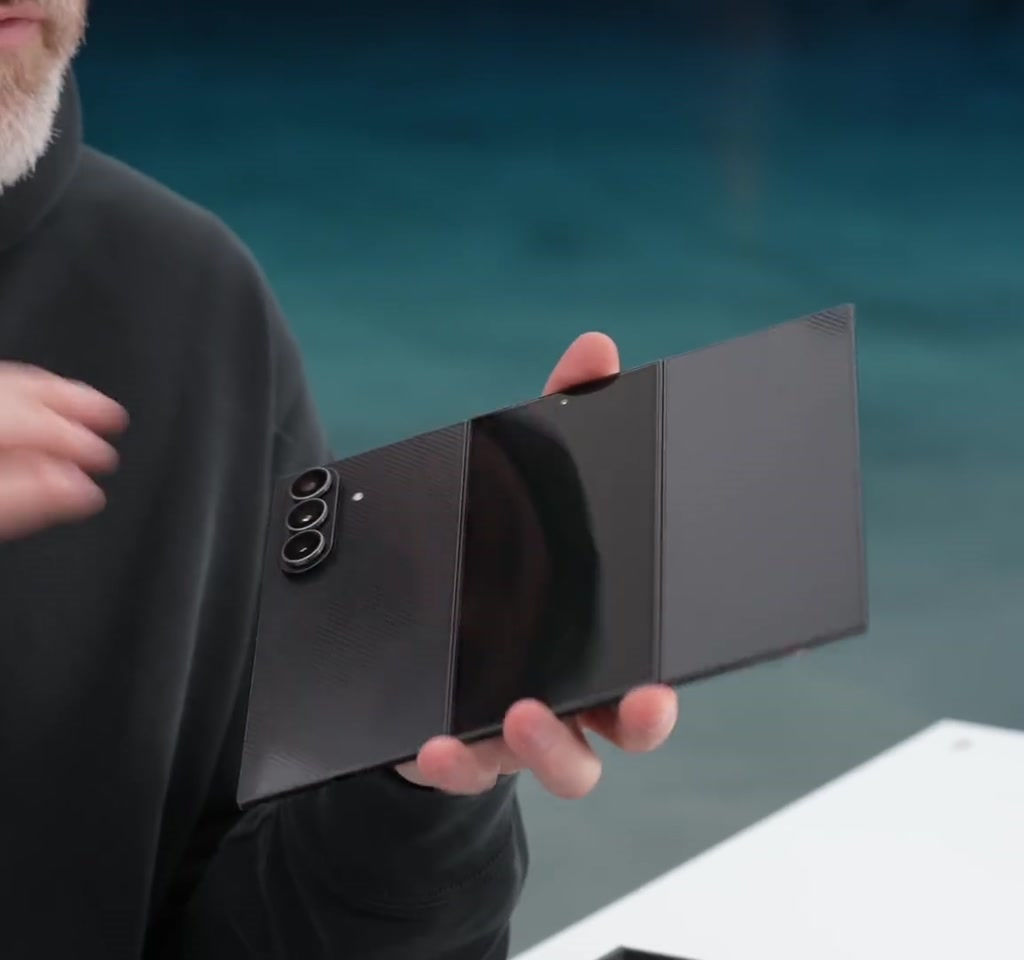
At its core the Samsung Galaxy Z Tri Fold is a thought experiment made real. Instead of stretching a single hinge into a larger slate, it introduces two seams and three panels that fold into a compact package. The device opens into a U-shaped layout that reads like a pocketable tablet rather than a phone that sighs and grows.
Concise Definition: The Tri-Fold uses three hinged panels to create a roughly 10-inch internal display while retaining a fully protected external screen when folded. This design prioritizes continuous screen area and durability over absolute thinness or the broad stereo audio geometry of thin slates.
The transcript used during the first impressions highlights two design signals that matter. First, Samsung gives you an independent external display that is fully protected when folded. Second, the internal display is treated as a softer, fully covered surface only exposed when opened. Those are material choices that shift the product away from fragile novelty and toward everyday utility.
Design, Feel, And The Physical Limits
What becomes obvious when you look closer is how physical realities govern the product. The exterior shows a hard, protective outer screen. The inner unfolded display is described as impossibly thin and bright. But the device is also notably thick along one edge where a full-sized USB-C port sits edge-to-edge. The speaker housing, hinge mechanism, and port geometry set a minimum thickness that current connectors demand.
Hinge Safety And User Interaction
There is a tactile safety built into the hinge mechanism. Attempt to fold the inner panel beyond its intended angle and the device warns you. That is a deliberate engineering choice to protect the more delicate interior. It is a small interaction but it speaks to the complexity of marrying triple-panel mechanics with human behavior.
Weight And The One Hand Tradeoff
The first impressions call out a heft that echoes early foldable generations. A cited ballpark figure was around 300, which reads like the expected order of magnitude in grams for a device of this size. That weight makes it feel more like a pocketable tablet when you hold it unfolded and more like a dense phone when folded. The practical consequence is that one-handed use becomes conditional rather than default.
Thickness And Port Reality
The edge-to-edge USB-C port is an explicit constraint. It helps explain why the Tri-Fold cannot be paper-thin. To go materially thinner would require either moving to a portless charging model or rethinking connector design. Those are non-trivial changes for a mainstream product where accessories and backward compatibility matter.
Display, Interface, And Media Behavior
Short Definition: The Tri Fold’s internal screen is a 120 hertz Dynamic AMOLED 2X panel, designed to give tablet-like fluidity and brightness in a collapsible package. The external cover display is a separate finished surface, improving perceived durability when folded.
The display technology is one of the device’s clearest strengths. The Tri Fold uses a 120 hertz Dynamic AMOLED 2X panel, and the external cover screen is described as bright, vibrant and searingly contrasty. That 120 hertz responsiveness is noticeable and it gives the UI a fluidity that feels modern and immediate.
Multitasking And Variable Aspect Ratios
There are interface implications too. The reviewer described the extra panel as enabling new multitasking gestures and reachability patterns, especially when the device is used partially folded during media playback. Software that takes advantage of variable aspect ratios will determine how compelling this becomes in practice.
Cameras, Audio, And Imaging Behavior
Camera performance follows Samsung’s lineage. The Tri-Fold pairs a high-resolution wide sensor with a reliable ultra-wide sensor. A 200 megapixel wide camera was called out during the unboxing and the ultra wide was identified at 12 megapixels. The device inherits many of the imaging strengths of the Galaxy line, such as strong color processing and robust low-light handling.
Imaging Features And Creative Uses
Imaging features include smooth zoom controls for video and responsive autofocus. In practice that combination turns the Tri Fold into a creative tool for framing, especially when using the unfolded panel as a monitor. The sense of cinematic framing is heightened by the large viewing surface.
Audio Geometry And Its Limits
Audio introduces a constraint worth noting. Speakers are placed toward the top and bottom of the device in folded use. That aligns poorly with a wide stereo separation model when you are watching video on the open tablet surface. In other words, the geometry that enables folding imposes an audio tradeoff. The speakers sound good but do not deliver the spatial breadth that a thin slate with side-firing drivers can produce.
Performance And Battery Life Explained
Quick Summary: The Tri-Fold ships with a 5600 milliamp hour battery and supports Samsung Super Fast Charging 2.0 at up to 45 watts plus 15-watt wireless charging. Those numbers favor longer runtimes versus many phones, but the larger 10-inch, 120 hertz display shifts energy demands upward.
Quantified context is helpful here. The Tri-Fold ships with a 5600 milliamp hour battery. That is significantly larger than many single-screen phones and is a predictable consequence of having to power a display that behaves like a small tablet. The device supports Samsung Super Fast Charging 2.0 at up to 45 watts, and wireless charging at 15 watts. These numbers mean charging can be brisk when available, but the scale of the battery also indicates that run time is a primary constraint when you run the 10-inch panel at high refresh rates.
Practical Battery Behavior
First, battery capacity matters in real numbers. A 5600 milliamp hour pack is large for a phone-class device, yet pushing a 10-inch panel at 120 hertz will usually make battery life measured in hours rather than an all-day guarantee for heavy users. Second, charging speed and convenience are bounded. 45-watt wired charging and 15-watt wireless charging are useful, but the larger battery means full charges will still take notable time compared with smaller phones.
Practical Tradeoffs And Everyday Realities
The Tri-Fold is most interesting when examined as a bundled set of tradeoffs rather than as a single impressive spec. Here are the concrete constraints to keep in view.
- Battery Scale And Power Behavior: The device includes a 5600 mAh battery which is substantial compared with most phones, but it is required to run the larger 10-inch display at 120 hertz. That means power draw becomes the limiting factor for heavy use. Expect faster depletion during continuous video playback or gaming than on similarly speced single screen phones.
- Thickness Set By Connectors: The edge-to-edge USB-C port forces a minimum thickness. To reduce that thickness you would need to shift to a portless model or a radically different connector design. In practical terms that means cases, accessories, and the device footprint are all working inside this fixed envelope.
- Audio Geometry: Speaker placement is constrained by fold mechanics. Top and bottom firing units are a compromise that preserves fold clearance but reduces stereo separation on the unfolded display. Expect acceptable loudness but not expanded spatial audio like a tablet with side-firing drivers.
- Weight And Handling: The device was described as feeling heavy in hand, in the ballpark of a few hundred grams. That weight shifts the use case away from long single-handed sessions and toward two-handed consumption or short bursts of mobile productivity.
Two Quantified Boundaries
First, battery capacity matters in real numbers. A 5600 milliamp hour pack is large for a phone-class device, yet pushing a 10-inch panel at 120 hertz will usually make battery life measured in hours rather than an all-day guarantee for heavy users. Second, charging speed and convenience are bounded. 45-watt wired charging and 15-watt wireless charging are useful, but the larger battery means full charges will still take notable time compared with smaller phones.
Tri Fold Vs Tablets And Traditional Phones
Side by Side: Compared to a traditional phone, the Tri Fold offers far more screen area and improved multitasking at the cost of weight, thickness, and speaker geometry. Compared to an 11-inch tablet, it sacrifices some speaker separation and raw thinness in exchange for pocketability and an always foldable form factor.
Decision Factors In Real Use
If you prioritize continuous screen real estate and cross-device workflows, the Tri Fold narrows the gap with small tablets. If you prioritize the lightest carry, the thinnest profile, or the widest stereo separation, a single-screen phone or a small tablet may better suit those needs.
How Software And Accessories Change The Equation
There is an open friction here: software parity. A device this format is only as useful as the apps that adapt to three-panel continuity and variable aspect ratios. Samsung has made strides in multitasking and split-screen flows, but the ecosystem matters. The moment this approach breaks down is when apps do not respect the extra real estate or fail to scale content elegantly.
Accessories and cases will also shape perception. Protective shells, charging habits, and external stands change the way weight and thickness are experienced. If the accessory ecosystem matures, some present constraints will feel less limiting.
What Determines Whether It Works For You
The part that changes whether the Samsung Galaxy Z Tri Fold is a revelation or a niche tool depends on use patterns. If most of your day involves media consumption, long-form reading, or productivity where a larger canvas reduces friction, the value proposition is clear. If you spend most of your time on short one-handed interactions or prioritize the loudest possible audio on the go, those habits expose the Tri Fold’s tradeoffs.
Software will be the other decisive factor. A device this format is only as useful as the apps that adapt to three-panel continuity and variable aspect ratios. Samsung has made strides in multitasking and split-screen flows, but the ecosystem matters. The moment this approach breaks down is when apps do not respect the extra real estate or fail to scale content elegantly.
Who This Is For And Who This Is Not For
Who This Is For: People who prioritize a tablet-sized canvas in a pocketable device, heavy media consumers, mobile creatives who benefit from a monitor-like unfolded display, and users who value Samsung ecosystem multitasking features.
Who This Is Not For: Users who want the lightest, thinnest daily carry, those who prefer maximum stereo speaker separation for open surface media, and people whose workflows are dominated by short one-handed interactions.
Final Thoughts And A Forward-Looking Note
The Galaxy Z Tri Fold is a bold, ambitious step in visible product evolution. It reframes the problem that phones and tablets have been trying to solve, and it does so by accepting concrete physical costs for a different kind of payoff. That kind of tradeoff is the engine of meaningful innovation.
The most interesting part is what comes next. If Samsung and the app ecosystem continue tuning software and accessories to this form factor, these devices could alter how people choose a single pocketable computer. If connector standards evolve or if audio design adapts to the folding geometry, the constraints that define usefulness today may migrate into strengths tomorrow.
What remains true is this, the Tri-Fold does not simply add screen area. It asks users to recalibrate expectations about weight, thickness, and audio geometry in exchange for a tablet-grade surface that fits in a pocket. That is an invitation more than a conclusion. The real story will be written in how people adapt their workflows and which tradeoffs they accept.
For readers wanting a closer look at the Tri-Fold in motion, that first impressions video delivers the same hands-on perspective that shaped this piece and is worth a watch for the visual details and interaction moments discussed here.
FAQ
What Is The Samsung Galaxy Z Tri-Fold?
The Tri-Fold is a tri-panel foldable device that unfolds into a roughly 10-inch internal display while retaining an independent external screen when folded. It aims to deliver tablet class screen area in a pocketable form factor.
How Big Is The Internal Display?
The internal display opens into a roughly 10-inch surface and uses a 120 hertz Dynamic AMOLED 2X panel, according to the first impressions transcript.
How Long Does The Battery Last?
The device ships with a 5600 mAh battery, which is large for phone-class hardware. Actual runtime depends on use patterns and refresh rate; running the 10-inch panel at 120 hertz will increase power draw and reduce hours of continuous use compared with lower refresh settings.
What Are The Camera Specs?
The Tri-Fold pairs a high-resolution wide sensor referenced at 200 megapixels with a 12 megapixel ultra-wide. It inherits Samsung imaging traits such as strong color processing and robust low-light handling.
Does The Tri Fold Support Fast Charging?
Yes. The device supports Samsung Super Fast Charging 2.0 at up to 45 watts for wired charging and 15-watt wireless charging, per the transcript.
Is The Tri Fold Good For One Hand Use?
One-handed use is conditional. The device was described as feeling heavy, in the ballpark of a few hundred grams, which makes long single-handed sessions more awkward than with lighter phones.
How Do The Speakers Sound?
The speakers deliver acceptable loudness and clarity, but their top and bottom placement in folded use reduces stereo separation on the open tablet surface compared with side-firing drivers on thin slates.
Should I Buy The Tri Fold Instead Of A Tablet?
It depends on priorities. The Tri-Fold offers tablet-like screen continuity while remaining pocketable, but it sacrifices some audio geometry, thinness, and possibly all-day battery for heavy users. Those who want the lightest, loudest tablet experience may prefer a dedicated small tablet instead.
COMMENTS