


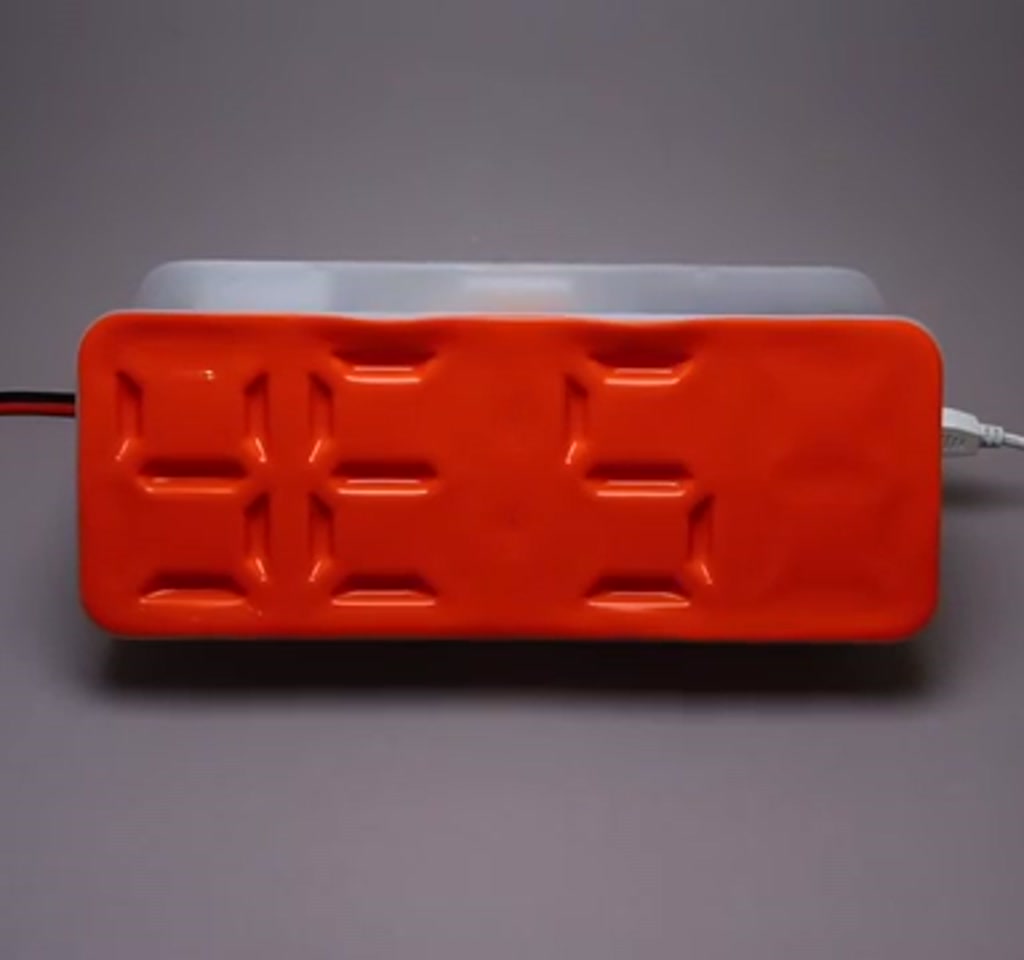
The most striking thing about the Air Powered Seven Segment Display is not that it can tell the time. It is that the device treats vacuum and atmosphere as bits, building an addressable, visible memory array out of soft matter and air channels.
The real significance here is not the novelty of an air-driven clock but the architectural move: instead of trying to make pneumatic signals as fast as electrons, the designer embraces air’s slowness and converts it into a persistent state. Memory, not speed, becomes the lever that makes multiplexing practical with air.
That reframing solves the core objection most people raise when they first see pneumatic logic: air is slow. Rather than toggling digits hundreds of times per second, the system writes a vacuum state into each segment and that state latches until explicitly overwritten. The result is a display that looks alive while resting on a set of soft, physical bits.
This article walks through how the segments, vacuum transistors, one-way valves, and a 30-hour printed body come together. It also lays out the practical tradeoffs that define when this approach is compelling and where it becomes fragile.
How Electronic Multiplexing Informed A Pneumatic Approach
Seven-segment electronic displays rely on shared segment wiring and rapid time multiplexing, so a handful of lines can control many LEDs. Pneumatic systems cannot match those switching speeds, so the designer translated the multiplexing topology into a write-latch sequence: present data, open a write enable, and let the segment retain its state until the next write.
What Is Pneumatic RAM And Why It Matters
Pneumatic RAM is a way to store state using pressure differences instead of charge. In this design, vacuum represents one and atmosphere represents zero. A physically latched membrane holds that pressure differential, creating a persistent bit that can be addressed and read by sight without continuous actuation.
From Segment To Memory: Vacuum Transistors And Latching Membranes
The Segment As A Bit
Each segment is a layered assembly: a thin silicone display membrane, a clamping frame that forms a lip seal, and a printed body with integrated channels. When vacuum is applied behind the membrane it deflects inward and stays deflected because the surrounding structure holds the pressure differential. Atmosphere equals zero and vacuum equals one.
The Vacuum Transistor
The write mechanism is a tiny microvalve or vacuum transistor. A soft membrane sits between two 3D printed parts with channels. In its default state the valve is closed. Apply vacuum to the transistor’s control port and the membrane unseats, opening a path that allows the segment to be written. Once the control vacuum is removed the valve reseals and the written state persists.
Seen together, these parts form a visible memory array: vacuum and atmosphere are the physical bits, and the silicone membrane is the storage medium.
Scaling To Four Digits: Addressing, Dots, And One-Way Valves
The full assembly repeats the seven-bit memory cell for each digit and adds a per-digit write enable. Seven common data lines run through the display while each digit has a transistor array gated by its own enable. To write a digit the controller drives the data pattern and opens that digit’s enable so the segments latch the pattern.
The colon dots required a one-way valve trick. Those valves let a write pull the dots into vacuum while preventing the dot lines from routing back and enabling other digits unintentionally. The result is a shared dot line that responds to any digit write without corrupting adjacent digit states.
Printing, Casting, And Assembly
Printing Choices And Surface Finish
The display body was printed in PLA with attention to the sealing surface. Printing on glass produced a mirror-like finish that improved membrane sealing. Swapping from a 0.2 to a 0.4 mm nozzle reduced print time at a small cost to transparency; the main multi-digit body required roughly 30 hours of printing.
Casting Thin Membranes
Silicone membranes were cast on glass with masking and cut to shape. The display membrane is extremely thin and delicate, so alignment and clamping are critical. A clamping frame pulls a raised lip into a tight seal so the segment can reliably hold vacuum without leaks.
Control Hardware
Eleven solenoid valves provide the user-facing control: seven data lines and four write enables. Those solenoids, their drivers, a vacuum pump, a microcontroller, and a power supply live inside a translucent resin enclosure produced via a resin printing service. The maker supplies the control electronics to switch the valve lines.
Two Concrete Tradeoffs That Define Usefulness
The first tradeoff is speed versus memory. Electronic multiplexing relies on rapid switching at hundreds to thousands of hertz. This pneumatic design trades temporal bandwidth for persistent state: the maker refreshes one digit per second to run the clock, a cadence comfortable for humans but far slower than electronics.
The second tradeoff is complexity and component count. The project needs at least 11 solenoid valves plus a vacuum pump, valve drivers, a microcontroller, and the 3D printed body. Printing time and parts add build time and cost, with the bill of materials commonly ranging from the tens to low hundreds of dollars depending on choices.
Practical Limits: Durability, Power, And Readability
Membrane durability is a practical boundary. Thin silicone flexes under pressure and repeated write cycles will cause fatigue. Exact failure intervals depend on material and thickness, but such membranes commonly show wear after tens to hundreds of actuations unless reinforced or reengineered.
Power and maintenance matter too. Small vacuum pumps and multiple solenoids draw steady power, often in the tens of watts for compact systems. Maintenance shows up as leaking seals, clogged channels, or fatigued membranes, especially under continuous use away from mains power.
Patterns, Clock Modes, And What It Looks Like In Action
The maker implemented four practical modes: a clock that refreshes one digit per second so the dots blink every second, a stopwatch with minutes and seconds, a countdown, and playful animations like conveyor or breathing patterns. Leading zero suppression controls visual style during hour transitions.
Seven-segment geometry limits detailed text, but numbers and short letters are straightforward. The tangible nature of the display makes timekeeping feel mechanical and craft-like rather than electronic and invisible, which is part of its appeal.
Pneumatic RAM Vs Electronic Displays
Speed is the clearest divider: electronics win by orders of magnitude. Pneumatic RAM trades raw speed for visible, persistent state and simpler per-element mechanics. For designs where readable persistence, mechanical simplicity, or electrical isolation matter, pneumatic approaches offer a distinct and defensible alternative.
Speed And Refresh
Electronic multiplexing relies on sub-millisecond switching. The pneumatic display runs at human time scales, refreshing one digit per second in the clock mode. That makes animations slow but legible and reduces the need for continuous pumping during idle intervals.
Power, Complexity, And Cost
Electronics typically use less power for equivalent refresh behavior and require fewer bulky moving parts. Pneumatic builds need pumps and many valves, pushing up complexity, size, and maintenance. Costs vary by part quality, but pneumatic setups often expense more in mechanical components and assembly time.
Visibility And Tactility
Pneumatic memory is visible and inspectable: the state is physically embodied in membranes and pressure. That visibility can be an advantage for soft robotics, tactile interfaces, or educational projects where seeing state matters as much as reading it.
Who This Is For And Who This Is Not For
Who This Is For: Makers, soft robotics designers, and craft-minded builders who value visible state, electrical isolation, and the aesthetics of soft mechanisms. It is a natural fit for projects that prioritize legible persistence over rapid updates.
Who This Is Not For: Anyone who needs high refresh rates, fast animations, or minimal maintenance. If you need millisecond switching, very low power for continuous operation, or compact electronics-only solutions, conventional LED or OLED multiplexing is the better choice.
FAQ
What Is An Air Powered Seven Segment Display?
An Air Powered Seven Segment Display is a multi-digit readout that uses vacuum and air as binary states. Thin silicone membranes deflect under vacuum to show segments, and those deflected states latch until explicitly rewritten, creating a visible, addressable memory array.
How Does Pneumatic RAM Work?
Pneumatic RAM stores bits as pressure differentials held by membranes. A vacuum transistor or microvalve opens to write vacuum into a segment; when the control vacuum is removed the valve reseals and the segment holds its state until overwritten.
Is The Display Faster Than Electronic Multiplexing?
No. The pneumatic design is orders of magnitude slower. The maker runs the clock by refreshing one digit per second. The advantage comes from persistence, not speed, which makes the design suitable for human-paced updates.
How Many Valves And Pumps Are Required?
The maker used eleven solenoid valves: seven data lines and four write enables, plus a vacuum pump and drivers. Exact counts can change with alternate encodings, but expect a nontrivial valve and pump count compared to electronic equivalents.
How Durable Are The Silicone Membranes?
Durability depends on membrane thickness and material. Thin membranes are described as delicate and commonly show wear after repeated flexing. Tens to hundreds of actuations without reinforcement is a realistic starting expectation, but exact life depends on materials and geometry.
Can This Scale Beyond Four Digits?
Scaling is possible but increases print time, valve count, and assembly complexity. The architecture supports more digits via repeated memory cells and additional write enables, but practical limits appear in component count, sealing challenges, and maintenance.
Is Pneumatic Memory Useful Outside Clocks?
Yes. The maker suggests applications in soft robots, tactile interfaces, or any system where visible, inspectable state and electrical isolation matter. The approach is a study in embodied computation rather than a drop in replacement for electronics.
What Are The Main Open Questions For Future Work?
Key open questions include increasing membrane cycle life, reducing external valve count through multiplexed pneumatic encodings, and shrinking components to make assembly practical. The transcript frames these as engineering directions rather than solved problems, so further work is needed.
COMMENTS