


Imagine an umbrella that hovers beside you and follows your steps across a field. After a year of hidden failures and repeated rebuilds, that concept moved from novelty to a functioning autonomous demonstrator. The project exposed the real constraints that determine whether a playful idea can become repeatable engineering.
The key insight was never the propellers. It was the integration of tracking fidelity, mechanical reliability, and redundancy so no single faulty module wrecks the whole system. Get any of those wrong and the build collapses into a cascade of unrelated failures.
Development History And Initial Failures
Version one overview: basic flying umbrella with propellers
Direct Answer: The original build mounted propellers to an umbrella frame and achieved lift, but it lacked reliable person following. Early flights exposed that lift and stable hover do not equal autonomy. Real autonomy required robust tracking, consistent flight behavior under canopy load, and fewer single points of failure.
Limitations: lack of autonomous following capability
Version one did fly, but only as a stunt. The initial setup could hover but not keep a person centered. Problems ranged from dropped camera frames to miswired motors. Each small failure masked the real issue: the system could not localize a human target reliably in real-world conditions.
Community Feedback And Lessons Learned
Community comments and early testers flagged three repeated themes: fragile electronics, unstable mechanics, and overreliance on a single sensor. Those voices pushed the team toward modular testing and a dedicated test drone so failures could be isolated without risking the final umbrella frame.
Redesigning For Autonomy
Goals: reliability, convenience, full autonomy
Direct Answer: The redesign prioritized reliable person following over aesthetic compactness. Goals included removing single points of failure, improving short-range depth sensing, and making the umbrella portable through foldable arms. The tradeoff was more testing, heavier components, and careful integration of sensors and flight software.
Choosing tracking methods: camera, lidar, GPS, teleoperators
The team evaluated several tracking approaches. Downward-facing cameras, time-of-flight depth sensors, lidar, and GPS telemetry each have distinct ranges, costs, and fragilities. The practical decision favored a short-range depth sensor for meter-scale accuracy, supplemented by visual tracking when lighting permitted.
Building A Testing Drone As A Prototype Platform
Before risking the umbrella frame, the team assembled a conventional test drone with a Holly Bro style frame and a professional flight controller. That platform allowed iteration of tracking algorithms and PID tuning without the complexity of the folding umbrella structure.
Flight Controller And Hardware Setup
Selection of drone frame and flight controller
Direct Answer: The project used a robust test frame and a professional flight controller to tune motors and controls before moving hardware to the umbrella. Selecting a reliable flight controller reduced unknowns, letting the team focus on tracking and mechanical issues instead of basic stability problems.
Motor installation and GPS integration
Motor wiring mistakes and default controller settings caused days of delay. GPS was integrated early for rough positioning, but the off-the-shelf units in the budget proved too coarse for smooth person following, so the team relied on short-range sensors for final control loops.
Challenges And Troubleshooting In Initial Flights
Initial flights revealed oscillations when the canopy disturbed airflow, frames that resonated under vibration, and single-board computers that bricked under load. Each problem required disassembly, component replacement, or tuning that stretched the project timeline.
Designing The Folding Arms Mechanism
Problems with original fixed frame design
Early fixed-frame approaches were impractical for portability. The umbrella’s central rod is the only robust attachment point, so designers needed folding arms that stowed compactly yet locked rigidly in flight. Initial prototypes had too much play and loosened under load.
Concept And Prototypes For Folding Arms
Concept iterations focused on axis placement and locking geometry. Moving the rotation axis and redesigning the locking plate eliminated play while preserving deployability. Prototypes emphasized repeatable locking under torsion and easy field deployment.
Locking Mechanism Refinements And Final CAD Design
CAD iterations tightened tolerances and improved contact surfaces for the locking plate. The final design prioritized a positive mechanical engagement that resists vibrational unloading while remaining straightforward to print and assemble.
3D Printing Innovations With Bambu Lab Printers
Switching to a Bambu Lab H2T with a heated chamber and automated material handling improved success rates with carbon fiber reinforced nylon. That allowed stronger printed parts and fewer failed prints, though soluble supports and post-processing still added time and cost.
Electronics And Software Integration
Raspberry Pi integration for real-time processing
Direct Answer: The Raspberry Pi ran the person tracking code and sent setpoints to the flight controller. While convenient, it introduced a critical single point of failure: a bricked Pi left the autonomy stack powerless and forced the team to maintain spare boards and plan for replacement delays.
Tracking code development and challenges
Tracking code required extensive tuning to handle frame drops, latency, and sensor noise. The team logged more than 60 walking clips to evaluate responsiveness and stability, refining filters and setpoint smoothing to avoid oscillations near the human target.
Use Of Time-Of-Flight Camera Technology For Depth Sensing
Time-of-flight sensors provided short-range depth maps suitable for the few-meter follow distances. They helped keep the umbrella centered on a person when GPS was too coarse. However, ToF modules showed sensitivity to lighting and occasional firmware or hardware errors that needed replacement.
Hardware Failures And Component Replacements
The team faced bricked single-board computers, failed ToF modules, and vibration-induced sensor noise. A brute force strategy of replacing suspect components proved effective when failure modes were too entangled to trace cleanly.
Vs GPS Tracking System
Time-of-flight camera tracking compared to GPS tracking
Direct Answer: In this project, short-range time-of-flight tracking outperformed off-the-shelf GPS for meter-scale person following. GPS units tested were about 3 meter accurate, which is inadequate for smooth centering. ToF offered closer range precision but with tradeoffs in light sensitivity and fragility.
Accuracy differences and cost considerations
GPS accuracy in consumer modules hovered around three meters, making it unsuitable for precise lateral following. High precision RTK GPS can achieve centimeter-level accuracy but typically costs substantially more, shifting the project from hobby budgets toward professional gear.
Pros And Cons Of Each System For Autonomous Flight
Pros of ToF: compact, low-latency depth mapping at a few meters, suitable for following a person. Cons of ToF: sensitive to lighting, potentially fragile, and sometimes produced unexplained errors. Pros of GPS: global positioning and familiar integration. Cons of GPS: insufficient precision for tight person following without expensive upgrades.
Final Assembly And Flight Tests
Attaching umbrella to drone frame
Direct Answer: Final assembly moved the refined tracking hardware and folding frame onto the umbrella rod and verified mechanical interfaces. Careful cable management, vibration damping, and secure locking were necessary before live tests to avoid midflight failures that had plagued earlier prototypes.
Cable management and securing components
Cable routes were redesigned to keep sensor and power lines clear of folding joints. Rubber dampers and strategic tie points reduced sensor vibration and prevented loose lines from snagging during arm deployment.
Tuning Flight Controls And Initial Umbrella Flights
Each assembly change required fresh PID tuning. The umbrella canopy and added structural elements changed the system’s inertia and introduced new vibration modes, so tuning sessions were measured in hours. A successful hover in a lab does not guarantee stable following in a field.
Field Tests And Rain Trial Results
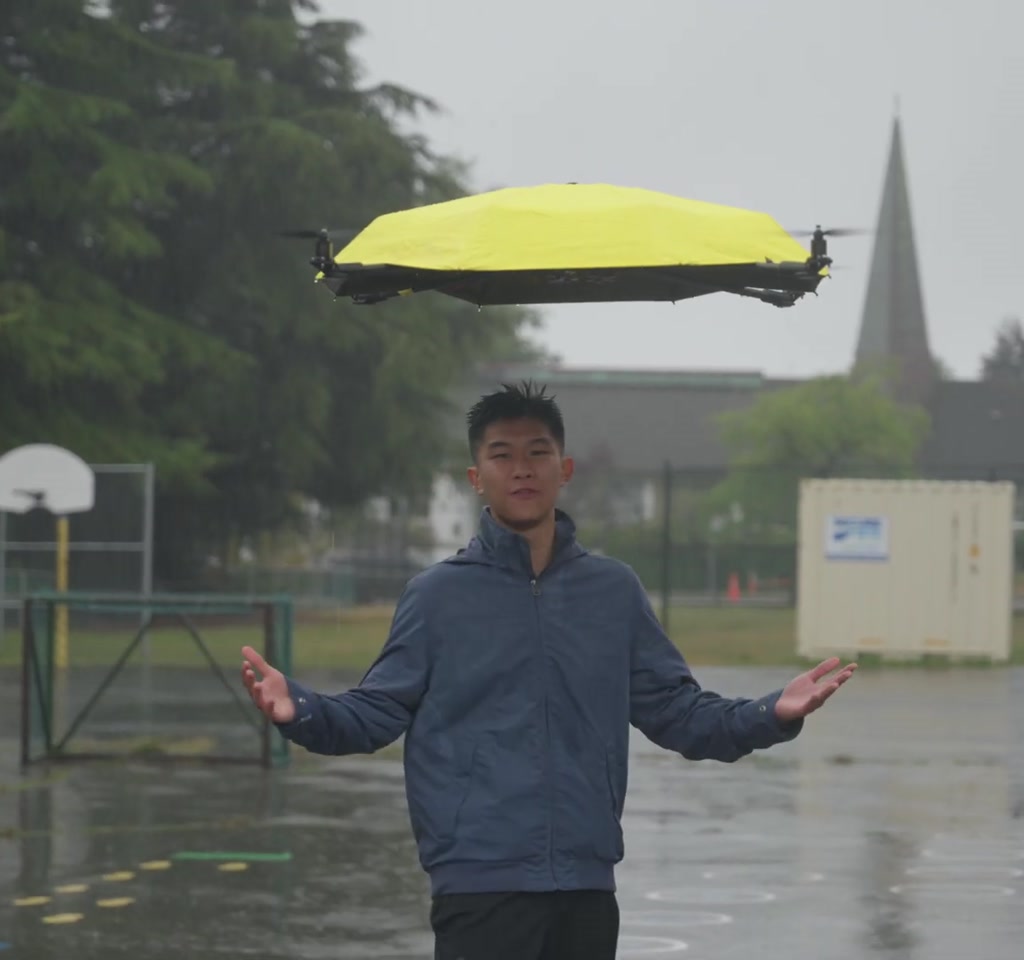
Field tests produced the first convincing person following sequences. After replacing unreliable components and refining filters, the umbrella followed across a field and withstood heavy rain in at least one recorded test. That rain result suggests reasonable environmental robustness, though continued testing is required for wider claims.
Who This Is For
- Drone enthusiasts interested in autonomous systems
- Makers and engineers exploring advanced robotics
- Early adopters of novel tech in personal accessories
This project best serves people who want a deep, hands-on exercise in combining sensors, flight control, and mechanical design. It is valuable for those who expect to iterate, replace parts, and tolerate long tuning cycles.
Who This Is Not For
- Casual users seeking a simple umbrella solution
- Individuals unwilling to handle technical troubleshooting
- Those avoiding investment in experimental projects
If you want a plug-and-play umbrella or have little patience for hardware debugging, this is not the right fit. The build demands spare parts, time, and willingness to accept imperfect but functioning systems.
Frequently Asked Questions
What Is The Flying Umbrella And How Does It Work?
The flying umbrella is an umbrella frame fitted with propellers, a flight controller, and short-range tracking sensors. It uses a controller to maintain hover and a time-of-flight depth sensor plus visual processing to follow a person at a few meter range.
How Does The Flying Umbrella Follow A Person Autonomously?
Tracking code running on a single board computer processes depth and visual data to locate a person, then sends position setpoints to the flight controller. The controller adjusts motors to keep the umbrella centered relative to the person while PID tuning smooths motion.
What Kind Of Tracking System Is Used In The Umbrella?
The build relied on a short-range time-of-flight depth camera supplemented by visual tracking. GPS was evaluated but found too coarse for precise person following within the project’s budget.
How Accurate Is The Umbrella’s Position Tracking?
Time-of-flight provides meter-scale depth precision at the follow distances used, which was sufficient for stable following after tuning. Off-the-shelf GPS units tested were around 3 meter accurate, which proved inadequate for smooth centering.
Can The Flying Umbrella Be Used In Rainy Or Windy Conditions?
The team recorded at least one successful heavy rain trial, indicating some weather robustness. Wind remains a variable: canopies change airflow and increase control complexity, so windy conditions reduce performance and increase risk.
How Long Did The Development Process Take?
The project spanned many months with repeated rebuilds. The writeup notes roughly seven months of iterative work and more than 60 walking clips used for tuning and validation.
What Are The Main Challenges In Building A Flying Umbrella?
Main challenges include precise short-range tracking, mechanical stability of foldable arms, vibration management, and avoiding single points of failure in single-board computers and sensors.
Is The Folding Arm Mechanism Durable Enough For Regular Use?
The final CAD and printed parts improved locking under load and reduced play, making the mechanism robust for repeated tests. Durability in long-term daily use remains unproven without extended field deployment and maintenance routines.
Can The Flying Umbrella Be Controlled Manually As Well?
The design retains a flight controller and supports manual control modes for testing and safety. In practice, manual override is important during development and for safety during public trials.
COMMENTS