


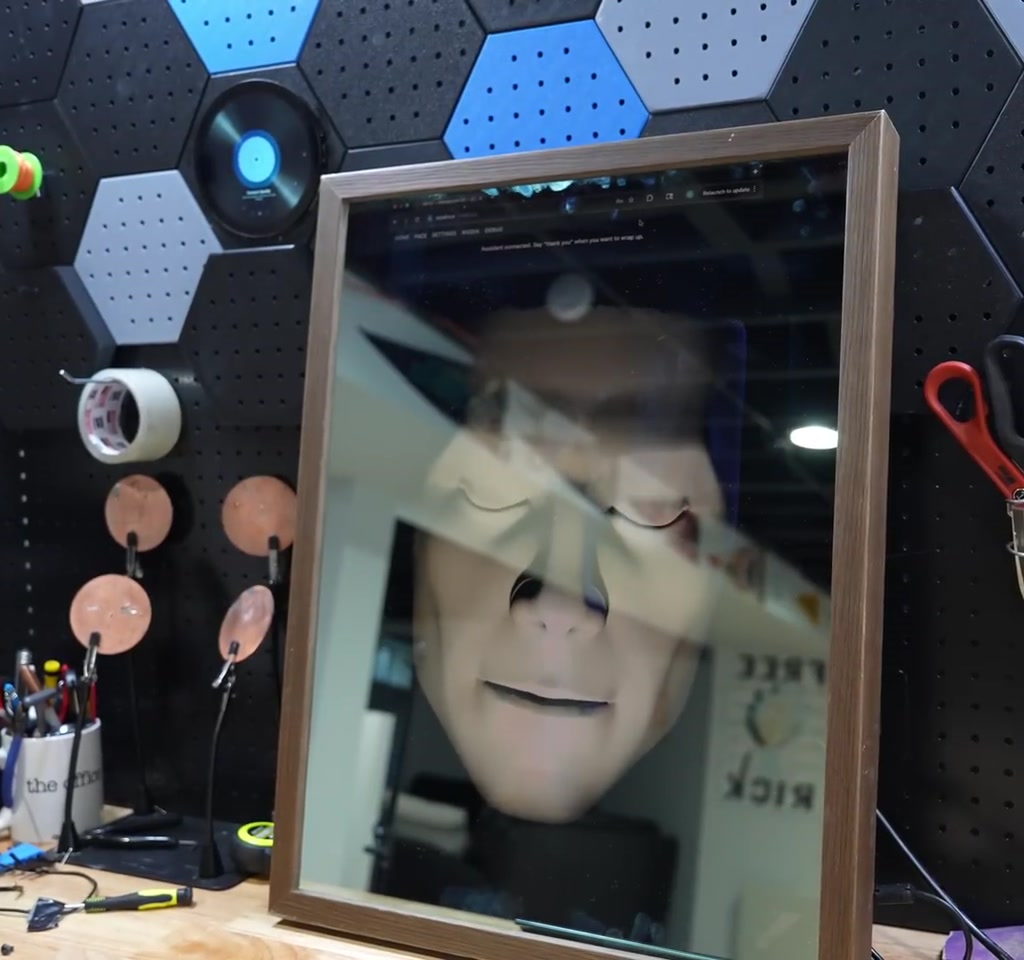
There is something quietly subversive about turning a decorative mirror into a personality. This build does it deliberately: a huge ornate frame hides a floating, speaking head that can compliment or roast you on demand. The result is unsettling in the best way because the maker treated timing and choreography as the core design problems.
Early on the project defines a few central themes: mirror optics, animation sync, conversational latency, and physical scale. These themes shape tradeoffs that decide whether the talking mirror feels like a prop or collapses into a novelty.
What Is A Talking Magic Mirror
Direct Answer: A talking magic mirror places a display behind a one-way mirror so a face appears to float on the reflective surface while a conversation engine supplies speech and personality. The illusion depends on matching mouth movement to sound, hiding the screen until needed, and controlling light so the face reads clearly.
How The Talking Magic Mirror Works
Direct Answer: The build pairs a one-way glass sheet and a display with a local computer to route audio and text to a conversational endpoint. Viseme-driven animation and blend shape rigging synchronize mouth shapes with phonetic timing while the frame and back plate manage light and contrast.
One-Way Glass Optics And Light Balance
The mirror sheet is the most fragile and costly component. In this build the one-way sheet reflects roughly 85 percent of incoming light and transmits about 15 percent when the rear scene is lit correctly. That narrow window is the core technical lever: too much backlight bleeds the display, too little and the reflection dominates.
Display, Back Plate, And Light Sealing
Stray light through the rear ruins the floating illusion. The maker printed a full back plate on a large-format resin printer and mounted it to corner brackets to seal the cavity. That sealing preserves display contrast and prevents leakage that makes graphics wash out.
Animating The Floating Face
Direct Answer: Believable speech needs more than simple mouth motion. The creator used blend shapes and visemes to tie jaw, lips, cheeks, and skin folds together so phonetic shapes flow smoothly and mouth movement lines up with audio timing, avoiding brittle or uncanny results.
Blend Shapes And Rigging Details
Blend shapes let multiple facial areas deform together instead of jerking a single vertex. The builder created a 3D mask model, rigged it with coordinated controls, and tuned lights to match the cinematic look they were after.
Visemes And Lip Sync Timing
Visemes map mouth shapes to phonetic outputs. The maker timed transitions and generated viseme animations synchronously with phonetic timing so the face appears to be producing sound rather than lagging behind it. Randomized blinks and a smoke reveal reduce mechanical repetition.
Real-Time Speech And The Conversation Engine
Direct Answer: A Raspberry Pi acts as the on-site computer, routing outgoing text and incoming audio to a conversational endpoint. Tight coupling between speech output and viseme generation creates synchronous lip sync, while network and local processing determine perceived latency.
Raspberry Pi Role And Routing
The Pi handles local plumbing and sends requests to a conversational endpoint similar to those used by conversational phone apps. This allows the mirror to answer naturally and adopt a sarcastic personality when tuned to roast the user.
Latency Factors And Practical Limits
Latency depends on network round-trip time and local processing. On a good network with minimal local work, low single-digit second responses are realistic. Heavy local synthesis or a congested link can move delays into several seconds. Sub-second responsiveness requires a fast link and distributed processing.
Benefits Of A Talking Magic Mirror
Direct Answer: A talking magic mirror turns a reflective surface into an emotional prop that can entertain, inform, and interact. When synchronized correctly, it creates presence and engagement far beyond static displays, making it useful for theatrical installations, experience design, and playful home gadgets.
Presence And Emotional Engagement
Size amplifies presence. Printing a large ornate frame turns the object into a prop you react to emotionally. The same techniques work at smaller scales, but scale drives theatrical impact.
Designer And Maker Value
This project demonstrates how animation, audio, and latency become primary design variables. It is a template for makers who want physical objects to carry personality without exposing technical complexity.
Limitations And Challenges
Direct Answer: The main constraints are fragile optics, strict lighting requirements, and cost and time for large prints. The illusion breaks with light leakage, mouth-audio misalignment, or multi-second conversational lag. Those limits make this a medium-sized time and money investment rather than a weekend build.
Light And Contrast Sensitivity
The one-way sheet only leaves a narrow operating window. If you do not fully block backlight or control ambient lighting the floating animation will wash out. That makes installation and room selection critical.
Cost, Print Time, And Durability
Large ornamental parts and the one-way mirror push costs into the hundreds and print time into tens of hours, often stretching into multiple days. The glass must be protected by a sturdy frame to avoid expensive damage.
Talking Magic Mirror Versus Traditional Smart Mirror
Direct Answer: Compared to a traditional smart mirror that shows widgets and notifications, a talking magic mirror prioritizes synchronized animation, conversational flow, and theatrical reveal. A standard smart mirror is easier to light and cheaper, while the talking mirror trades simplicity for presence and personality.
Use Case Differences
Traditional smart mirrors are optimized for utility and daytime visibility. Talking magic mirrors are optimized for controlled lighting and staged interactions where timing and lip sync matter.
Technical Tradeoffs
Smart mirrors can often be built with off-the-shelf displays and simpler software. A talking mirror needs viseme mapping, tighter audio-animation coupling, and often a more robust enclosure to control lighting and acoustics.
Real World Build Considerations
Parts And Tools To Prioritize
Prioritize a high-quality one-way mirror sheet, a sealed back plate, and reliable viseme-capable animation. Large 3D prints are rewarding but plan for days of print and post-processing time rather than hours.
Performance And Network Planning
If you expect snappy responses, design for low-latency networking and consider offloading heavy synthesis to a remote service. Running everything on a modest single-board computer can work, but it increases the risk of multi-second delays under load.
Who This Is For / Who This Is Not For
Who This Is For: Makers and designers who want theatrical, personality-first installations; people willing to invest time and money in large prints, a quality one-way sheet, and careful lighting control.
Who This Is Not For: Buyers seeking a cheap weekend project, those who need daytime readable information displays, or anyone unable to control ambient light and room placement.
Build Resources And Reproducibility
The maker published 3D files, code, and a build manual so others can replicate the frame, back plate, and viseme rigging choices. That documentation makes it feasible to reproduce the core design decisions without guessing at key parameters.
Summary And Final Thoughts
The build succeeds because it treats the mirror as a choreography problem, not a purely hardware one. Synchronize light, animation, and reply speed and the object becomes uncanny in a way that commands attention. The talking magic mirror trades simplicity for emotional impact and requires honest expectations about cost and time.
FAQ
What Is A Talking Magic Mirror?
It is a display placed behind a one-way mirror combined with animation and a conversation engine so a face appears to float on the reflective surface and speak. Success depends on lighting, lip sync, and latency.
How Does The One-Way Glass Affect The Build?
The one-way sheet reflects roughly 85 percent of light and transmits about 15 percent when lit correctly. That narrow balance makes light control essential to prevent the display from washing out or being overtaken by reflection.
How Is Lip Sync Achieved?
Lip sync is done with blend shapes and visemes. Visemes map phonetic outputs to mouth shapes and are generated in sync with speech so the face appears to originate the sound.
Is A Raspberry Pi Enough For The Conversation Engine?
A Raspberry Pi can route audio and text to a conversational endpoint and handle local coordination, but network and processing limits can produce multi-second latency. For sub-second responsiveness, faster networking or distributed processing is advisable.
How Much Time And Cost Should I Expect?
Expect the one-way sheet and large 3D prints to push costs into the hundreds. Printing and finishing often take tens of hours and commonly extend into multiple days, so plan for a medium-sized investment in time and money.
Can I Make A Smaller Or Cheaper Version?
Yes. Smaller displays and frames reduce cost and print time, but size amplifies theatrical presence. Smaller builds are more practical for casual makers and still benefit from the same principles: light control, sync, and latency management.
Does The Builder Share Files And Instructions?
Yes. The maker published 3D files, code, and a build manual so others can replicate the frame, back plate, and viseme rigging choices. Documentation helps avoid guesswork about critical parameters.
What Are The Main Failure Modes To Watch For?
Watch for light leakage, mouth-audio misalignment, and network delays. Any of these can break the illusion and turn the talking mirror into an awkward novelty rather than a compelling prop.
COMMENTS