


People say they do not have space for an aquarium on their desk, but what this project proves is that a very thin, carefully designed volume of water can host an entire riverlike community. The real significance here is not the charm of cute fish, it is how different species can be assembled to fill specific ecological roles so the system largely maintains itself.
That insight appears within the first few days of setup. When plants, snails, clams, amphipods, gobies, crabs and a few schooling fish are given the right architecture, most of the heavy lifting shifts from the owner to biology. What actually determines whether this matters is how you manage light, nutrient pathways and movement in a space that is shallow by design. This Desk Aquarium project illustrates those management decisions plainly.
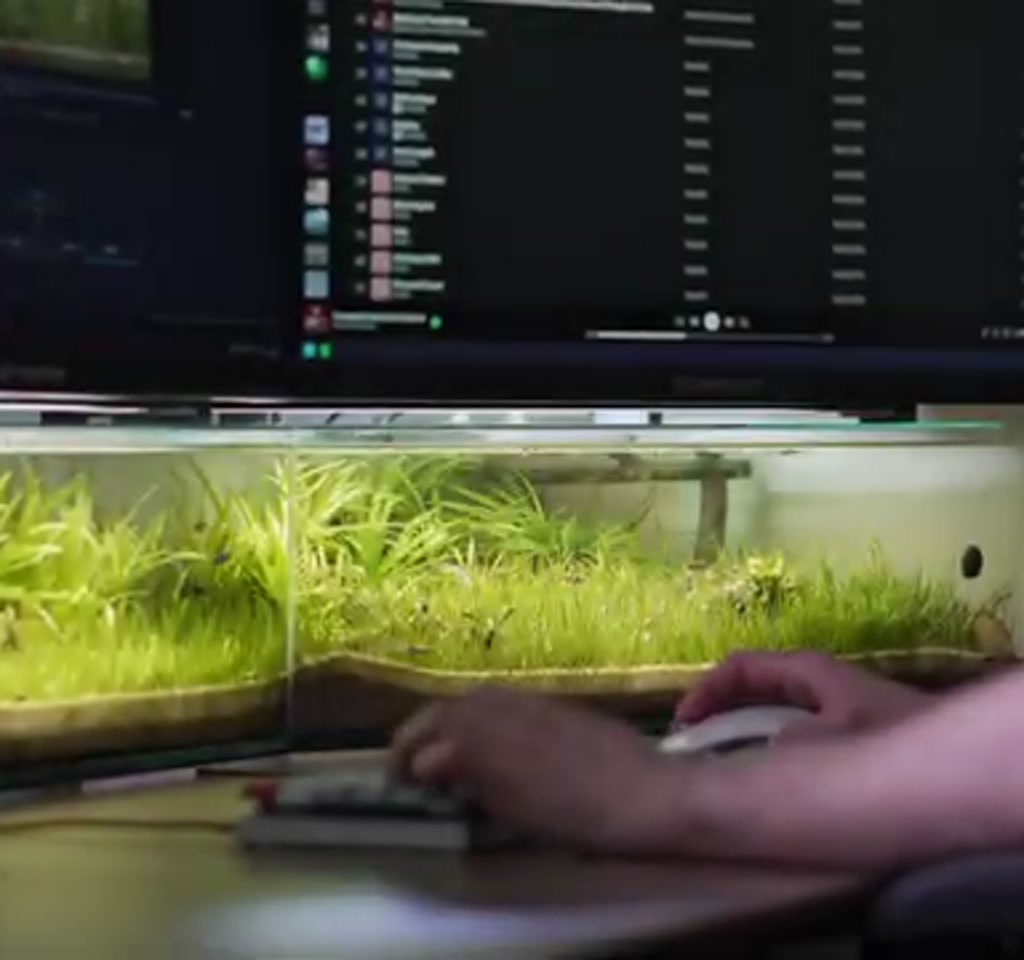
The maker of this Desk Aquarium began with a strange shape carved to sit beneath monitors and a motorized desk. With math, silicone and a little lifting, a thin tank was created to maximize the available footprint while leaving room for cables and a keyboard. The constraints of that unusual envelope are the secret to why the ecosystem can be simple and robust when treated carefully.
From an editorial standpoint, the part that changes how you should think about this is role assignment. Instead of stocking a tiny tank with random species and hoping for balance, the builder intentionally selected organisms that serve complementary functions: grazers to control algae, scavengers to recycle detritus, filterers to polish water, excavators to rework substrate, and mid water swimmers to carry constant movement that signals safety. The idea succeeds up to the point where design and maintenance match one another.
Designing For A Thin Slice Of Water
Shallow aquariums are not miniature versions of normal tanks. Surface to volume ratios, light penetration and circulation behave differently, so design choices must prioritize circulation patterns, light control and usability above traditional volume-based thinking. The maker solved for human ergonomics while preempting the unique physics of shallow water.
The maker addressed those physics choices first by shaping the glass to fill the desk cavity and by slightly elevating the tank to keep input devices usable.
Raising the tank a little had two consequences. It provided clearance for a keyboard and avoided the need for fully wireless peripherals. And it gave a small gap to route plumbing and hide wires behind frosted film so the scene looks like a window into a river, not an appliance with cables.
The builder also anticipated desk motion. Because the desk is motorized, pipes and power leads could be stressed if left to hang. The pump and heated filter were suspended on the desk hardware that normally holds a computer, so all components move together. That is a good example of designing the ecosystem to live with the human tools around it, not in spite of them.
Shallow Tank Physics Explained
Shallow water amplifies rapid changes: light and nutrient pulses alter the whole system faster than in deep tanks, and circulation must be deliberate to avoid dead zones. In practice that means smaller pumps placed to create gentle flow, shorter lighting windows, and stronger attention to filtration that matches the reduced water volume.
Building The Riverbed
The aesthetic came from a nearby river. Stones and pebbles were collected in a bucket, brushed and left to dry. Large rocks became focal points and pebbles filled gaps, while a pathway was sculpted to draw the eye to the back as in classical aquascapes.
Substrate was created in two layers. Nutrient-rich soil and water were mixed into a mud to feed rooted plants. A thicker sand layer was spread on top to lock the soil in place and to give a natural riverbed texture for bottom dwellers to dig into.
Plants were assigned by position and feeding mode. Bushy varieties framed the edges, grassy tufts occupied mid-ground pockets, and epiphytic rare species were glued to rock surfaces so they could absorb nutrients directly from the water column. That last choice increases visual variety and forces a different nutrient path into the system.
Population And Roles
Species selection was deliberate and strategic. By assigning clear ecological roles to each introduction the builder turned a fragile collection into a functioning community, where grazers, filterers and scavengers each reduce the maintenance burden and create predictable interactions.
Bottom Dwellers And Scavengers
Snails were added early to graze free-floating algae and biofilm. Some snail species need help right after introduction, so each individual was held against the glass until it could latch on and avoid flipping onto its back in shallow water. Clams were introduced as filter feeders that draw water into their shells and trap particles.
Amphipods, often called scuds, were transplanted from another tank. These tiny scavengers clean leaf surfaces and detritus, and they function as both recyclers and live food for carnivores. Their presence accelerates nutrient cycling but also creates competition for grazers that eat the same microfauna.
Predators And Mid-Water Fish
A set of gobies were added as territorial grazers that maintain bare patches on rock surfaces, and a small crab population was introduced to rework the sand and hunt scavengers. The crab behaves like a tiny landscape manager, continually shuffling across the floor, digging, and occasionally snatching a scud for breakfast.
Later, tiny emerald rasboras were introduced to provide midwater motion. Their constant swimming reassures bottom dwellers that the open water is safe and reduces the tendency of some species to hide. That simple behavioral nudge strengthens community stability because animals are more likely to forage when they perceive safety.
Balancing Growth And Maintenance
Shallow tanks reach equilibrium quickly, which is a double-edged sword. Early conditions determine whether plants or algae dominate, so light duration, grazing pressure and nutrient availability must be tuned fast. Adjustments in the first days and weeks have outsized effects on long-term stability.
Early stages looked ugly. Powerful lights on the lid drove a rapid algae bloom that turned the tank into a thick green soup within days. Colonies formed comet shapes across the glass, showing how quickly free-floating algae can seed surfaces in a shallow environment.
That moment is instructive because it highlights a common tension of shallow tanks. High light intensity plus a large surface area relative to volume favors phytoplankton and filamentous algae.
The maker reduced light duration to a few hours per day and later added plants and grazers that competed successfully, but the algae taught the most useful lesson: small systems reach biological equilibrium very quickly, and early conditions determine which communities dominate.
CO2 was added later to accelerate plant growth. In this instance an inline diffuser from another tank was repurposed and plumbed into the riverbed. The result was a measurable change in a few weeks as plants outcompeted the algae for dissolved nutrients, improving water clarity from nearly zero visibility to clear in a short time.
Constraints And Tradeoffs
This setup succeeds because it trades simplicity for defined limits. That tradeoff appears when you consider three concrete constraints.
First, light management is a limiting factor. Powerful LEDs placed close to a shallow water surface can trigger algae blooms within hours to days if not dialed back. In practice the maker set lights to run only a few hours daily during the initial weeks and then adjusted the schedule to match human evening lighting so the tank does not become a green cloud again.
Second, CO2 systems add complexity and cost. Investing in a diffuser, regulator and cylinder usually moves expenses from the tens into the low hundreds of dollars or local currency. It also introduces maintenance cycles such as periodic refills or cartridge swaps and a monitoring habit that falls into weekly rather than monthly timeframes.
Third, the shallow geometry amplifies biological responses. Power draw from two strong lights is noticeable in continuous use, adding tens of watts to your desk power budget and making energy use a factor to consider over a full workday.
Likewise, the small water volume means that any nutrient pulse or fish waste affects chemistry faster than in a larger tank, so water parameters can swing in hours rather than days unless the community and filtration are balanced.
Those three constraints create an unresolved tension: you gain immediacy and control, but you surrender the forgiving inertia of larger systems. That tension is worth confronting because it explains why some design choices must be conservative while others can be experimental.
Desk Aquarium Vs Traditional Aquarium
Comparing a Desk Aquarium to a standard desktop or living room tank highlights different decision factors: footprint, visibility, maintenance tempo, and species selection. Desks favor shallow depth, species visible from above, and rapid feedback loops. Traditional aquariums favor volume, stable chemistry, and a wider palette of plants and fish.
For someone choosing between the two, the tradeoffs are clear. A Desk Aquarium prioritizes space efficiency and intimacy with fast learning curves, while a conventional aquarium offers stability and fewer surprises at the expense of space and installation effort.
Practical Observations And Behavior
What becomes obvious when you look closer is how each species leaves a signature. Snails create clean grazing trails, clams sit semi-buried and pump water to feed, and crabs constantly sculpt the substrate. These are not random effects. They are predictable outcomes that can be used intentionally when composing a desktop aquascape.
From an editorial viewpoint, the decision to favor bottom dwellers and to add mid-water schooling fish is a strategic discipline. Bottom dwellers give the desk viewer something to discover in detail. Mid-water fish give the eye a constant, low attention motion that reduces the distracting startle you get when a hidden fish suddenly bursts out of cover.
A quotable moment from the build is this observation: ‘Every species lives off the land, and in turn keeps the land in equilibrium.’ That line stands alone because it captures the design ethic here. The maker seeded a landscape and then let biological interactions distribute work across species rather than across human effort.
Maintenance Rhythms
Maintenance in this project shifts from heavy early work to lighter ongoing habits. In the first few weeks scraping glass, trimming plants and watching grazing patterns was daily to every few days. After plants established with CO2 and grazers controlled algal hotspots, inspections dropped to a cadence measured in weeks.
That pattern is typical. Initial interventions tend to last a few weeks, while long-term maintenance usually becomes a weekly or biweekly check that focuses on water top-offs, a quick glass scrape, and watching for aggressive territorial behavior that might demand population adjustments.
Behavioral Ecology At Desk Scale
Territoriality is a recurring theme. Even calm species mark small corners and will defend or excavate a hole. Introducing carnivores to control amphipod populations shifted foraging pressure and reduced the sheer abundance of microfauna without collapsing the detritus cycle.
Introducing a crab that eats sand may seem eccentric, yet it fills a role. The crab is a constant mover and landscape reworker. He is effective at keeping fine particles mixed and available to filter feeders, but he also increases substrate disturbance which has to be balanced against plant rooting strategies.
Refinements And Human Factors
There are thoughtful human-centered touches here. Frosted film hides messy wires so the scene reads like a miniature landscape rather than a tangle of plastic. Suspending filtration equipment on the desk hardware makes the entire assembly move with the adjustable desk and reduces stress on fittings. These engineering choices are low-tech solutions to everyday inclusion problems.
Lighting schedules were synced to an evening warm color mode used on the owner computer. That reduces eye strain and grounds the tank’s daily rhythm in the human workday. Small decisions like that change how live ecosystems coexist with productive work rather than interfere with it.
Another practical refinement is choosing species visible from above. Desk viewing is an overhead perspective, and bottom dwellers that occasionally peek out are more captivating than fish that adopt permanent depths inaccessible to a desktop angle.
Internal dynamics continue to change. Newcomers first panic, then hide, and then explore. Predators learn to hunt in dense foliage. Plants expand into light gaps. That slow arc from chaos to calm is the satisfying narrative of an ecosystem earning stability.
Why This Matters Beyond A Pretty Desktop
This Desk Aquarium is a compact demonstration of ecological engineering. It shows how design, species selection and simple plumbing choices can convert an unused shelf into a living system that performs most ecological functions for itself. The broader implication is that small, well-thought-out biomes can be both delightful and resilient if their boundaries and resource flows are respected.
It is also a reminder that living systems are not purely passive decor. They demand pattern management, and they reward careful observation. The payoff is not only a calming view but a micro laboratory where behavioral ecology plays out in real time and within arm reach.
One practical takeaway is that successful desktop aquascaping privileges constraints as design tools. Limited depth means fewer species choices, but it also means you can understand cause and effect faster and tune variables such as light and CO2 in days instead of months.
There is a small invitation in that last point. If you are curious about motorized desks, desktop plants and how living systems can fit inside human workflows, this project is a useful reference. It connects to ongoing conversations about making technology and nature coexist in tight spaces without either dominating the other.
What remains open is how these tiny rivers evolve when given more time and more species. Will the balance hold when the community grows denser, or will new interactions require a redesign of the landscape? That is an experiment worth watching from a comfortable chair under a warm desk light.
Editors note: The builder also experimented with software and browser customizations to coordinate personal lighting habits with the tank schedule. That human layer of habit and tool choice is as crucial as the biological choices when the ecosystem lives in a workspace.
For now, the Desk Aquarium offers a front row seat to a small, active world that continues to change every day. The final thought to carry away is that constraints are not the enemy of creativity, they are the engine of it. Small spaces force clarity about roles, and when roles are well assigned biology does the rest.
Who This Is For And Who This Is Not For
Who This Is For: People with limited desk footprint who want a close, learnable ecosystem; designers who value visual texture and predictable species interactions; hobbyists who prefer weekly maintenance rhythms and fast feedback on adjustments.
Who This Is Not For: People seeking low attention pets with long gaps between care, anyone unwilling to manage light and CO2 schedules, and those who need large fish or deep water behaviors that require conventional aquarium volumes.
FAQ
What Is A Desk Aquarium?
A Desk Aquarium is a shallow, space-efficient aquascape designed to sit beneath or beside a monitor. It prioritizes depth-limited design, species visible from above, and rapid ecological feedback rather than large water volume or broad species diversity.
How Does A Shallow Aquarium Differ From A Regular Tank?
Shallow aquariums have higher surface-to-volume ratios, faster chemical changes, and different light penetration. They require tighter control of lighting, targeted circulation, and species choices that tolerate limited depth.
Is CO2 Necessary For A Desk Aquarium?
CO2 is not strictly necessary, but adding it accelerated plant growth in this build and helped plants outcompete algae. CO2 adds cost and a weekly monitoring habit, so it is a tradeoff between faster plant growth and added complexity.
Can You Put Typical Pet Fish In A Desk Aquarium?
Not always. Desk aquariums limit depth and often volume, which restricts fish choices to small, schooling species that do well in shallow water. Species selection must match the geometry and community roles described here.
How Often Do You Need To Maintain A Desk Aquarium?
Maintenance is frontloaded in the first few weeks with daily or every few days tasks, then slows to weekly or biweekly checks for water top-offs, glass scraping, and observing territorial behavior once plants and grazers stabilize.
What Are The Main Risks Or Failure Modes?
The main risks are rapid algae blooms from excessive light, chemistry swings from the small water volume, and overcomplicated systems that negate the simplicity advantage. Early tuning of light and grazing pressure mitigates many common failures.
Does The Desk Movement Cause Problems?
Moving components with the desk, such as suspending pumps on the desk hardware, reduced stress on fittings. Anticipating motion and routing plumbing and power through a hidden gap are effective mitigation strategies used in this project.
Can A Desk Aquarium Scale Up Over Time?
It can evolve, but scaling changes the constraints that made the design robust. Adding more species or volume may demand different filtration and light strategies. The long-term outcome is uncertain and worth observing rather than assuming linear growth.
COMMENTS