


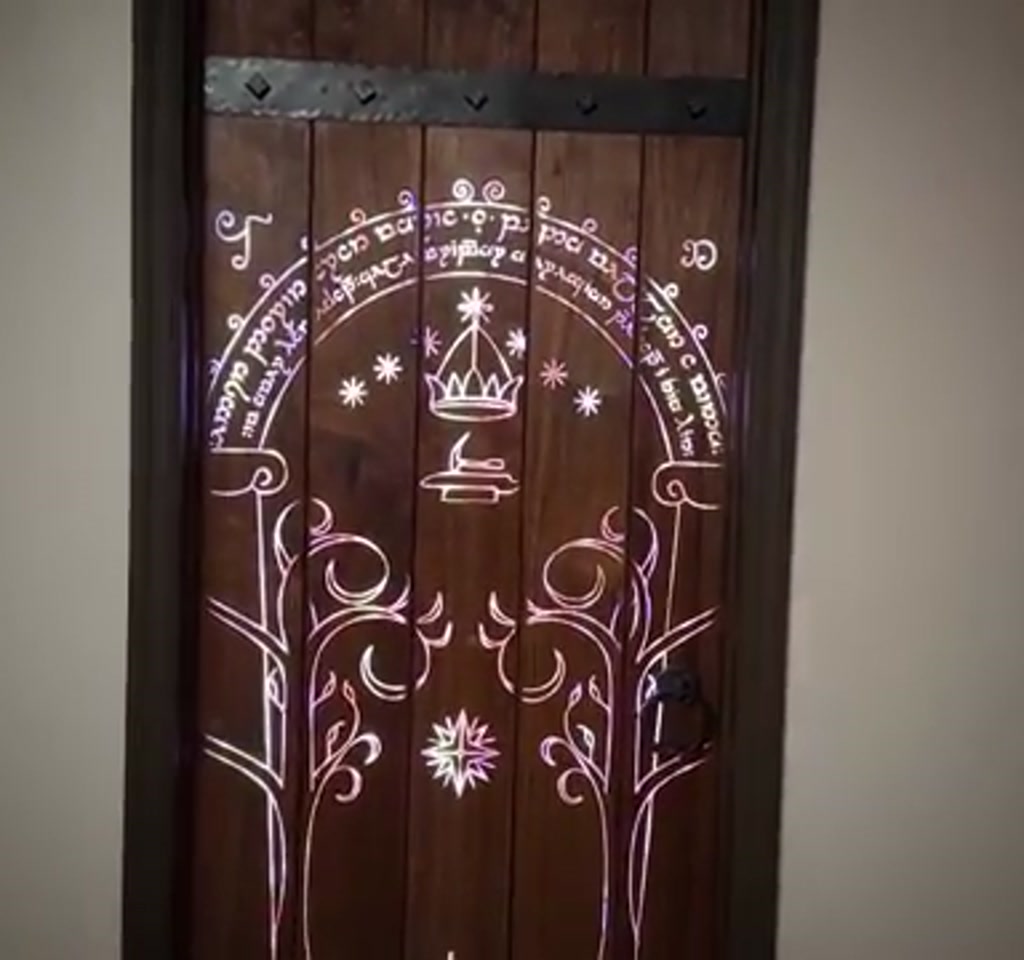
The Doors Of Durin from Lord of the Rings are an archetype of what a portal should feel like: ceremonial, mechanical and secretive. Recreating that feeling for a home laundry closet is not about slavish reproduction, it is about translating myth into real materials and real technical boundaries.
The central revelation of this build is that the magic lives where craft and constraints meet. The inscription and glow are only convincing because the maker planned for wood movement, heat management and offline voice control from the first cut. What actually determines whether this works is not the prettiest plaque or the fanciest code, it is the quiet engineering choices that stop the illusion from falling apart over time.
Most people imagine a fantasy door as pure ornament. This project reveals the opposite. The door is a systems problem made tactile: forged hardware must be physically honest with the wood, LEDs need controlled cooling paths, and wake word hardware must be coaxed into talking to the rest of the electronics without cloud services. Those are the knots the builder had to untie.
What becomes obvious when you look closer is how small decisions change everything. Walnut veneer, routed epoxy inlays and a single ring pull are the visible rewards. Behind them are repeated adjustments for grain, routing blowouts, and a micro-soldered hack to make a local wake word module useful. That blend of practical compromise and aesthetic intent is where this Doors Of Durin recreation finds its integrity.
Forging The Pull And Choosing A Style
The door gets its personality from metalwork as much as wood. The maker forged a large ring pull with a geometric, dwarven aesthetic so it reads heavy and utilitarian on camera and in the hand. Small workshop tricks show up here — hot glue used as a temporary third hand, wax for the finish, and citric acid to remove modern zinc coatings so bolts can look era-appropriate.
There is a practical constraint baked into those choices. Modern fasteners often have coatings that clash with a historic look, so descaling and custom texturizing is necessary. That process is simple chemistry but it adds labor and risk, because reusing hardware can leave the bolts 5 millimeters too short for the final assembly if dimensions are not rechecked.
Crafting The Magic Planks
The project’s signature element is the “magic plank”: walnut routed with runes, filled with epoxy, sanded to a thin veneer so 24-volt COB LEDs can shine through. The maker opted for walnut for its chatoyancy, then solved for walnut’s open grain with filler and a thin primer layer of epoxy to prevent delamination under the vinyl stencil during routing and fill operations.
There is an iterative craft rhythm here. Boards were acclimated for days, resawn, jointed where possible and planed down carefully to bring the epoxy flush without breaching the veneer. Handling thin planks requires finishing both sides evenly to avoid warping, and that small practice prevents seasonal disappointment later.
Technique And Small Failures That Matter
Routing in passes, gluing pieces to MDF to prevent curl, and making a tab to preserve a reference edge are all low glam but high impact. A router push caused premature wear, which was repaired by replacing brushes and clearing a blowout. Those are the moments that teach what the shop budget and schedule will actually look like.
Epoxy, Grain Filler And The Illusion Of Depth
Using vinyl stencils and epoxy to create the runes is a constrained solution: it produces convincing translucence but demands patience. Sanding too aggressively can burn through the veneer, and planing requires a millimeter level of control to preserve the thin layer that lets light pass. The reward is a plank that reads like a relic, not a backlit veneer surface.
Electronics And Local Automation
Electrically, the door is straightforward in principle but delicate in practice. The maker mounted 24-volt COB LEDs on an aluminum composite panel to act as a lightweight heatsink and used a Raspberry Pi Pico to generate PWM fades. That choice kept the control local, predictable and hackable.
From an editorial standpoint, the most interesting decision was insisting on local voice activation and sunset timing without cloud dependencies. The builder implemented a NOAA sunrise and sunset algorithm in the Pico so the door lights come on 30 minutes after sunset using only coordinates and trigonometry. That is the kind of robust simplicity that scales to other projects.
Power, PWM And Thermal Reality
COB strips at 24 volts can be very bright, and their power draw scales with length. For a door-sized array, the consumption typically sits in the tens of watts rather than single-digit watts. A cautious estimate for a door installation of this scale is roughly 20 to 60 watts depending on strip density and length. That range matters because it determines power supply sizing, fuse choices and how aggressive the heatsink strategy must be.
Wake Word Hardware Hack
Voice activation was trained to the elvish word for friend, “Melon,” on an offline wake word module. The device did not expose a clean serial or digital trigger, so the maker observed the module’s LED blink on wake and micro-soldered a tap to that indicator. That tiny hardware workaround is a practical constraint to expect when favoring privacy and local detection over cloud assistants.
That workaround also leaves a question about long-term reliability versus replacing the module with a more standard interface, a tension addressed later when we discuss tradeoffs between privacy and maintainability.
Mounting, Weight And Mechanics
Doors sag if you let them. To prevent racking the build includes a diagonal brace designed to carry shear across the frame so the door keeps its geometry under load. The maker double-checked hinge placement using a jig and used clear brackets with CA glue to keep panels flush while allowing for seasonal movement.
The final door weight was about 82 pounds, and that number drove hinge selection, spring sizing and how the door is hung. The practical takeaway is that a decorative, mechanical door is still a structural object. Throwing ornate hardware on a weak frame is where illusions fail, so the build prioritized functional fasteners disguised by forged aesthetics.
Two Constraints That Define The Project
This approach only stays magical when two conditions are respected. First, wood movement matters: walnut and thin planks will want to move with humidity cycles, often producing measurable gaps of a few millimeters across seasons if panels are fully glued down. The tradeoff here is between a rigid, glued look and the breathing space wood needs to remain stable.
Second, power and heat set real limits. The 24-volt COB array, sized for the door, will typically draw in the tens of watts and therefore needs a dedicated power supply and a heatsink strategy. If the LED run approaches the high end of the 20 to 60-watt range, plan for active cooling or a larger thermal path because heat will shorten LED life and change color rendition over time.
Both constraints raise a maintenance question: how often will seasonal checks, fastener retorques and electrical inspections be needed to keep the illusion intact? That detail is part of the project’s ongoing story and is discussed in limitations and tradeoffs below.
Finishing Touches And The Theater Of A Portal
Small details sell the story. The maker added chamfers to plank edges to create shadow and depth, painted the surrounding trim to make the portal feel separate from its garage context and installed a product intended to force a theatrical creak on opening. Springs provide the opening force and a magnet acts as a simple latch; this is a functional compromise that prioritizes effect over lockable security.
There is a sensory accuracy to these decisions. The polish on the planks had to be wiped with alcohol to remove uncured stain that made the epoxy shine too brightly. Those kinds of micro corrections are part of the craft. They are also the reason a vignette of wood and metal can feel like a door you might step through into a story.
Quotable and useful: convincing fantasy hardware is less about exaggeration and more about truthful responses to force, heat and time.
What This Project Means For Makers
The project is a compact lesson in systems thinking for anyone blending traditional craft with electronics. It demonstrates how a simple wake word, local timing based on sunrise and sunset and a considered thermal plan keep a fantasy prop working long after the initial reveal.
If you are motivated to try this yourself expect an iterative path. The parts list is accessible, but the work is in the details: routing jigs that prevent curl, epoxy techniques to stop delamination, checking fastener lengths twice, and being ready to micro-solder when off-the-shelf modules do not behave the way you need them to.
For builders who are curious about local voice recognition modules or Raspberry Pi Pico projects, this door is a compact case study in privacy-forward automation and how mechanical and electrical design must be integrated to hold the illusion together.
Looking ahead, the same approach scales. Swap materials, increase scale to an arched double door or translate the pattern into a stone surround. The experiment that began as a single walnut plank ends as a template for making portals that feel both plausible and programmable.
For anyone who wants the technical blueprints, the maker has published the schematics and step notes on their support page, which is a useful starting point for adapting the technique to different doors and climates.
There is more to explore here than a single build can contain, and the real work of design is in knowing which constraints you will honor and which you will bend. That choice is where the next interesting door will come from.
How The Voice Activation Works
The voice activation in this build is local and narrowly focused: an offline wake word module listens for the trained keyword “Melon” and signals the rest of the system by blinking an indicator LED. The Raspberry Pi Pico polls that signal and runs PWM fades for the 24V COB strips, keeping wake detection and lighting control within the home network and out of the cloud.
Benefits Of Local Control And Privacy
Keeping voice detection and timing local removes dependencies on external services and reduces latency. Local control also simplifies testing and modification: coordinates and a NOAA sunset algorithm on a Pico mean reliable scheduling without account linking, and that reliability is part of the appeal for privacy-minded makers.
Limitations And Tradeoffs
Choosing local, offline components trades convenience for responsibility. You gain privacy and predictable behavior, but you also accept potential hardware workarounds, manual firmware updates and a higher bar for initial integration. Expect to micro-solder or replace modules if they lack standard interfaces.
On the material side, walnut veneer and thin epoxy-filled planks offer beautiful translucence but require careful acclimation and balanced finishing to avoid warping. Thermal limits for the LEDs demand a conservative power budget and a plan for heatsinking that may add weight and cost.
Doors Of Durin Vs Conventional Smart Doors
Doors Of Durin Recreation Versus Cloud Smart Door Systems highlights clear decision factors: privacy, customization, and craft integration versus out-of-the-box features, voice assistant compatibility and remote access. If you want theatrical presence and offline timing, a local build wins; if you prioritize easy remote control and ecosystem integration, conventional smart doors have the edge.
Comparison By Use Case
- Privacy and local automation: Doors Of Durin recreation.
- Remote monitoring and ecosystem features: conventional smart doors.
- Customization and aesthetic control: Doors Of Durin recreation.
Who This Is For And Who This Is Not For
Who This Is For: Makers comfortable with woodworking, basic electronics, and occasional micro soldering who want a privacy-focused, theatrical portal that prioritizes craft and local automation. Also suitable for people who value customization over turnkey convenience.
Who This Is Not For: Someone seeking a simple, app-controlled smart door with cloud features and remote access out of the box. If you cannot or do not want to service hardware or handle seasonal wood adjustments, consider conventional smart hardware instead.
FAQ: Frequently Asked Questions
What Is The Doors Of Durin Recreation?
The build is a walnut and forged-iron inspired door with routed epoxy rune inlays, 24V COB lighting, and offline voice activation trained to the word “Melon,” designed as a theatrical, privacy-forward portal rather than a conventional lockable door.
How Does Voice Activation Work Without The Cloud?
An offline wake word module detects the trained keyword and indicates detection via an LED blink. The Raspberry Pi Pico watches that signal and runs local logic for timing and LED fades, removing the need for internet-connected voice assistants.
How Much Power Do The LEDs Use?
Power draw depends on COB strip length and density. For a door scale array the project estimates roughly 20 to 60 watts, which informs power supply selection and heatsinking strategy.
Will The Walnut Planks Warp Over Time?
Walnut and thin planks are sensitive to humidity. The maker acclimated boards, finished both sides evenly and left small allowances for movement. Seasonal gaps of a few millimeters are possible if panels are fully restricted.
Can I Replace The Wake Word Module With A Different Device?
Yes, but expect integration work. The original module required a micro-soldered tap to use its indicator as a trigger. Replacing it with hardware that exposes a digital output reduces hack work but may change latency or training workflows.
Is This Door Secure As A Primary Entry?
No. The project prioritizes theatrical effect and privacy-forward automation over lockable security. Springs, magnets and a theatrical creak product are used for effect rather than robust locking. For primary entry security use tested lock hardware.
Where Can I Find The Schematics And Step Notes?
The maker published schematics and step notes on their support page, which is listed as a resource for adapting the technique to different doors and climates. The article does not host the blueprints directly.
How Do I Decide Between Active Cooling And Larger Heatsinks?
That choice depends on LED run wattage and enclosure constraints. If your installation approaches the high end of the 20 to 60-watt range, plan for a larger passive thermal path or active cooling to protect LED life and color stability.
COMMENTS