


When a gadget arrives looking smaller than your expectations and thinner than a credit card, the immediate reaction is wonder. The GAMERCARD earns that reaction. It is a 6 millimeter thick handheld, the size of a supermarket gift card, packing a Raspberry Pi Zero, a square 4 inch IPS display and a 1600 milliamp hour battery into a package that deliberately flirts with absurdity.
The early insight here is not merely that this is astonishingly thin. The real significance is that the GAMERCARD is a design statement that forces a set of difficult tradeoffs. Those tradeoffs are practical, commercial and technical. They determine whether the device stands as a collectible oddity, a niche maker success, or something that can survive everyday use and retail shelving.
Spending a day with Grant Sinclair, who designed the device and who is Clive Sinclair’s nephew, provides more than first impressions. It reveals the lineage behind the idea, the thinking that put a sapphire screen and stereo amplifiers into something that can hang on a rack, and the points where engineering constraints meet retail reality. What most people misunderstand at first glance is that the GAMERCARD is not trying to be the most powerful handheld. It is trying to be the thinnest one that still plays games, and that decision shapes everything else.
This article looks closely at the design choices, the hardware that fits into that 6 millimeter envelope, the control layout and its durability implications, and the software compromises that come with using a Raspberry Pi Zero as the brains. Along the way there are two unavoidable constraints up front: the battery and the controls. They are the variables that most affect daily usefulness and long-term durability.
Design And Heritage
The GAMERCARD wears its inspiration visibly. Grant Sinclair points to family history, specifically the Sinclair Executive calculator and the ZX Spectrum. Those devices were exercises in making technology as thin and as playful as possible. The GAMERCARD continues that lineage with a retro futuristic aesthetic: matte black faceplate, a subtle gold accent, and a square display that dominates the front.
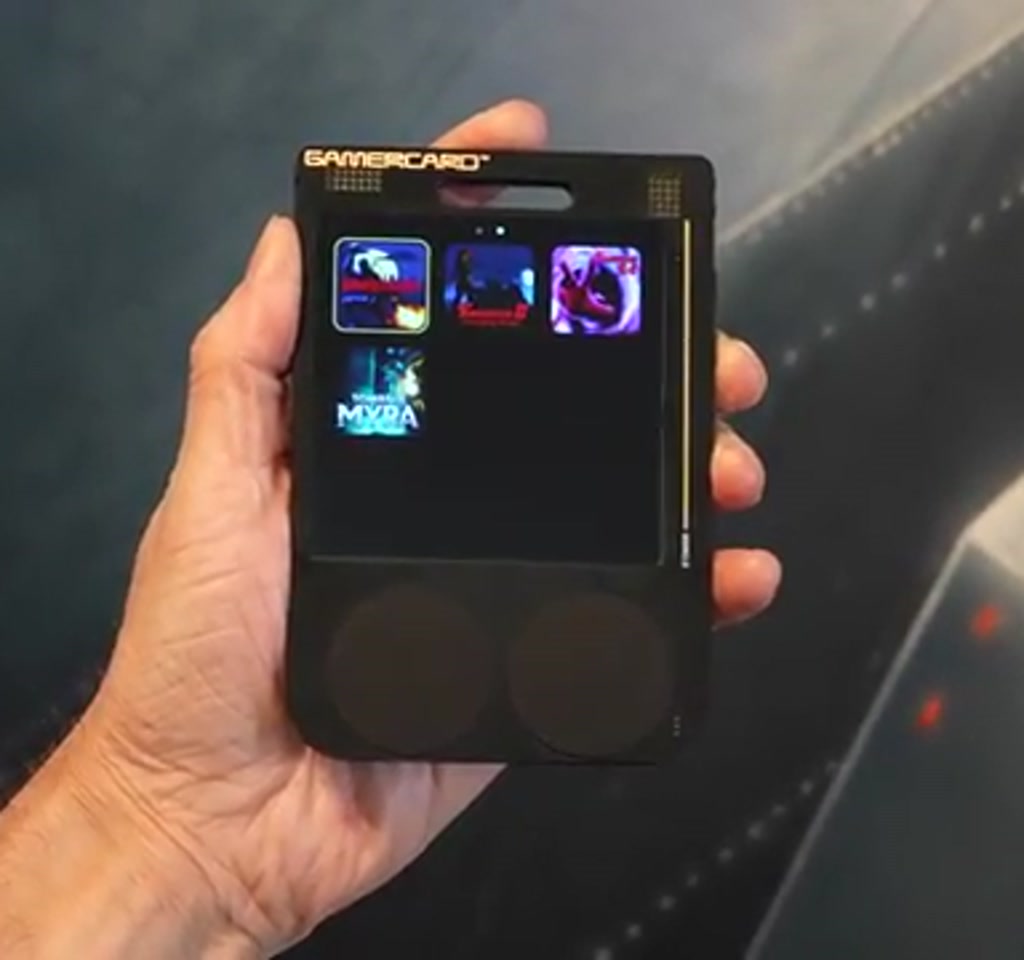
Key measurements are concrete. Thickness is 6 millimeters. The display is a 4-inch IPS panel at roughly 256 pixels per inch, a density that the team compares favorably with laptop retina screens. The display glass is sapphire, chosen for scratch resistance, which is a nod to longevity in one slice of the design. Stereo speakers sit at the top of the faceplate, each with its own amplifier to make audio punchy despite the tiny chassis.
Grant’s retail idea is provocative. He wants these to hang like gift cards with a hole or hang tab, zero packaging, and a grab-and-scan experience. That is an industrial design dream: minimal waste and direct merchandising. The constraint is practical. A 6 millimeter device on a shelf brings theft risk, and a precharged battery will slowly lose power in storage. Retailers will weigh shrinkage and shelf life against eye-catching novelty. That tension is as much a part of the product as the silicon inside.
What Is The GAMERCARD
The GAMERCARD is a deliberately minimalist handheld that prioritizes thinness and form over raw performance. Built around a Raspberry Pi Zero, a 4-inch sapphire display, and a 1600 milliamp-hour battery, it aims to be a collectible, a developer canvas for Pico 8, and a conversation piece that trades everyday convenience for radical design.
Hardware And Performance
The GAMERCARD is powered by a Raspberry Pi Zero, paired with a 1600 milliamp-hour battery and a sapphire 4-inch IPS display. This hardware mix defines the device: compact, affordable, and capable of crisp 2D and light 3D workloads, while imposing a clear upper bound on emulation and native 3D performance.
At the heart of the GAMERCARD is a Raspberry Pi Zero. That choice signals an intentional tradeoff. A Raspberry Pi Zero is compact and affordable, but it is not a high-performance gaming SoC. It enables native Pico 8 development, snappy 8 and 16 bit emulation, and in many cases a satisfying experience for retro content. It also defines an upper bound for what can be emulated comfortably, with PlayStation 1 era titles typically being the practical limit on devices built around that compute class.
The device ships with a 1600 milliamp-hour battery. Here is a quantified constraint: depending on standby draw and how the system manages sleep, battery depletion on a shelf could happen in several weeks to a few months. That means a zero packaging retail model needs a plan for either periodic charging, in-store lockups with power, or acceptance that some units will be dead until recharged at checkout. Any of those solutions adds cost, friction or logistical complexity.
Thermal design also matters. Grant tells a clear story about including a heatsink. In practice the device gets warm under continuous play but not hot. Observations during a hands-on session across a few hours showed warmth rather than uncomfortable heat. That matters because in a 6 millimeter body even modest heat can become perceptible. Heat management in such a thin device is a constraint that limits burst performance and sustained workloads; longer play sessions may push the Raspberry Pi Zero close to its thermal ceiling.
Controls And Durability
The GAMERCARD’s controls are an explicit design compromise meant to keep the exterior minimal while preserving discrete input. Two silicon circles hide directional and action buttons beneath, creating a pared-back front that looks clean but places stress on soft materials and the underlying switches.
One of the most striking design choices is the pair of silicon circles on the face that hide the controls. Underneath them are four directional buttons on one side and four action buttons on the other. The tactile approach demands discrete presses rather than sliding or sweeping fingers, which is part of the device’s unique play philosophy.
Comfort And Feel
Holding the GAMERCARD is an odd pleasure. It feels impossibly thin yet substantial. The square display makes everything look modern, and the matte finish planned for production should mute reflections compared to the glossy prototypes. The speakers provide a louder, clearer audio picture than might be expected for such a small chassis.
Wear, Replaceability And Risk
The silicon face is soft and flexible by design, but that flexibility is the second quantified constraint. High-frequency button presses wear materials out. The likely failure modes are silicon relaxation, loss of tactile snap, protrusion of underlying switches, or tears along stress points. Those effects typically appear after months of daily heavy use or after a year-long intermittent usage, depending on press frequency and material formulation.
Replaceability Options
Because the design favors minimal visual clutter, the practical remedy is to offer spare silicon pads or user service paths. Grant may need to provide replacement silicon pads, or design the faceplate to be user-serviceable. That adds complexity to a product whose chief selling point is minimalism, but it is necessary if the device will be used daily.
Software And User Experience
Software is where the design-to-use compromises show their effects. A bespoke launcher simplifies game access but lacks fluid navigation. The deliberate omission of a touchscreen preserves thinness at the cost of some intuition when navigating non-game UI elements.
What becomes obvious when you power the GAMERCARD is that the software does not rise to the same level as the hardware statement. Grant’s team built a custom launcher to simplify access to games and to mask the underlying Raspberry Pi operating system. However, the launcher needs more fluidity and clearer navigation cues. Exiting a game or returning to the launcher is not immediately obvious, and there are no dedicated physical menu buttons to make that interaction instant.
There is also a deliberate decision to avoid a touchscreen. Adding touch would increase thickness, and the device is specifically trying to remain in a unique thinness category. That choice is defensible but it shapes the user experience. Because the device is not a touchscreen computer, interacting with the underlying PC interface can feel clunky, requiring D-pad movements to operate a cursor and double presses to confirm. That is a software constraint with measurable consequences: a system that demands more button presses is slower in seconds and less intuitive in everyday use.
On the positive side, Pico 8 games sing on the display. The constrained color palette and lower resolution of Pico 8 titles fit the square panel naturally and show why the GAMERCARD will appeal to hobbyist developers and educators. The preloaded catalogue includes two licensed Switch ports, Astro Blaze and Blue Kid 2, and three ZX Spectrum Saboteur titles, which demonstrates both retro DNA and a willingness to ship with recognizable content.
Emulation, Limits And Licensing
Emulation works. SNES titles run, and it is reasonable to expect PlayStation 1 era games to be the upper practical limit for a Raspberry Pi Zero-based device. That is an important, quantified performance boundary. Heavier modern emulation or native 3D workloads will quickly exceed what the hardware can sustain.
Grant is cautious about marketing the GAMERCARD as an emulation machine for copyrighted material, and that caution is understandable given legal and ethical ambiguity in the retro handheld space. From a retail messaging standpoint, leaning into Pico 8, native indie titles, and licensed ports is a cleaner strategy. Those are the areas where the hardware and software align without promising more than the device can deliver.
GAMERCARD Vs Alternatives
Compared to bulkier boutique handhelds and modern emulation-first devices, the GAMERCARD trades performance for silhouette. If you prioritize absolute emulation capability, alternative Raspberry Pi-based handhelds or commercial retro consoles will outpace it. If you value thin industrial design and a sapphire display, few competitors match its aesthetic.
Decision factors include price, repairability, and intended library. At roughly 129 pounds, the GAMERCARD sits in a zone where buyers must choose between design provocation and specification-driven value. That is the practical calculus every buyer faces.
Constraints, Practicalities, And What Comes Next
- Battery Lifecycle A 1600 milliamp hour battery is enough for casual play sessions but not for long retail shelf life without power. Expect units left unplugged to be at risk of full discharge after several weeks to a few months, depending on standby management.
- Button Longevity The face silicon is prone to material relaxation and wear under repeated presses. Manufacturers should plan for spare pads or an easy replacement route, as the likely failure window is months of heavy use or a year of typical intermittent play.
- Performance Ceiling The Raspberry Pi Zero defines a sensible emulation and native game ceiling. PlayStation 1 era titles are a practical upper bound for comfortable performance, with heavier titles showing visible slowdowns.
Those practicalities do not negate the project. They are the reality checks that follow any radical industrial design. The question that remains is which constraints the maker chooses to accept and which he addresses. Grant seems to be betting that a vivid form factor and curated software experience will outweigh absolute performance or mainstream retail convenience.
Who This Is For And Who This Is Not For
Who This Is For: Collectors who prize design provenance and Sinclair lineage, handheld enthusiasts drawn to bold industrial ideas, and Pico 8 developers or educators seeking a portable, visually distinctive canvas. These buyers value story, novelty and form as much as function.
Who This Is Not For: Players looking for a heavy-duty emulation device, buyers who want a worry-free plug-and-play library comparable to mainstream consoles, and users who need long unattended retail shelf life without added logistics. For them, alternative devices or more conventional packaging models make more sense.
Why This Matters Beyond A Novelty
The GAMERCARD sits at an intersection that matters to smaller hardware makers. It asks whether boutique devices can be successful by leaning into story and singular design rather than raw spec sheets. It also asks retailers to reconsider how small, high-curiosity devices are merchandised without adding packaging waste. Those are broader industry questions: sustainable presentation, maintenance and replaceability, and the economics of niche hardware.
What becomes interesting is that the GAMERCARD is not just another tiny emulator. It is a physical argument about minimalism as a platform. It forces a conversation about the cost of beauty in hardware, and whether collectors and makers will subsidize a model that needs periodic hands-on repair or careful retail handling.
Final Thoughts
The GAMERCARD is a bold, elegant experiment. It is a reminder that hardware can still astonish through a clear aesthetic idea. At the same time, the device exposes where design purity collides with practical needs: power management, button durability and software fluency. Those tensions are not defects so much as the boundaries that define its usefulness.
For people who want a conversation-starting handheld, a collectible with Sinclair lineage, or a tiny canvas for Pico 8 and retro indie games, the GAMERCARD is compelling. For buyers seeking a mainstream, heavy-duty emulation experience or a worry-free retail purchase, the constraints will matter. The next steps to watch are how the maker addresses replaceability for wearable parts, how the launcher evolves to match the hardware’s minimalism, and how retailers respond to the zero packaging idea.
There is room for more makers to push the limits of what handheld gaming can look like. The GAMERCARD is an important experiment in that space, an invitation to rethink how thin is possible and what that thinness costs in real-world terms. The question now is whether those costs are acceptable to the people who will love it most.
Interested readers can look forward to a full review when a production unit becomes available and more details on software polish and repair options are clear. For now, the GAMERCARD is a daring piece of hardware that asks us to choose between design provocation and everyday convenience, and that choice is exactly what makes it fascinating.
FAQ
What Is The GAMERCARD?
The GAMERCARD is a 6 millimeter thick handheld built around a Raspberry Pi Zero, a 4-inch sapphire IPS display, and a 1600 milliamp-hour battery. It prioritizes thin industrial design and a curated software experience over raw emulation performance.
How Thick Is The GAMERCARD?
The device measures 6 millimeters thick, roughly the thickness of a credit card, which is the core design constraint shaping its hardware and interaction choices.
What Hardware Does The GAMERCARD Use?
It uses a Raspberry Pi Zero as the compute platform, a 4-inch IPS sapphire display, stereo speakers with separate amplifiers, and a 1600 milliamp-hour battery. A heatsink is included for thermal management.
How Long Will The Battery Last?
The article gives the battery capacity at 1600 milliamp hours and notes that battery depletion on a shelf could take several weeks to a few months depending on standby draw. Exact playtime per charge is not specified in the available information.
Can The GAMERCARD Emulate Modern Consoles?
Emulation on the GAMERCARD is reasonable for SNES and similar 16-bit titles. The practical upper bound for comfortable performance on the Raspberry Pi Zero is typically PlayStation 1 era games; heavier modern emulation is likely to show slowdowns.
Is The Screen Scratch-Resistant?
Yes. The display glass is sapphire, chosen specifically for scratch resistance as part of the product’s longevity strategy.
Does The GAMERCARD Have A Touchscreen?
No. The maker deliberately avoided adding a touchscreen to preserve thinness, and navigation relies on a physical D-pad and action buttons plus a custom launcher.
Will There Be Replacement Parts For Worn Buttons?
The article notes likely wear of the silicon face and suggests that manufacturers should plan for spare pads or user service paths. It is not yet certain how the maker will handle replacements in production.
COMMENTS