


The moment a retractable lightsaber unfurls and holds a solid edge, it stops feeling like a cosplay prop and starts feeling like a machine. That is the real accomplishment in this project. The glow is cinematic, but the engineering is what makes one of these devices safe and useful for dueling.
What becomes obvious when you look closer at this maker’s three-year journey is not just incremental iteration. The story is about stacking solutions so that each weak point is no longer the single point of failure. A software bug could make an LED strip blow up after hundreds of extensions. A single cracked gear could ruin dozens of tests. And a millimeter of missing interior space can force a full chassis redesign.
The key revelation early on is this. The most misunderstood part of a duel-ready retractable lightsaber is not the blade material, nor the brightness. What actually determines whether it works is the coordinated control of tension, rotation, and balance. Locking the blade by tightening the cane while pulling the LED strip, combined with a balanced spinning chassis and impact-forgiving stabilizer, is what turns a flexible magician’s cane into a tool you can swing repeatedly.
This article walks through the six-month sprint that turned a flashy prototype into something you can trade blows with. It surfaces the tradeoffs and constraints that shaped every engineering decision, the surprising accidental fixes, and the tiny practical details that most people miss when they see the final demo.
The Six-Month Mission
By the time the maker set the deadline, the project already had a long runway. The effort began as a childhood obsession with Star Wars and a desire to make a lightsaber that behaved like the ones on screen. Over several prototypes the design evolved from a bulky mechanism into something that fits inside a replica Graflex hilt, lights up brilliantly, and ignites nearly instantly.
The community pushed for one upgrade above all: dueling capability. That became the six-month mission with a public milestone of Star Wars Day. The constraints were obvious. The saber had to be stiff enough to take hits, stable enough for predictable handling while spinning, and durable enough to survive many duels. All of that had to fit inside the visual and dimensional envelope of a Graflex hilt.
Time was another constraint. The maker booked flights to demo the saber in California and intended to show it on a Star Wars night event. That placed schedule pressure on every design choice. Even small delays in solving thermal, mechanical, or electrical issues became critical, because the design needed to survive travel and public scrutiny in a live environment.
What Is A Retractable Lightsaber And How It Works
A retractable lightsaber is a compact blade system built around a coiling tube and an embedded LED strip that extends and retracts into a hilt. It works by converting rotation into axial motion, using coordinated motor control to tension the blade and an LED spool to provide light and mechanical linkage at the tip.
Three Engineering Challenges
Challenge One, Stiffening a Springy Blade
The blade is a magician’s cane, a long thin tube that compresses into a tight coil when retracted. That geometry is excellent for compactness but terrible for stiffness. Most duel-ready sabers use rigid polycarbonate tubes. The retractable approach has to make a floppy structure feel solid when extended.
Initial attempts to stiffen the cane included annealing the plastic with a heat gun. That is a known technique to alter polymer stiffness, but in practice it produced minimal benefit and even shortened the usable length. The breakthrough came from a different idea: actively increasing axial tension while the cane is extended. By reversing the rotation behavior of the cane motor and commanding the LED spool to pull hard, the cane is effectively locked in tension and becomes dramatically stiffer.
That solution relies on two coordinated actions: tightening the helical cane while tugging the LED strip at the tip. Alone, each measure helps a bit. Together, they change the physics of the system from a flexible tube to a tensioned column that resists bending.
Challenge Two, Stabilizing A Spinning Blade
The visual effect comes from spinning the blade rapidly so the embedded LED strip appears as a continuous, pulsing column of light. Spinning, however, creates gyroscopic forces and, if components are unbalanced, chaotic wobble. The maker discovered an obvious but critical source of wobble: a chassis that does not spin about its center of mass.
Testing for imbalance was low-tech and effective. The spinning chassis was rolled on the floor to see if one side favored the bottom. When it did, the maker added pockets into a chassis redesign to house tiny balancing weights.
Testing used a series of small metal inserts ranging from steel screws to tungsten rods and tape. Even after perfecting balance, wobble persisted, which clarified that balance reduces one class of wobble but does not eliminate instability caused by impact shocks and elastic interactions between the cane and the stabilizer.
Challenge Three, Durability Inside A Replica Hilt
Space, heat, and repeated mechanical stress were constantly at odds. The LED strip had to perform three roles: bright illumination, tensile element for retraction, and a load-bearing connection to the tip. That triple duty put the strip under torsion, tensile stress, and thermal cycling. The result was predictable: repeated spooling and tensioning created microfailures in the LED strip and adhesive.
A suite of incremental fixes followed. Material changes for printed gears to nylon carbon fiber stopped 3D-printed teeth from snapping during high-torque events.
Replacing ABS spools with polycarbonate solved heat softening. Backing the LED strip with fiberglass tape diverted tension away from the strip itself. Crucially, a software bug that was overdriving the strip and overheating it was identified and fixed, dramatically improving longevity.
The Long Tail Of Fixes And The Accidental Discovery
Engineering rarely proceeds in straight lines. The maker repeatedly hit brittle failure modes in motors, gears, adhesives, and electronics. One recurring problem was a retraction motor that kept breaking because magician’s canes require simultaneous downward force and rotation to rewrap correctly. Replacing that motor with a beefier unit solved the immediate failure but forced rethinking of gear geometry and heat dissipation.
A sensory detail that matters and that most viewers miss is sound. Running the rotation motor at high continuous torque made the device rigid, but it also created a drill-like noise that drowned out the intended sound design. The maker had to tune torque and motor drive so stiffness did not come at the expense of the user experience.
Then came the accident. In the late hours before a flight, a mis-soldered connection caused the cane to tighten instead of loosen during retraction. That electrical mistake stopped retraction, but the footage revealed that while the cane was tightening and the LED strip was pulling hard, the blade became the stiffest it had ever been.
The maker realized this could be the intended operating mode: intentionally tighten the cane on extension while commanding the strip to apply strong axial pull. With a now corrected software stack and LED strip cooling fixed, the strip could withstand the temporary high load and the blade would lock rigidly.
Materials, Thermal Limits, And Practical Tradeoffs
The evolution of materials and adhesives demonstrates two concrete constraints. First, thermal management is a real limiting factor. The LED strip overheated when overdriven, making adhesive and polymer parts fail after hundreds of activations.
Fixing the firmware to limit power draw and switching to polycarbonate spools reduced failures. That illustrates a quantified reality: under aggressive visual settings and repeated activation, thermal stress can surface in the order of hundreds of cycles rather than thousands.
Second, internal space creates hard boundaries. The replica Graflex hilt left not a millimeter to spare. That forced tradeoffs between motor size, balancing weights, and gear robustness.
The maker resorted to precious metal inserts like tungsten tape and tiny rods to shift center of mass without changing the external profile. The result is a system that works but is delicately packaged, which affects serviceability and manufacturing tolerance.
Other tradeoffs include noise versus stiffness, and durability versus retractability. Running motors constantly at high torque can give a stiff blade but produces unacceptable acoustic signatures.
Reinforcing the LED strip with protective tape improves longevity but interacts poorly with lubricants. The practical fix was to find a lubricant that does not destroy adhesives; silicone oil became the acceptable middle ground after mineral oil was found to break tape adhesives within days.
Benefits Of A Retractable Lightsaber
Retractable lightsabers offer a compact, portable blade that conceals long length inside a small hilt and delivers a striking cinematic effect. When engineered for dueling, they can mimic the feel of a heavier saber while enabling transport and storage advantages that rigid polycarbonate blades cannot match in compact replicas.
Visual Appeal And Portability
The quick extension and the glowing column created by a spinning LED strip produce a distinct stage presence. That visual payoff is paired with the practical advantage of storing a long blade inside a hilt sized for display or travel, which matters for cosplayers and performers who need both authenticity and logistics.
Limitations And Tradeoffs
Retractable designs trade inherent rigidity for compactness, which forces engineers to add systems that deliver stiffness indirectly. Thermal limits, serviceability challenges, and complex control software are common constraints that increase build complexity and cost compared to simple rigid blades.
Key Constraint Areas
Thermal stress shortens component life if LEDs are overdriven. Space limits drive compromises between motor torque and balancing mass. Durability often requires reinforcing the LED strip and upgrading materials, which raises cost and assembly difficulty. These tradeoffs define whether a retractable saber is practical for repeated dueling.
Retractable Lightsaber Vs Rigid Polycarbonate Sabers
Comparing retractable and rigid sabers clarifies design decisions. Rigid polycarbonate blades are reliably stiff, simple to service, and already used for dueling. Retractable blades win on compactness and spectacle but require coordinated tension control, thermal management, and frequent servicing to approach the same durability.
Decision factors include stiffness under impact, repairability in the field, transport and storage convenience, and cost to produce. For someone prioritizing immediate, rugged dueling, rigid polycarbonate remains the practical choice. For those prioritizing portability and a unique mechanical spectacle, retractable designs present a compelling, if more fragile, alternative.
Final Upgrades That Made The Saber Duel Ready
None of the final changes were singular miracles. The dual-ready behavior comes from combining multiple incremental improvements into a single system where no one failure mode dominates. Key upgrades included:
Stiffening Strategy The addition of a motor driver capable of reversing cane rotation, a beefier rotation motor, and commanding a higher axial pull on the LED strip during locking created a tensioned blade that resists bending.
Stability Measures A redesigned chassis with pockets for balancing weights, a focused brass mass at the chassis bottom, an impact forgiving stabilizer with flexible prongs, and an anti wobble algorithm that adjusts spin speed in real time reduced wobble from impacts and rotation anomalies.
Durability Improvements: Critical 3D-printed gears were moved to nylon carbon fiber composites, LED spools became polycarbonate to resist heat, LED strips were backed with fiberglass tape to bear tension, and firmware power limits prevented overheating.
What becomes clear from this list is a systems lesson. Each change traded off something else. Firmer locking required higher instantaneous tensile loads on the strip, which demanded thermal and mechanical upgrades elsewhere.
Balancing reduced low-speed shake but did not fix impact-induced wobble. The finished device is therefore the integrated outcome of many interlocking tradeoffs rather than a single perfect substitution.
Quantified Constraints To Keep In Mind
Thermal and cycle limits: the LED strip experienced failures after repeated activations when overdriven, a failure mode that showed up over the course of hundreds of trials rather than tens. Correcting drive signals and moving to heat-resistant spools extended life into many hundreds more activations, but the long-term goal remains an LED strip designed for tens of thousands of cycles.
Space and serviceability: packing balancing weights and stronger motors into a Graflex scale hilt left essentially zero spare volume. That means maintenance or swapping components will require partial disassembly or redesigned internals, which increases production complexity if this were to be manufactured at scale.
Who This Is For And Who This Is Not For
Who This Is For: Makers, cosplayers, and performers who value portability, spectacle, and are willing to accept higher maintenance and refinement cycles. Also useful for hobbyists who enjoy complex mechanical and firmware challenges and have access to community support for iterations.
Who This Is Not For: People seeking a low-maintenance, rugged dueling tool out of the box. If serviceability, long cycle life, and field repairs are the priority, a traditional rigid polycarbonate blade remains the safer and simpler choice.
Testing, Public Reaction, And The Road Ahead
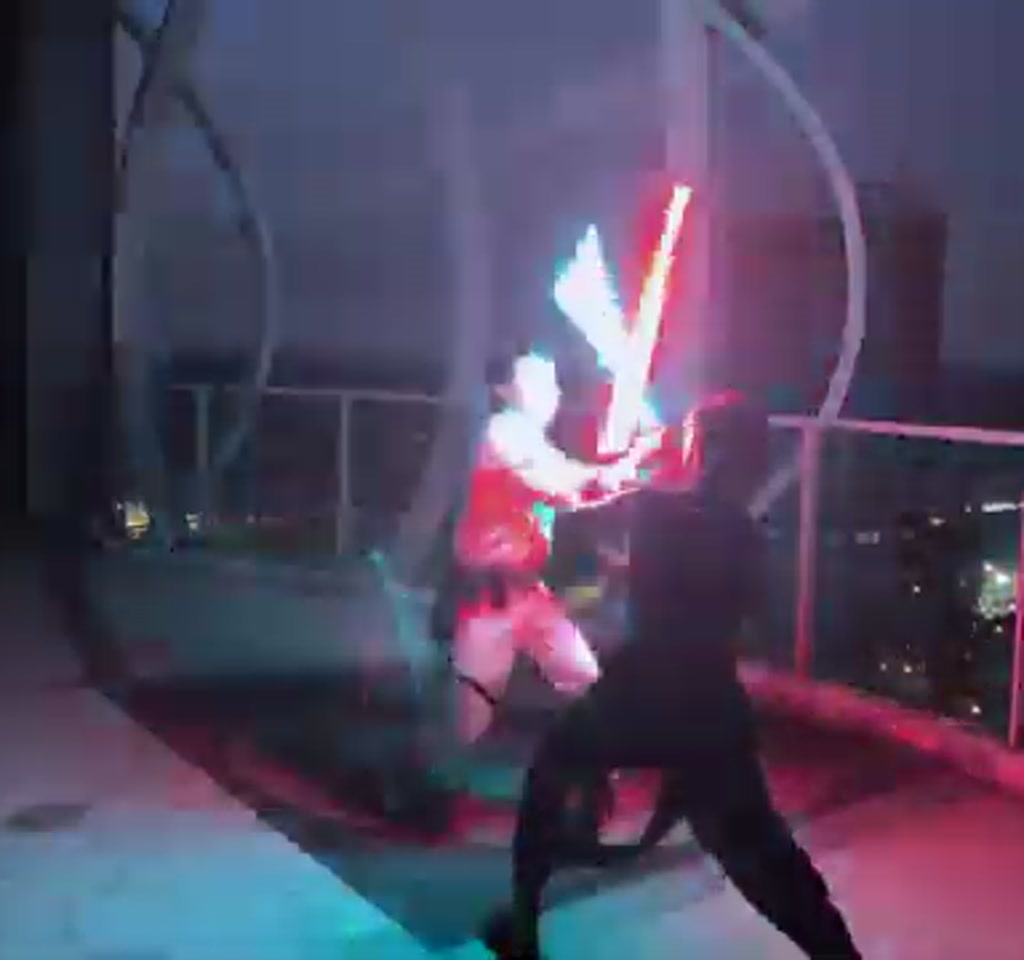
Despite last-minute electrical issues that grounded one prototype during a live demo, the working saber provoked genuine astonishment. The crowd reactions were a reminder that engineering for show is also engineering for perception. The chassis spinning creates a real gyroscopic feel that is not just theatrics. The resistance in motion mirrors a lore-friendly behavior and changes how a user aims and swings the saber.
From an editorial standpoint, the most compelling detail is how debugging in public altered the timeline and the solution set. The accidental solder mistake that later became the stiffening strategy is a perfect example of how engineering serendipity works. It is not luck alone; it is a combination of exhaustive testing, good instrumentation, and a willingness to learn from what initially looks like failure.
Looking forward, the maker has clear priorities: further stiffen the blade so heavy hits show less flex, improve runtime and retraction speed, perfect user friendliness, and design custom LED strips engineered for this dual duty. Each of these goals interacts with existing constraints, so future iterations will again be about tradeoffs rather than single fixes. Custom LED hardware, for instance, would reduce the need for fiberglass backing and allow higher tensile loading at the tip, but it will increase cost and require new supplier relationships.
The files and build notes were released to the community for a limited period, which means hobbyists can reproduce and iterate on the design. That openness accelerates development but also exposes the device to people who will push it to new limits. That is, in fact, part of the point: making a repeatable, buildable path from concept to duel-ready prototype.
One paragraph from this story stands alone as a guiding insight: the glow makes people gasp, but tension and balance make the tool useful. Engineers chasing cinematic fidelity need to design for load, heat, and mechanical resilience before they chase the perfect visual effect.
What comes next is the interesting part. Will manufacturers pick up these lessons to create modular, serviceable retractable blades for a wider audience? Can LED manufacturers be convinced to make strips that handle repeated tensile duty under heat? Those are the industrial questions that will determine whether retractable, duel-ready lightsabers stay a maker curiosity or become a broader product category.
For now, the project proves a broader point about creative engineering. A single accidental solder bridge did not make the saber. Persistence, rigorous testing, and a willingness to reframe failures as experiments did. That is the posture worth copying for any maker trying to turn fantasy into functioning hardware.
And in the same spirit of continuous iteration, the maker is already sketching the next hilt: a heavier, Vader style chassis that will require rethinking balance and motor placement but could make the feeling even more authentic. That unresolved idea is the best part of the story. It is an open invitation for others to build on what has been learned and push the design to the next threshold.
FAQ – Frequently Asked Questions
What Is A Retractable Lightsaber? A retractable lightsaber uses a coiling cane and an embedded LED strip that extends and retracts into a hilt. It trades the inherent rigidity of solid polycarbonate blades for compactness and a mechanical spectacle achieved through rotation and tension control.
How Does The Tension Locking Work? Tension locking combines reversed cane rotation with an axial pull on the LED spool. Tightening the helical cane while pulling the LED strip creates a tensioned column that resists bending, effectively stiffening a normally flexible retractable blade.
Is A Retractable Lightsaber Safe For Dueling? Safety depends on engineering choices. When designed with impact-forgiving stabilizers, a balanced chassis, and controlled torque limits, a retractable saber can be used for light dueling. However, it typically requires more maintenance and careful tuning than rigid blades.
How Long Does The LED Strip Last? In this project, LED strips showed failures after repeated activations when overheated, often in the order of hundreds of cycles. Firmware power limits and heat-resistant spools extended life into many hundreds more cycles. Long-term life remains limited compared to purpose-built LED hardware.
Can You Make One At Home? Yes, hobbyists can reproduce many elements from released files and build notes, but success requires experience with mechanical design, firmware tuning, and thermal management. The design is buildable, but not trivial.
What Are The Main Limitations To Expect? Expect thermal limits from LED overdrive, tight internal space that complicates serviceability, noise versus stiffness tradeoffs, and the need for reinforced LEDs or custom strips to reliably bear tensile loads.
Will Manufacturers Make Retractable Duel-Ready Sabers? That remains uncertain. The core barriers are cost, serviceability, and availability of LED strips designed for repeated tensile duty under heat. If component suppliers and manufacturers solve those problems, wider production becomes more feasible.
COMMENTS