


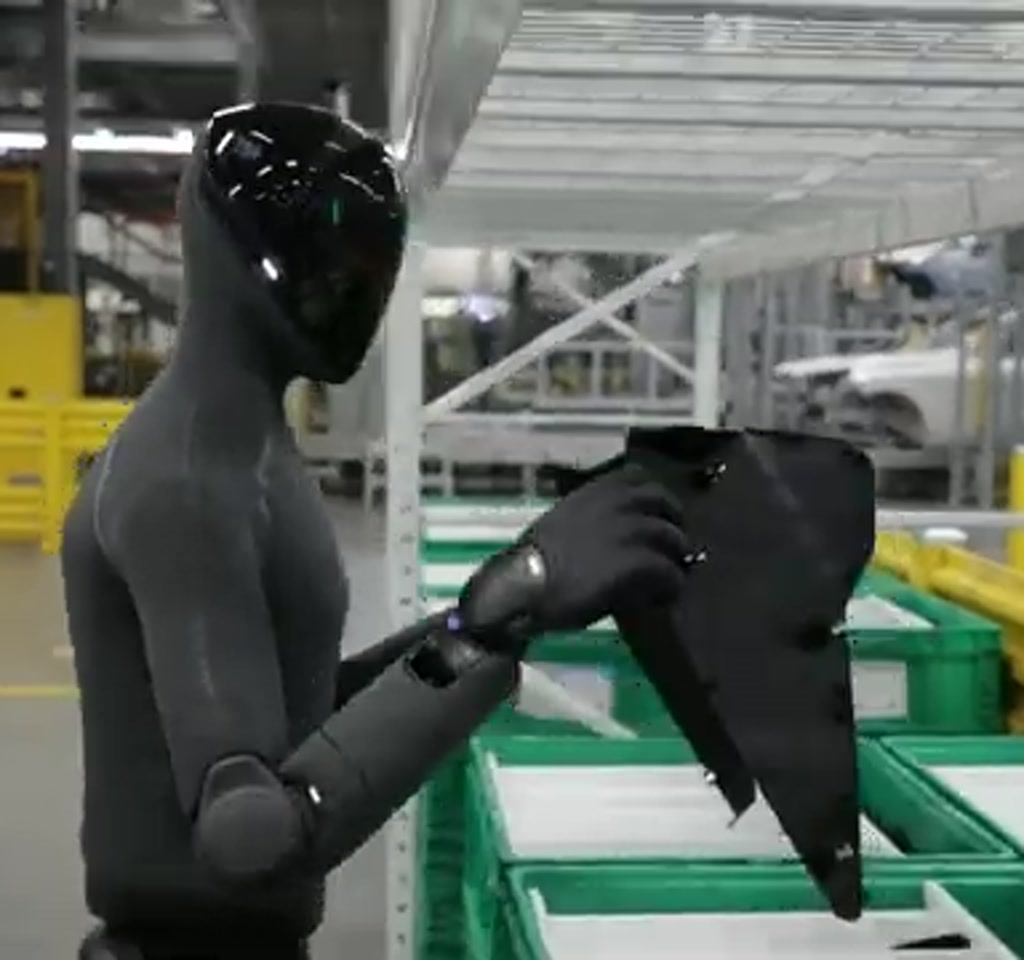
BMW has quietly shifted one of the most visible robotics experiments in automotive manufacturing into a place few outsiders see, the parts logistics area. The new Figure 03 humanoid robot, developed with Figure AI, is not being tested to weld or assemble. It is being asked to organize the messy, time-sensitive flow of components that keeps an assembly line moving.
The real significance here is not that a robot can lift or place a part. It is that BMW is testing humanoid form factors in tasks where human ergonomics, speech communication, and tactile finesse still matter. That repositioning changes how the technology will be judged by factory managers and by workers on the floor.
What most people misunderstand is the ambition. This is not about replacing skilled technicians. BMW frames Figure 03 as an intelligent teammate for repetitive, ergonomically demanding work, so humans can focus on higher-level tasks that require judgment and experience.
The pilot before this deployment, Figure 02, already supported production of more than 30,000 BMW X3 SUVs during a 10-month run at Plant Spartanburg, so the stakes and expectations are practical rather than theoretical.
What actually determines whether this matters is how well the robot handles the unseen plumbing of manufacturing logistics: sequencing, timing, and safe coexistence with people. That’s where Figure 03 will be judged, and where the next set of lessons for robotic helpers will come from.
Why Figure 03 Matters For BMW Logistics
Parts sequencing is a quiet but crucial choreography. Components arrive in bulk and must be delivered to assembly stations in the exact order needed. Mistakes or delays ripple through the line and cost time that cannot be reclaimed. By assigning Figure 03 to sequencing trolleys, BMW is placing a humanoid into a role defined by speed, repeatability, and spatial awareness.
Figure 02 proved the form factor can operate in a production environment, positioning sheet metal for welding across shifts. Figure 03 advances that mission with softer exterior panels for safer human interaction, wireless charging to reduce manual battery swaps, and hands that combine tactile sensors with palm cameras for finer object awareness.
What Figure 03 Brings To The Factory Floor
The technical upgrades sound incremental, but they change the task envelope. Tactile sensors let the robot sense grip force, which matters when parts vary in weight or slipperiness. Integrated palm cameras enable close-range vision for orientation and minor corrections in real time. Speech-to-speech interaction is aimed at making routine coordination more natural, not theatrical.
Sequence Efficiency And Throughput
Sequencing trolleys are loaded, moved to collection points, and handed off to automated tuggers or smart transport robots. The advantage of a humanoid here is adaptability. Humans often handle irregular containers, awkwardly stacked parts, and last-minute substitutions. A robot that can see, touch, talk, and adapt reduces the need for special fixtures and micro automation for every unique bin.
That adaptability can cut idle time across shifts. Every second saved in logistics compounds at scale. The Figure 02 pilot, which supported 30,000 vehicles over 10 months, shows that humanoids can meet both speed and consistency requirements when integrated correctly.
Safety And Human Collaboration
Redesigned soft exteriors and tactile awareness create a different safety model than caged industrial arms. What becomes obvious when you look closer is that safety here depends on context, not on form factor alone. A soft surface and proximity sensors reduce impact risk, but safe workflow design, awareness of human movement, and clear communication protocols remain essential.
Speech support is a subtle but important innovation. Short verbal confirmations and status updates can replace or complement visual signals and handheld devices, especially in noisy or visually cluttered zones. That is not a panacea; it is another channel to be calibrated for accents, safety commands, and production cadence.
What Figure 03 Is
Figure 03 is a humanoid logistics assistant designed to bridge dexterity, perception, and human communication in factory environments. It is a generalist form factor intended to reduce bespoke fixtures and allow a single platform to handle multiple irregular tasks that would otherwise need custom automation.
How It Works In Parts Sequencing
In practice, the robot performs the stepwise work of identifying, grasping, and placing components onto sequence trolleys, then coordinating handoffs to transport systems. Sensors, palm cameras, and tactile feedback let it correct minor misalignments, while speech and status signals integrate it into human workflows.
Limits, Tradeoffs, And The Real Cost Of Humanoid Assistants
This approach only holds up when the economics and operational complexity line up. Humanoid robots trade simplicity for flexibility. A fixed conveyor or a purpose-built gripper is cheaper and often faster for a single repeated motion. But those solutions scale poorly when bins, parts, and sequences change frequently.
Costs tend to scale into the hundreds of thousands rather than the tens when deploying humanoid systems, once you include the robot, integration, safety systems, and software tuning. That places deployments in a boundary where volume and variability must justify the investment.
Power, Maintenance, And Integration Time
Wireless charging reduces manual intervention, yet battery life is typically measured in hours rather than minutes. Charging cycles, battery wear, and maintenance windows therefore become part of daily operations rather than a one-time setup problem. Planning infrastructure and spare part logistics becomes a continuous operational concern.
Training and software tuning are another tradeoff. The Figure 02 pilot ran for 10 months and yielded production proof points. That timing implies real-world adoption is measured in months, not days. Virtual Factory simulations can compress the learning curve, but physical tuning in situ remains essential.
Figure 03 Vs Purpose-Built Automation
When deciding between a humanoid cell and purpose-built automation, the core questions are variability, ergonomics, and scale. Purpose-built grippers and conveyors win when the task is singular and high volume. Humanoids win when many different parts, awkward geometries, or human interaction points make individual fixtures impractical.
Key Decision Factors
Compare initial capital, expected change frequency, ergonomic risk, and integration time. If parts change monthly and ergonomic strain is high, a humanoid becomes more plausible. If a single part repeats millions of times, a specialized gripper remains the sensible choice.
How This Fits Into The BMW iFactory Vision
BMW’s iFactory idea stitches together automation, digital planning, and artificial intelligence into a coherent manufacturing strategy. Figure 03 is a node in that system, not an isolated trophy. It interacts with digital scheduling, smart transport robots, AI-driven quality inspection, and human operators to form a tightly coordinated production cell.
AIQX, the Artificial Intelligence QualityNext system, and the Virtual Factory simulations are complementary tools. Quality systems catch issues earlier in the process, and simulations help reduce unnecessary motion before hardware is committed. Together these tools let humanoid robots focus on exceptions and human ergonomics rather than brute force repetition.
Practical Constraints That Will Decide Success
Two constraints are decisive. First, return on investment must appear within a practical window. If integration extends into many months with marginal throughput gains, the net value diminishes. Second, the reliability and maintenance profile must be predictable. Maintenance tends to surface after repeated use cycles, and spare part logistics for robotic hands and sensors add operational overhead.
Quantified context matters. If a pilot requires 6 to 12 months of tuning and the capital is in the low hundreds of thousands per cell, then factory managers will only deploy where variability and ergonomic risk are high enough to justify those numbers. Conversely, in high-volume, high-variability zones, the flexibility of a humanoid can become an operational multiplier.
Where This Could Lead
Figure 03 is a step in a longer experiment about how physical intelligence integrates with human labor. If the robot reliably reduces ergonomic strain, lowers sequence errors, and fits into existing material flows without creating new bottlenecks, the case for broader rollout strengthens.
From an editorial standpoint, the part that changes how this should be understood is simple. The question is not whether a humanoid can lift a part, but whether it can reduce the invisible friction that turns a smoothly scheduled line into a stop-and-go operation. That friction is where time, waste, and human fatigue accumulate.
Who This Is For And Who This Is Not For
Best Suited For: Operations with high part variability, frequent line changeovers, and measurable ergonomic risk. Teams that already use digital twins and scheduling systems will gain most because integration points already exist.
Not Recommended For: Single-task, ultra-high volume lines where a purpose-built gripper or conveyor delivers a lower cost per action. Facilities that lack maintenance budgets, spare part strategies, or the time to run a 6 to 12 month pilot should consider alternative automation first.
FAQ
What Is Figure 03?
Figure 03 is a humanoid logistics robot deployed by BMW for parts sequencing and human-robot coordination in factory logistics. It emphasizes tactile sensing, palm cameras, and speech interaction to handle variable parts and human collaboration.
How Does Figure 03 Improve Parts Sequencing?
It improves sequencing by using vision, tactile feedback, and adaptable hands to handle irregular bins and last-minute substitutions, reducing the need for custom fixtures and cutting idle time across shifts.
Is Figure 03 Safe To Work Alongside Humans?
Safety is addressed through soft exteriors, proximity sensing, and tactile awareness, but safe workflow design and communication protocols remain essential. Soft form does not remove the need for careful process design.
How Much Does Deploying A Humanoid Cell Cost?
Deployments typically scale into the low hundreds of thousands once robot hardware, integration, safety systems, and software tuning are included. Total cost varies by scope and facility readiness.
How Long Does Integration Take?
Real-world integration and tuning are often measured in months. The Figure 02 pilot ran for 10 months, indicating that production-ready confidence requires extended in situ testing and iterative refinement.
Figure 03 Vs Purpose-Built Automation: Which Is Better?
Neither is categorically better. Purpose-built automation is cheaper and faster for a single repeated motion. Humanoids are preferable where variability, ergonomics, and human interaction make custom fixtures impractical.
Can Figure 03 Reduce Ergonomic Risk?
Yes. The design intent is to take on ergonomically demanding, repetitive tasks so humans can focus on judgment tasks. Measurable reductions depend on deployment, task selection, and workflow integration.
Read more about BMW’s robotics journey and its implications for factory work and logistics as Figure 03 starts its assignment in Spartanburg.
COMMENTS