


There are artifacts in computing that do more than teach history. They force a different kind of understanding about what information is and how fragile our modern assumptions about storage have become.
This build recreates one of those artifacts: 64 iron cores, hand-threaded, each storing a single bit through magnetism rather than charge. The device holds eight characters of text and will still show those characters after power is removed.
The real significance here is not nostalgia. What this project reveals early on is the specific tradeoff that defined midcentury memory: near indestructibility and true nonvolatile behavior at the cost of density, fabrication difficulty, and per-bit energy requirements. Getting to that conclusion requires looking at how a core is flipped, sensed, and wired, and what those actions demand in the real world.
Most people assume modern chips are strictly superior. What actually determines whether core memory matters is the problem you are solving. When resilience and radiation tolerance trump density, magnetic cores remain a compelling historical answer. The maker of this project chose to build one from salvaged Soviet cores, a hand-milled board, and a modern microcontroller to show those tradeoffs in plain sight.
What Core Memory Actually Is
Magnetic core memory stores each bit as the magnetic orientation of a tiny ferrite ring. Unlike charge-based flash or DRAM, a magnetized core holds its state without power, making magnetic core memory a true form of nonvolatile storage that is robust against transient electrical events.
Core memory stores a bit in the magnetic orientation of a small ferrite ring. Each ring can be magnetized in one of two directions, representing one or zero. There is nothing microscopic about these parts. The rings are visible to the naked eye and were classically woven by hand using sewing needles.
How A Bit Is Stored And Read
Writing a bit requires driving a current through orthogonal X and Y wires that pass through a chosen core. If the combined magnetic field exceeds the core’s switching threshold, the core flips its polarity. That flip in turn induces a brief pulse in a shared sense line threaded through every core, which the electronics detect as the act of switching.
Sensing is destructive by default. Historically, reading a core often required a writeback step. The sense line only tells whether a flip occurred during the read operation, so the read sequence is commonly paired with a restore sequence to leave the correct value in place.
How Core Memory Works In Practice
Practically, a core array is a woven matrix of X and Y drive lines plus a common sense line. Selecting a row and column concentrates magnetic field at a single ring; the ring flips when the combined field crosses a threshold and the resulting pulse on the sense wire is the only direct evidence that a flip took place.
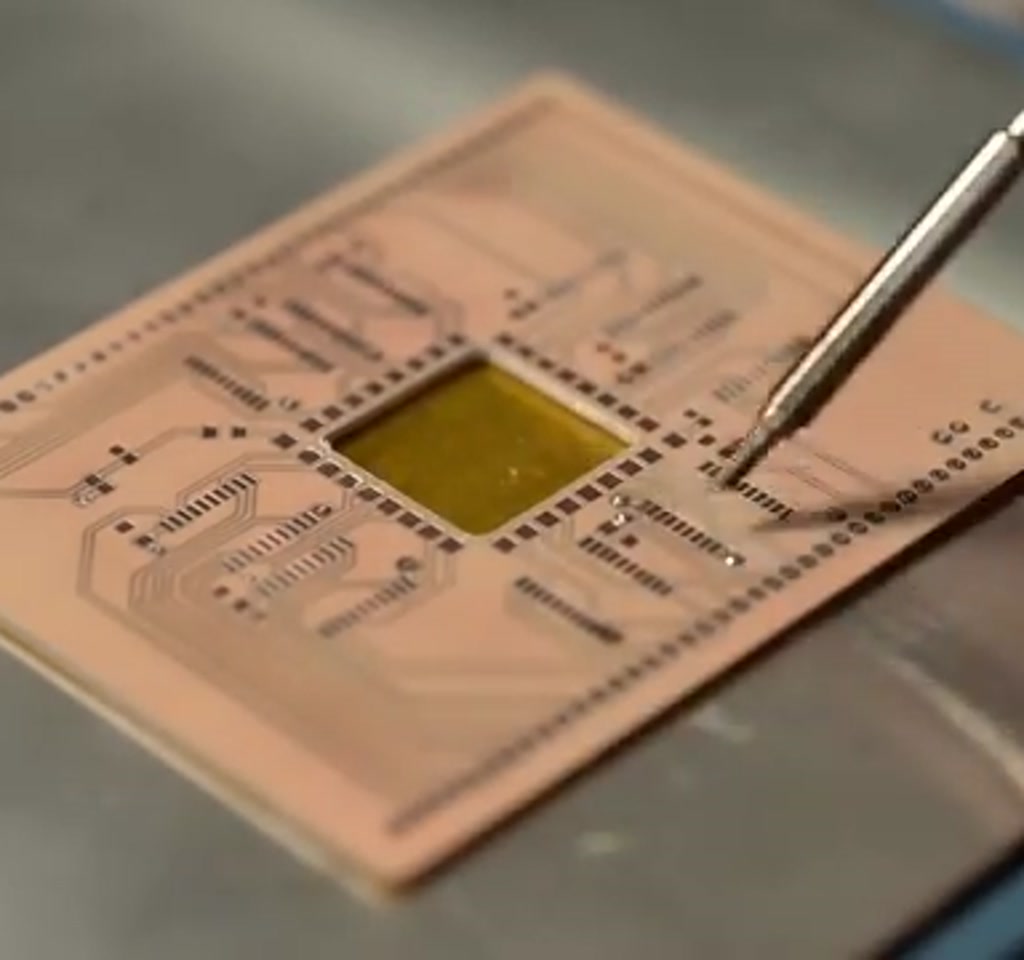
The project reuses authentic cores salvaged from an old Soviet era machine and combines modern tools for the surrounding electronics and enclosure. Two double-sided PCBs were milled, a resin enclosure was printed, and the whole array was threaded by hand into a tight woven matrix of X, Y, and sense wires.
There is an immediately tactile quality to the build. Threading the 8 by 8 matrix and trimming enamel-coated wires is an exercise in patience. The maker inspected each ring as it was added because a single damaged core will silently kill that line. The act of weaving is where the elegance of the design meets the brute reality of manual labor.
The Electronics And Test Harness
An ESP32 acts as the controller and USB interface. A bench power supply provides the write currents because standard USB power is insufficient. The build started testing at around 6 volts and needed to be increased toward 12 volts before reliable flips were observed on the oscilloscope. In practice that means write operations require a supply with higher voltage and current capacity than a phone charger can deliver.
The approach used a trigger from the ESP32 and an oscilloscope watching the sense line. Small inductive spikes appear from coupling but the meaningful signal is a distinct dip or pulse that indicates a core flip. Observing and saving that waveform was how the maker validated both individual cores and the full array.
Enclosure, Oil Bath, And Material Choices
To stabilize switching thresholds the entire assembly was submerged in silicone oil. The oil is nonconductive so it does not short the board, and it evens out temperature differences across the cores. The decision to use oil is a practical mitigation against thermal sensitivity, and it makes for a striking visual.
For the enclosure, the project combined FDM rapid prototyping with high-performance resin prints for the final vessel. Flexible silicone gaskets and sealed acrylic windows completed the package. The maker notes a visceral hesitation about pouring liquid over a powered board, which highlights the contrast between theoretical safety and human caution.
Benefits And Why It Still Matters
Core memory’s chief advantages are true nonvolatility and resistance to ionizing events that upset semiconductor memories. For applications where data must persist through power loss or harsh radiation environments, magnetic core memory demonstrates properties that modern flash and DRAM cannot match without heavy redundancy or shielding.
Core memory is nonvolatile. Once magnetized a core holds its state without power, and it tolerates radiation bursts that would wreck semiconductor memory. That attribute is not academic. It explains why early space systems used cores and why some niche applications still value magnetic storage concepts.
Tradeoffs And Practical Constraints
Density, energy per write, and assembly difficulty are the three explicit costs. A hand-woven 8 by 8 array holds eight bytes; write currents need higher voltage and current than USB, and scaling by hand multiplies labor linearly. Those constraints define where core memory remains a curiosity rather than a consumer solution.
Density And Scale. A single 8 by 8 array holds only eight bytes. Scaling to kilobytes or megabytes multiplies the parts count and the manual work. Hand weaving scales linearly, so going from 64 cores to 64,000 cores changes assembly time from hours to weeks unless automation is introduced.
Power And Drive Requirements. This build showed successful writes after increasing the drive voltage from about 6 volts toward 12 volts. The initial USB power source was insufficient. That implies write drivers need voltage and current headroom, and that energy per write is orders of magnitude higher per bit than modern DRAM or flash when considered in absolute terms.
Temperature Sensitivity. A core’s switching threshold shifts with temperature. The maker used silicone oil to stabilize the array and reduce the chance of marginal writes. For larger systems this requirement historically led to active heating or thermal control, so thermal management is a real operational cost.
Repair And Assembly Complexity. Home-milled PCBs need rivets for through connections and careful soldering. The construction path required continuity checks, bodge wires, and manual rework. That maintenance overhead is small for a tinkering project but becomes a barrier at production scale.
Core Memory Vs Flash: Practical Comparison
Density
Flash wins on density by many orders of magnitude. A pocket flash drive stores billions of times more data than an 8-by-8 core plane. That single fact alone explains why silicon dominated general-purpose storage once manufacturing moved to lithography.
Energy And Power
Per bit write energy is higher for cores because flipping a ferrite ring requires a deliberate current pulse and voltage headroom. Modern flash programs cells at much lower energy per stored bit, making it superior for low power and mobile devices.
Resilience And Radiation Tolerance
Where flash and DRAM may fail under ionizing radiation or prolonged power loss, cores keep state. That makes core memory appealing for space heritage systems, critical industrial controls, and any environment where robustness is far more valuable than capacity.
Manufacturing Complexity
Silicon benefits from automation and scale. Core arrays historically required hand assembly or specialized machines. The manual nature of ferrite weaving and individual core inspection adds both time and failure modes that modern semiconductor fabs avoid.
What Becomes Clear When You Look Closer
Practically speaking, the charm of core memory is not that it would displace flash in consumer devices. The candid lesson is that storage design is a negotiation between physical reality and system requirements. When capacity and density dominate, silicon wins. When retention without power and immunity to ionizing events dominate, cores have serious merit.
From an editorial standpoint, the project excels as a teaching tool. It forces one to confront the physics of bit storage. Watching the sense line pulse as a polarity flips is the purest way to see what a one or zero actually is, stripped of voltages, file systems, and abstraction layers.
Two Small Innovations And One Nostalgic Truth
The maker combined modern microcontrollers and fabrication with vintage components. Using an ESP32 to present a USB mass storage interface and exposing a single text file that maps directly to the eight bytes is a neat bridge between eras. Writing to that file translates directly into magnetic states, and removing power proves the data is still there.
The nostalgic truth is mechanical. Early computers appeared large not because computation was hard but because storing every bit required physical infrastructure. The size, weight, and human effort behind core arrays explain how the room scale of early machines grew from practical engineering decisions.
Who This Is For And Who This Is Not For
Best Suited For: Educators, retro computing enthusiasts, and engineers interested in resilience, radiation-tolerant design, or the physicality of information. The build is a tactile demonstration of principles that are otherwise hidden inside packaged chips.
Not Well Suited For: Product teams seeking high capacity, low power, or compact consumer solutions. Anyone who needs gigabytes on a phone or low-energy writes should look to flash or DRAM rather than core memory for practical systems.
Open Questions And Where Experiments Should Go Next
There are still experiments to run. How would a small automated winder change the economics of assembly? Could modern materials reduce write energy or increase density without losing radiation hardness? These questions keep the project in the realm of engineering homework rather than museum craft.
Expect more demonstrations that pair retro hardware with contemporary controllers. That mix is where surprising insights hide, because it lets us measure not just how far technology has come but why those choices were made in the first place.
FAQ
What Is Core Memory?
Core memory is a form of magnetic storage where each bit is stored as the magnetic orientation of a small ferrite ring. It is nonvolatile, meaning a core retains its state without power, and it was widely used before semiconductor memories became dominant.
How Does Core Memory Store Data?
Data is stored by driving currents through orthogonal X and Y wires that pass through a chosen core. The combined magnetic field flips the core’s polarity when it exceeds a threshold, and that flip induces a pulse on a shared sense line which the electronics detect.
Is Core Memory Nonvolatile?
Yes. Once magnetized, a ferrite core retains its orientation and therefore its stored bit without power. That nonvolatility is one of the primary reasons core memory was used in early space and military systems.
Can Core Memory Replace Flash In Consumer Devices?
Practically no. Density, per-bit energy, and manufacturing complexity make core memory unsuitable for modern consumer storage needs. It remains relevant only for niche applications where resilience outweighs capacity concerns.
How Much Data Does A 64 Core Array Hold?
The build described stores 64 bits arranged as eight bytes, which maps to eight ASCII characters. That is roughly eight bytes of storage versus gigabytes or terabytes available from modern flash devices.
Why Use Silicone Oil In The Enclosure?
Silicone oil stabilizes temperature across the array and helps keep core switching thresholds consistent. It is nonconductive and reduces thermal sensitivity, which lowers the chance of marginal writes in a small demonstrator array.
What Power Is Required To Write To Cores?
The project started testing around 6 volts and needed to increase toward 12 volts for reliable flips, using a bench supply with sufficient current. Standard USB power was insufficient, indicating write drivers need voltage and current headroom.
Could Automation Scale Assembly?
Automation would reduce the linear labor cost of weaving and inspection, but the transcript does not provide a tested automated solution. The question is open and is suggested as a next experiment rather than a solved problem.
COMMENTS