


A train platform, a hotel lobby, a trade show booth, a corner cafe with a tricky menu. These are the moments where translation earbuds can be useful, as long as the exchange is short and the speaker is nearby. Once the conversation turns into contract language, fast technical detail, or several voices talking over one another, the tool starts to show its limits.
That balance matters. AI translator earbuds can make travel and daily life easier, but they are not magic interpreters tucked inside a charging case. Clear speech, a decent network, and a simple topic still do much of the work. The sections below explain where they fit, where a phone app may be simpler, and what to check before buying.
A traveler wearing Liberty 5 Pro Max translation earbuds talks briefly at a hotel front desk.

Cloud Translation vs Offline Translation
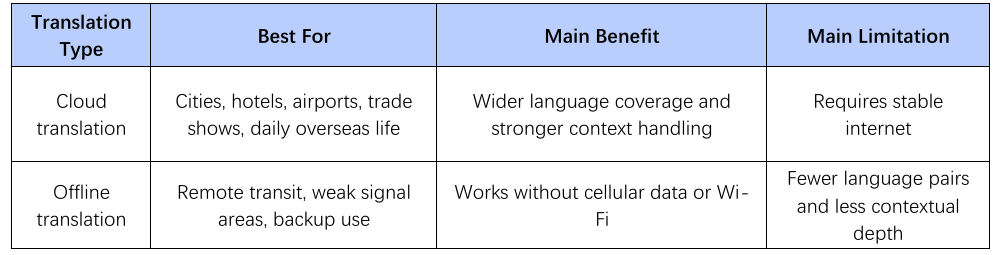
Before looking at language counts, look at the trip itself. Will the earbuds have internet access at the moment you need help? Most real time translation earbuds use cloud translation, so spoken audio is processed through online language databases rather than only on the device.
That online connection is the reason cloud translation can handle more languages and more context.
- It works best when Wi-Fi, roaming, a local SIM, or an eSIM is already set up. In a connected city, language translation earbuds can help with hotel check-ins, airport questions, food orders, and short business exchanges.
- On a weak signal, the same feature can feel slower or stop working.
For a quick decision, cloud translation fits trips where reliable internet is expected.
- soundcore Liberty 5 Pro Max belongs to this type of setup, with support promoted at around 100 languages and stronger context handling than a small offline system.
- Offline translation, seen in some dedicated options such as Padmate S80 Pro, is useful when there is no network, though it usually covers fewer main language pairs and can be less precise.
The better question is simple: will your route stay connected?
Cloud-based earbuds also make sense when translation is only one part of the day. A traveler might need a phrase at breakfast, a clear call after lunch, and quiet focus time on the train. In that kind of routine, one device with several everyday audio functions can be more practical than a single-purpose translator.
Offline translation plays a different role. It keeps a smaller language set on the device, which helps in remote transit areas or places where hotel Wi-Fi is unreliable. The trade-off is narrower coverage and less flexible context handling. If offline access matters most, compare dedicated alternatives such as Padmate S80 Pro, but do not expect every offline mode to behave like cloud translation.
Where Translation Earbuds Fit Best
Translation earbuds do better when the conversation has a clear job. One question, one answer, one speaker nearby. The more crowded the audio gets, the more patience you need.
Travel Navigation And Hospitality
Travel errands are a natural place to use them. Buying a train ticket, asking whether a taxi takes cards, checking a hotel reservation, or ordering lunch all rely on familiar words. A pause for translation does not usually feel awkward in these situations, because both sides know the exchange is practical.
Network access still decides a lot. A hotel lobby, airport, or downtown station may give cloud translation enough room to work well. An underground platform or rural stop may not. Roaming or an eSIM should be ready before the trip, with offline maps and saved phrases kept as backup.
Casual Daily Conversations And Expat Life
Living abroad brings a steady stream of small language problems. A neighbor asks about a package. A delivery driver needs the building code. A repair worker points at something and waits for an answer. None of it is dramatic, but the repetition wears people down.
Real time translation earbuds can make these short exchanges feel less like a stop-and-start phone routine. Hands stay free, eye contact is easier, and the other person does not have to stare at a screen. The translation will not catch every nuance, but it can make daily errands feel less heavy.
Client Meetings And Business Updates
Business travel calls for a narrower use case. Translation earbuds can help with introductions, schedule updates, basic alignment, or a quick trade show conversation. They should not be used as the only support for legal negotiations, medical discussions, contract details, or technical deal terms.
All-in-one earbuds can still earn a place in the bag. Translation depends on the language and network, yet clear calls, noise control, and meeting recording can help throughout the day. The value is not professional interpretation. There are fewer devices and less friction during routine business travel.
Video And Phone Conferences
Video and phone calls are tougher. Live calls often come with compressed audio, people interrupting, and several speakers changing turns quickly. The meeting app is already managing the microphone and speaker, so routing sound through another device can add delay or make the audio feel uneven.
Meeting transcription and summary software usually suits this situation better. It can work directly with the call audio, identify speakers more cleanly, and leave a record to search later. Translation earbuds may help one listener catch a short section, but they are rarely the cleanest tool for a full multi-party call.
How Are Translation Earbuds Different From Smartphone Apps
Phone apps still deserve a place in the travel toolkit. Google Translate is often faster for signs, menus, labels, and posted notices. Point at the camera, read the result, and keep moving.
Earbuds feel more natural when someone is speaking to you. Hands stay free, eye contact stays in the conversation, and there is no phone screen sitting between two people. That can help in shops, hotel lobbies, conference booths, and quick meetups.
There is a social side to this, though. Passing one earbud to a stranger may feel uncomfortable, and some people will not want to wear another person’s device. A phone speaker mode may be better at that moment. The setting often chooses the tool for you.
Five Factors To Check Before You Choose
The better buying question is not which model lists the most features. It is where earbuds will actually be used.
1. Check language coverage
Make sure the device supports the languages and dialects you are likely to hear. Official state languages do not always match local speech.
2. Confirm network dependency
City-heavy trips tend to favor cloud translation. Remote routes, long transit days, and weak-signal areas make verified offline language pairs more important.
3. Think about latency
Many products aim for a natural conversation pace, but network speed, app processing, and background noise can still change the rhythm. A small delay at a hotel desk may be fine. In a fast meeting, it can be distracting.
4. Review device compatibility.
The app should run cleanly on your phone. For Android users who also care about Bluetooth stability, app support, and audio features, comparing broader wireless earbuds for android options can help before choosing a translation-capable model.
5. Decide between all-in-one utility and dedicated hardware.
Everyday earbuds with AI features make sense if calls, ANC, sound quality, commuting, and meeting records matter along with translation. soundcore Liberty 5 Pro Max is one example of that route.
- It combines the Thus™ AI chip, Adaptive ANC 4.0, Whisper-Clear Calls, AI recording, and real time translation.
- Its 1.78-inch AMOLED touch charging case can be used for music, ANC, EQ, recording entry, and translation entry, while the IP55-rated earbuds add sweat and splash resistance for commuting and travel.
- It also offers up to 12 hours of normal earbud playtime and up to 50 hours with the case, or 6.5 hours and 28 hours with ANC on.
(Notes: If translation is the main job and offline access is essential, dedicated translation hardware may fit better. )
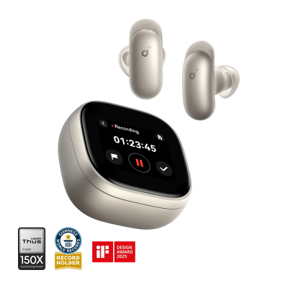
soundcore Liberty 5 Pro Max|AI Recording Earbuds with Smart Case
Liberty 5 Pro Max promotes 100-language translation, but the feature needs an internet connection and does not support offline translation.
Recording works without a subscription, while transcription and summaries need a subscription, with 120 minutes per month included for 24 months for eligible buyers. soundcore also notes that real time translation is free today but will require a subscription in the future. Check those terms before depending on it for frequent work notes.
How to Set Realistic Expectations
Translation earbuds are best treated as a way to remove small bits of friction.
- Ordering dinner, asking for directions, introducing yourself at a booth, or handling a daily errand abroad can all become easier when the language gap is smaller.
They still have limits.
- Overlapping voices, heavy accents, slang, quiet speakers, wind, street noise, and specialized vocabulary can affect the result.
- They should not be treated as a reliable record for legal, medical, or contract-sensitive situations.
- If the details matter, repeat the key point, ask for confirmation, and follow up in writing.
For most readers, the choice comes back to the environment. A trip with steady internet pairs well with cloud-based AI translator earbuds, especially when the same device will also handle music, calls, meetings, and short translations. A route that often goes off-grid puts more weight on offline translation, even if fewer languages are supported.
Conclusion
Translation earbuds work best in the right kind of moment. Short face-to-face conversations, travel navigation, hotel questions, and casual daily exchanges are their strongest areas. High-stakes negotiations, technical discussions, and multi-party digital calls remain harder.
The smartest purchase is not the model with the biggest headline number. It is the one that fits your destinations, your phone, your network access, and your daily routine. Choose earbuds you would still use for sound quality, calls, comfort, and productivity, then treat translation as an extra layer for the moments that suit it.
FAQs
Do translation earbuds work without the internet?
Some do, but many real time models need an internet connection. Cloud-based earbuds usually cover more languages, while offline models support fewer language pairs. Check the specific product’s offline language list before traveling.
Are real time translation earbuds accurate enough for business travel?
Yes, for basic business communication, but use them carefully. They are better for introductions, schedule updates, and simple alignment than for legal terms, contracts, or technical negotiations. Confirm important points in writing.
Are AI translator earbuds better than Google Translate?
It depends on the task. Earbuds are often more comfortable for spoken face-to-face conversation because they keep your hands free. A phone app is usually better for signs, menus, documents, and situations where sharing an earbud would feel awkward.
Can translation earbuds replace a human interpreter?
No. They are helpful communication tools, not a replacement for trained interpreters in high-risk settings. Use them for everyday understanding, then rely on professional support when accuracy, confidentiality, or legal meaning is critical.
COMMENTS