


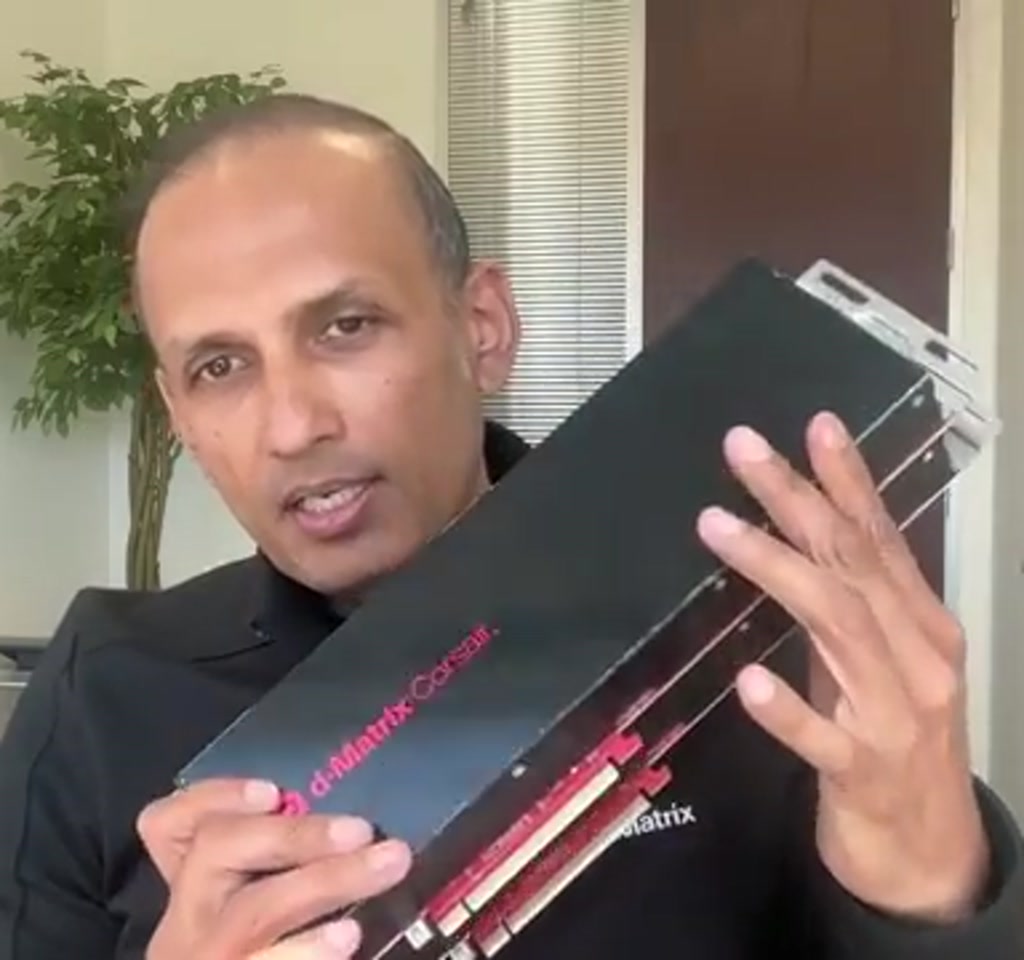
Something important just moved from rumor to reality: D-Matrix says its Corsair inference accelerator is now in full production and will begin shipping this month. That matters because the company is pitching a very different tradeoff than the industry has been optimizing for. Instead of piling on high-bandwidth DRAM, Corsair puts SRAM inside or very close to the compute, and that changes where latency, cost, and model capacity land on the balance sheet.
The central claim is simple and headline-grabbing. D-Matrix describes a rack-level configuration that pairs its custom accelerators with GPUs to generate tokens about 10 times faster than GPUs alone. The company also says the configuration is roughly three times cheaper and up to five times more energy efficient for inference workloads where throughput and latency are king.
The real significance here is not only the raw speed claim. What actually determines whether this matters is how the SRAM-first architecture reshapes the memory bottleneck that has been constraining inference economics.
Memory is not a single variable you can dial up for free. Choosing SRAM over DRAM rewrites density, cost, model size limits, and software integration in ways that will decide whether Corsair is a niche high-performance option or a platform-level disruptor.
What becomes obvious when you look closer is that Corsair is playing the same thematic card a few other memory-first players have played this year: prioritize local, low-latency memory to avoid moving data back and forth. But that choice creates a clear set of conditions under which the approach excels and other conditions where it is plainly not the optimal path.
What D-Matrix Is Claiming
D-Matrix, a California-based company founded in 2019, announced Corsair as a production device built at TSMC on a 6-nanometer node. The product is described as a server-pluggable unit housing a collection of four chips. The company says it has commitments from hyperscalers, neo-clouds, and AI labs, though D-Matrix is not publicly naming customers yet.
On performance and efficiency the claims are bold. D-Matrix positions Corsair as an inference specialist, saying that in a rack alongside GPUs it can generate tokens 10 times faster than GPUs alone, at one third the cost, and up to five times lower energy use for those inference tasks. The company is explicitly targeting latency-sensitive workloads such as chatbots, video generation, and agentic AI.
How Corsair Works
Corsair centers its architecture on local SRAM rather than relying primarily on DRAM or HBM. By placing fast SRAM inside or tightly coupled to compute elements, the design reduces the number of expensive round trips between processors and distant memory, lowering access latency and energy per access while changing where capacity limits appear.
SRAM First, Memory Bottleneck Avoided
D-Matrix frames the advantage this way: GPUs are dependent on large amounts of high-bandwidth memory that is in tight supply from DRAM makers. By contrast, Corsair’s design reduces reliance on that supply chain, prioritizing very fast on-die or tightly coupled SRAM so the accelerator spends less time and energy moving data between compute and memory.
Chiplet And Rack Pairing
The announced deployment model pairs Corsair accelerators with GPUs in the same rack. In that configuration the accelerator takes on the token generation workload where its latency and throughput advantages show most. GPUs remain useful for other stages of model processing or for workloads that need very large memory capacity.
The Memory Tradeoff That Changes The Math
Moving to SRAM-first designs buys lower latency and lower energy per access, but it imposes limits on capacity and changes cost dynamics. SRAM is substantially less dense than DRAM, which typically means on-die SRAM capacity is measured in megabytes or low tens of megabytes per block rather than the multiple gigabytes an attached DRAM or HBM stack provides.
That gulf in density creates a concrete boundary: Corsair-style accelerators will excel when the model working set fits inside the local SRAM fabric. For very large models or scenarios that require maintaining gigabytes of context per instance, the SRAM-first approach will require partitioning, sharding, or falling back to off-chip memory, each of which reintroduces latency and engineering complexity.
Two Concrete Constraints That Matter
First, capacity versus latency. SRAM-first chips typically deliver microsecond-level access and lower energy per access, but the available memory per socket will be much smaller than what DRAM or HBM stacks can provide. This architecture favors smaller working sets or carefully sharded models; multi-gigabyte contexts will push teams toward hybrid designs.
Second, integration and software cost. Corsair is not a drop-in GPU replacement. D-Matrix pairs its accelerators with GPUs in a rack-scale system, and that requires engineering across the model serving stack, scheduler changes, and possibly model partitioning strategies. Expect integration timelines measured in weeks to months, not minutes.
Quantified Context
To give scale to the constraints, SRAM densities often mean on-die capacities are in the low megabytes to low tens of megabytes per compute block, while HBM and DRAM solutions provide gigabytes per device. That gulf in capacity forces architectural choices. Likewise, the company’s claims of three times lower capital cost and up to five times better energy efficiency should be read as conditional on a workload being SRAM-friendly.
Competition, Partnerships, And Market Dynamics
The Corsair announcement echoes a larger industry recalibration toward memory-first designs. Other players have emphasized local memory to attack inference economics, and incumbents are responding with architectural adjustments. These moves show that memory architecture has become a strategic battleground, not just an engineering detail.
D-Matrix announced a reported fundraising round of about $275 million and a reported valuation around $2 billion, with Microsofts M12 named as an investor. The company has also described partnerships with Arista, Broadcom, and Supermicro to deliver rack-scale systems integrating its accelerators.
Geopolitics And Export Controls
One operational implication to watch is market access. D-Matrix has indicated the company might be able to ship Corsair to China to run models efficiently, on the premise that the chips are optimized for inference and not for large-scale training. How governments will interpret export controls around AI compute capability could materially affect addressable markets.
Corsair Vs GPUs And Alternatives
At a practical level the decision between Corsair and GPU-centric racks depends on real-world tradeoffs: token latency and energy per token versus per-instance context capacity and software integration cost. Corsair promises lower latency and better efficiency when the working set fits SRAM, while GPUs retain advantage for very large models and flexible memory demands.
When Corsair Wins
Corsair is likely to win on latency-sensitive inference where per-instance context fits the SRAM envelope and where throughput and energy cost per token dominate procurement decisions. In those scenarios, less data movement and faster local access translate to meaningful production advantages.
When GPUs Or HBM Win
GPUs or HBM-backed accelerators will remain preferable when models require multi-gigabyte contexts per instance, when serving many large models concurrently, or when teams want to avoid added integration work. In those cases the raw memory capacity and existing software ecosystems of GPUs matter more than token-level latency.
Where Corsair Is Likely To Win, And Where The Limits Appear
The idea succeeds up to the point where the model working set fits within the SRAM envelope and where latency and energy per token are the primary metrics. In those conditions Corsair’s on-die memory wins: less data movement, lower power draw per access, and faster token generation.
The tradeoff appears when model size or multi-model serving needs increase. For very large models, the architecture faces a tension between preserving latency and offering capacity. Solving that tension often forces additional complexity such as model quantization, sharding, or hierarchical memory, which reduces the pure throughput advantage.
Supply and economics are another practical limit. Corsair is reported to be produced at TSMC on 6 nanometer nodes and ships as a multi-chip unit. Scaling beyond initial commitments will depend on foundry capacity, yields, and system-level production throughput as much as architectural merit.
What This Means For AI Infrastructure
The larger implication is a diversification of inference hardware strategies. For years the default assumption was that GPUs were the universal substrate for AI. Memory-first accelerators like Corsair make the case that different classes of inference workloads deserve bespoke hardware, and rack-scale orchestration will decide whether these silicon choices translate to production wins.
Industry watchers will track three variables closely: how large models get in production, how costly it is to rework the serving stack, and how constrained high-bandwidth DRAM supply remains. The interaction of those variables will determine if Corsair becomes a standard component of inference racks or a high-performance niche.
Who This Is For And Who It Is Not For
Who This Is For: Teams running latency-sensitive inference with working sets that can fit in on-die SRAM, or organizations willing to invest in rack-level integration to harvest token-level efficiency and throughput gains. Hyperscalers, neo-clouds, and AI labs with predictable, high-volume inference traffic match the profile described by the company.
Who This Is Not For: Groups that rely on very large context windows per instance, serve many heterogeneous large models concurrently, or cannot allocate engineering cycles to change schedulers and partitioning strategies. For those teams, sticking with GPU-HBM stacks or other high-capacity solutions will likely be more pragmatic.
FAQ
What Is The Corsair Inference Accelerator?
Corsair is a server-pluggable inference accelerator from D-Matrix built on a TSMC 6 nanometer process. It is described as a multi-chip unit that prioritizes SRAM to reduce memory access latency for token generation workloads.
How Does Corsair Use SRAM To Improve Performance?
Corsair places SRAM inside or very close to compute blocks so that frequent data accesses occur with lower latency and lower energy per access compared to moving data to and from DRAM or HBM, according to the company.
Does Corsair Replace GPUs?
No. D-Matrix positions Corsair as complementary to GPUs in rack-scale configurations. The accelerator takes on latency-sensitive token generation while GPUs remain useful for stages that need large memory capacity or for training workloads.
What Workloads Benefit Most From Corsair?
Workloads that are latency-sensitive and have working sets small enough to fit in local SRAM, such as high-throughput chatbots, certain video generation inference paths, and agentic AI inference tasks, are the primary targets noted by the company.
What Are The Capacity Limits Of SRAM-First Designs?
SRAM is far less dense than DRAM or HBM. On-die SRAM capacities are typically measured in megabytes to low tens of megabytes per block, while DRAM and HBM provide gigabytes per device. That density gap constrains model context size unless hybrid strategies are used.
Can Corsair Be Shipped To China?
D-Matrix has indicated it might be able to ship Corsair to China for inference workloads on the premise the chips are optimized for inference. How export controls will be applied in practice is a regulatory matter and remains subject to interpretation.
How Much Faster Is Corsair Than GPUs In Token Generation?
D-Matrix claims about 10 times faster token generation in a rack pairing against GPUs alone. Those figures are company claims and should be validated in real-world deployments over time.
Is Corsair Cost-Effective For Small Teams?
The company claims roughly three times lower capital cost for certain inference profiles, but integration and software changes are required. For small teams without capacity to rework serving stacks, the operational cost may outweigh raw chip-level savings.
COMMENTS